• HOME
  • NEWS
  • EXPLORE
    • CAREER
      • Companies
      • Jobs
    • EVENTS
    • iGEM
      • News
      • Team
    • PHOTOS
    • VIDEO
    • WIKI
  • BLOG
  • COMMUNITY
    • FACEBOOK
    • INSTAGRAM
    • TWITTER
Thursday, March 26, 2026
BIOENGINEER.ORG
No Result
View All Result
  • Login
  • HOME
  • NEWS
  • EXPLORE
    • CAREER
      • Companies
      • Jobs
        • Lecturer
        • PhD Studentship
        • Postdoc
        • Research Assistant
    • EVENTS
    • iGEM
      • News
      • Team
    • PHOTOS
    • VIDEO
    • WIKI
  • BLOG
  • COMMUNITY
    • FACEBOOK
    • INSTAGRAM
    • TWITTER
  • HOME
  • NEWS
  • EXPLORE
    • CAREER
      • Companies
      • Jobs
        • Lecturer
        • PhD Studentship
        • Postdoc
        • Research Assistant
    • EVENTS
    • iGEM
      • News
      • Team
    • PHOTOS
    • VIDEO
    • WIKI
  • BLOG
  • COMMUNITY
    • FACEBOOK
    • INSTAGRAM
    • TWITTER
No Result
View All Result
Bioengineer.org
No Result
View All Result
Home NEWS Science News Chemistry

Green plastic production made easy

Bioengineer by Bioengineer
April 17, 2019
in Chemistry
Reading Time: 3 mins read
0
IMAGE
Share on FacebookShare on TwitterShare on LinkedinShare on RedditShare on Telegram

IMAGE

Credit: Kiyotaka Nakajima, Hokkaido University

A one-step method enables scalable and more environmentally friendly production of plant-derived plastic monomers, paving the way towards the mass production of a sustainable alternative to petroleum-based materials.

An international team, including Kiyotaka Nakajima of Hokkaido University, Japan, and Emiel Hensen of Eindhoven University of Technology, the Netherlands, has developed an energy-efficient method to synthesize bioplastic ingredients. The new technology will contribute towards the realization of sustainable ‘green products’, such as completely biobased beverage bottles. This study was conducted jointly with Mitsubishi Chemical Corporation and the findings were published in ACS Catalysis.

Biobased plastics are emerging as a next generation material and are expected to replace petroleum-derived plastics. A plant-derived polyester, called polyethylene furanoate (PEF), is a promising 100% renewables-based polymer derived from plants that can replace the giant of the plastic industry, polyethylene terephthalate (PET), due to its better physical, mechanical and thermal properties. However, realizing large-scale PEF production is seriously hampered by an inefficient production of the monomers.

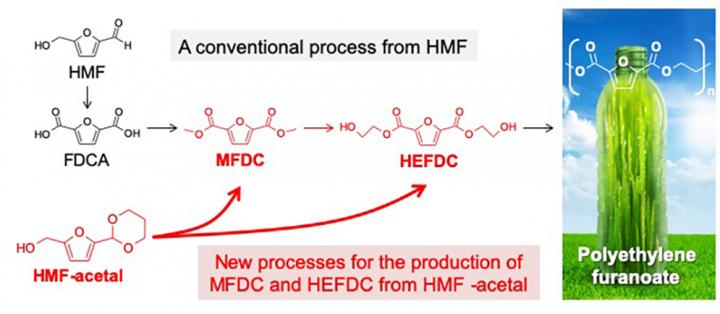
Aerobic oxidation of a biomass-derived substrate called HMF in methanol and ethylene glycol produces monomers called MFDC and HEFDC, respectively. They are recognized as crucial monomers in the manufacture of PEF, because polymerization of MFDC with ethylene glycol or self-condensation of HEFDC can yield high-quality PEF (Figure 1).

However, MFDC production has so far been exclusively studied for dilute HMF solutions, and more desirable routes for the production of HEFDC is currently impractical because a high-yield of the monomer cannot be produced efficiently. This limitation can be attributed to the highly reactive formyl (-CHO) groups in HMF, which are involved in heavy side reactions, especially in concentrated solutions: chemical transformation in concentrated HMF solutions that aims at large-scale production of commodity chemicals is accompanied by the formation of huge amounts of solid byproducts.

Nakajima, Hensen, and their colleagues previously developed a more stable compound called HMF-acetal (Figure 1). They have now examined the utility of HMF-acetal and found that 80-95% of HMF-acetal in a concentrated solution (10-20 wt%) can be successfully converted to MFDC and HEFDC with a gold nanoparticle catalyst. The present results represent a significant advance over the current state of the art, overcoming an inherent limitation of the HMF oxidation to important monomers for biopolymer production. The researchers note that this method has “less reaction steps, and the use of highly concentrated solutions will require less energy than conventional processes.”

The researchers expect the new technique will not only improve the feasibility of commercial PEF production in the chemical industry, but also help advance a more ubiquitous use of bioplastics, as well as provide insight for the development of other bio-based chemical applications from various biomass-derived carbohydrates.

###

Media Contact
Tyler Tannert
 @hokkaidouni

011-706-2186

Original Source

https://www.global.hokudai.ac.jp/blog/green-plastic-production-made-easy/

Related Journal Article

http://dx.doi.org/10.1021/acscatal.9b00450

Tags: BiochemistryBiomedical/Environmental/Chemical EngineeringBiotechnologyBusiness/EconomicsChemistry/Physics/Materials SciencesPolymer ChemistryResearch/Development
Share12Tweet8Share2ShareShareShare2

Related Posts

Isolated H2-Reduced Clusters Boost CO2-to-Methanol Catalysis

Isolated H2-Reduced Clusters Boost CO2-to-Methanol Catalysis

March 25, 2026
blank

Physicists Identify Electronic Drivers Behind Flat Band Quantum Materials

March 21, 2026

Würzburg Chemistry Professor Claudia Höbartner Receives Prestigious Honor

March 20, 2026

Scientists Reveal How Magnets Control Metamaterial Behavior

March 20, 2026
Please login to join discussion

POPULAR NEWS

  • blank

    Revolutionary AI Model Enhances Precision in Detecting Food Contamination

    96 shares
    Share 38 Tweet 24
  • Imagine a Social Media Feed That Challenges Your Views Instead of Reinforcing Them

    1003 shares
    Share 397 Tweet 248
  • Uncovering Functions of Cavernous Malformation Proteins in Organoids

    54 shares
    Share 22 Tweet 14
  • Promising Outcomes from First Clinical Trials of Gene Regulation in Epilepsy

    51 shares
    Share 20 Tweet 13

About

We bring you the latest biotechnology news from best research centers and universities around the world. Check our website.

Follow us

Recent News

In-Sensor Cryptography Links Physical Process to Digital Identity

Can Psychosocial Factors Influence Cancer Risk?

Depression Factors in Elderly: Pre vs. Post-COVID Analysis

Subscribe to Blog via Email

Success! An email was just sent to confirm your subscription. Please find the email now and click 'Confirm' to start subscribing.

Join 78 other subscribers
  • Contact Us

Bioengineer.org © Copyright 2023 All Rights Reserved.

Welcome Back!

Login to your account below

Forgotten Password?

Retrieve your password

Please enter your username or email address to reset your password.

Log In
No Result
View All Result
  • Homepages
    • Home Page 1
    • Home Page 2
  • News
  • National
  • Business
  • Health
  • Lifestyle
  • Science

Bioengineer.org © Copyright 2023 All Rights Reserved.