• HOME
  • NEWS
  • EXPLORE
    • CAREER
      • Companies
      • Jobs
    • EVENTS
    • iGEM
      • News
      • Team
    • PHOTOS
    • VIDEO
    • WIKI
  • BLOG
  • COMMUNITY
    • FACEBOOK
    • INSTAGRAM
    • TWITTER
Saturday, February 7, 2026
BIOENGINEER.ORG
No Result
View All Result
  • Login
  • HOME
  • NEWS
  • EXPLORE
    • CAREER
      • Companies
      • Jobs
        • Lecturer
        • PhD Studentship
        • Postdoc
        • Research Assistant
    • EVENTS
    • iGEM
      • News
      • Team
    • PHOTOS
    • VIDEO
    • WIKI
  • BLOG
  • COMMUNITY
    • FACEBOOK
    • INSTAGRAM
    • TWITTER
  • HOME
  • NEWS
  • EXPLORE
    • CAREER
      • Companies
      • Jobs
        • Lecturer
        • PhD Studentship
        • Postdoc
        • Research Assistant
    • EVENTS
    • iGEM
      • News
      • Team
    • PHOTOS
    • VIDEO
    • WIKI
  • BLOG
  • COMMUNITY
    • FACEBOOK
    • INSTAGRAM
    • TWITTER
No Result
View All Result
Bioengineer.org
No Result
View All Result
Home NEWS Science News Chemistry

US Naval Research Lab develops quantum dot polymer for next-gen screens

Bioengineer by Bioengineer
April 12, 2019
in Chemistry
Reading Time: 2 mins read
0
IMAGE
Share on FacebookShare on TwitterShare on LinkedinShare on RedditShare on Telegram

Groundbreaking technology available for manufacturing, sales of new and improved electronics
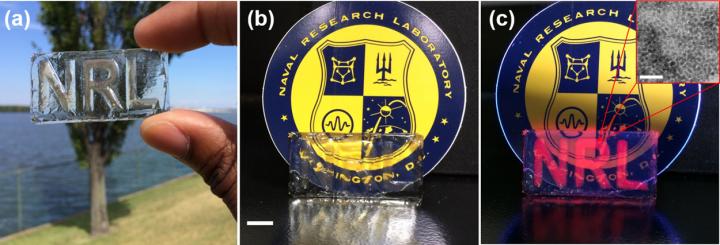
IMAGE

Credit: NRL photo

U.S. Naval Research Laboratory scientists have developed and patented the fabrication of transparent, luminescent material they say could give smartphone and television screens flexible, stretchable, and shatterproof properties.

The material is a thiol-yne nanocomposite polymer tailored to hold light-emitting quantum dots, tiny semiconductors whose size and composition can be precisely tuned to produce bright, clear, and energy-efficient colors.

According to a study published by the lab’s Optical Sciences Division in March 2018, the thiol-yne polymer binds strongly to the quantum dots with a novel ligand and has a uniform distribution throughout the matrix. The material can be polymerized by ultraviolet light or thermal curing.

On Thursday, the U.S. Patent and Trademark Office published the Navy’s patent application, listing inventors Darryl Boyd, Michael Stewart, Kimihiro Susum, Euknkeu Oh, and James Wissman.

“Our invention creates a material with tailorable optical properties, which are dependent on the monomers used in the prepolymer formulation and/or depending on the Quantum Dots incorporated into the prepolymer,” states the patent application, which included a photo of a tiny gecko that was created with the prepolymer resin and a 3D printer.

In collaboration with the laboratory’s technology transfer office, TechLink is helping private businesses access the government-funded research for commercial applications.

TechLink’s Austin Leach, a certified licensing professional, has been in contact with the lab and is excited to see the technology transition into the electronics marketplace.

“Functionalized quantum dots produce color properties that make displays brighter and more realistic,” Leach said. “Just think about the millions of mobile phones, flat-screen TVs, and touch screen devices in the world — this could also make them stronger and more energy efficient.”

###

Licensing related inquiries can be sent to Austin Leach at [email protected] or by telephone at 406-994-7707.

Media Contact
Troy Carter
[email protected]

Original Source

https://techlinkcenter.org/u-s-naval-research-lab-develops-quantum-dot-polymer-for-next-gen-screens-interested/

Tags: Electrical Engineering/ElectronicsNanotechnology/MicromachinesPolymer ChemistryResearch/DevelopmentTechnology TransferTechnology/Engineering/Computer Science
Share12Tweet8Share2ShareShareShare2

Related Posts

blank

Breakthrough in Environmental Cleanup: Scientists Develop Solar-Activated Biochar for Faster Remediation

February 7, 2026
blank

Cutting Costs: Making Hydrogen Fuel Cells More Affordable

February 6, 2026

Scientists Develop Hand-Held “Levitating” Time Crystals

February 6, 2026

Observing a Key Green-Energy Catalyst Dissolve Atom by Atom

February 6, 2026
Please login to join discussion

POPULAR NEWS

  • Robotic Ureteral Reconstruction: A Novel Approach

    Robotic Ureteral Reconstruction: A Novel Approach

    82 shares
    Share 33 Tweet 21
  • Digital Privacy: Health Data Control in Incarceration

    63 shares
    Share 25 Tweet 16
  • Study Reveals Lipid Accumulation in ME/CFS Cells

    57 shares
    Share 23 Tweet 14
  • Breakthrough in RNA Research Accelerates Medical Innovations Timeline

    53 shares
    Share 21 Tweet 13

About

We bring you the latest biotechnology news from best research centers and universities around the world. Check our website.

Follow us

Recent News

Decoding Prostate Cancer Origins via snFLARE-seq, mxFRIZNGRND

Digital Health Perspectives from Baltic Sea Experts

Florida Cane Toad: Complex Spread and Selective Evolution

Subscribe to Blog via Email

Enter your email address to subscribe to this blog and receive notifications of new posts by email.

Join 73 other subscribers
  • Contact Us

Bioengineer.org © Copyright 2023 All Rights Reserved.

Welcome Back!

Login to your account below

Forgotten Password?

Retrieve your password

Please enter your username or email address to reset your password.

Log In
No Result
View All Result
  • Homepages
    • Home Page 1
    • Home Page 2
  • News
  • National
  • Business
  • Health
  • Lifestyle
  • Science

Bioengineer.org © Copyright 2023 All Rights Reserved.