• HOME
  • NEWS
  • EXPLORE
    • CAREER
      • Companies
      • Jobs
    • EVENTS
    • iGEM
      • News
      • Team
    • PHOTOS
    • VIDEO
    • WIKI
  • BLOG
  • COMMUNITY
    • FACEBOOK
    • INSTAGRAM
    • TWITTER
Friday, September 25, 2026
BIOENGINEER.ORG
No Result
View All Result
  • Login
  • HOME
  • NEWS
  • EXPLORE
    • CAREER
      • Companies
      • Jobs
        • Lecturer
        • PhD Studentship
        • Postdoc
        • Research Assistant
    • EVENTS
    • iGEM
      • News
      • Team
    • PHOTOS
    • VIDEO
    • WIKI
  • BLOG
  • COMMUNITY
    • FACEBOOK
    • INSTAGRAM
    • TWITTER
  • HOME
  • NEWS
  • EXPLORE
    • CAREER
      • Companies
      • Jobs
        • Lecturer
        • PhD Studentship
        • Postdoc
        • Research Assistant
    • EVENTS
    • iGEM
      • News
      • Team
    • PHOTOS
    • VIDEO
    • WIKI
  • BLOG
  • COMMUNITY
    • FACEBOOK
    • INSTAGRAM
    • TWITTER
No Result
View All Result
Bioengineer.org
No Result
View All Result
Home NEWS Science News Chemistry

The Army invented a Venetian blind-inspired power generator

Bioengineer by Bioengineer
April 11, 2019
in Chemistry
Reading Time: 2 mins read
0
IMAGE
Share on FacebookShare on TwitterShare on LinkedinShare on RedditShare on Telegram

Government invention is available to businesses or entrepreneurs who would make, use, or sell it
IMAGE

Credit: EJ Hersom/DoD

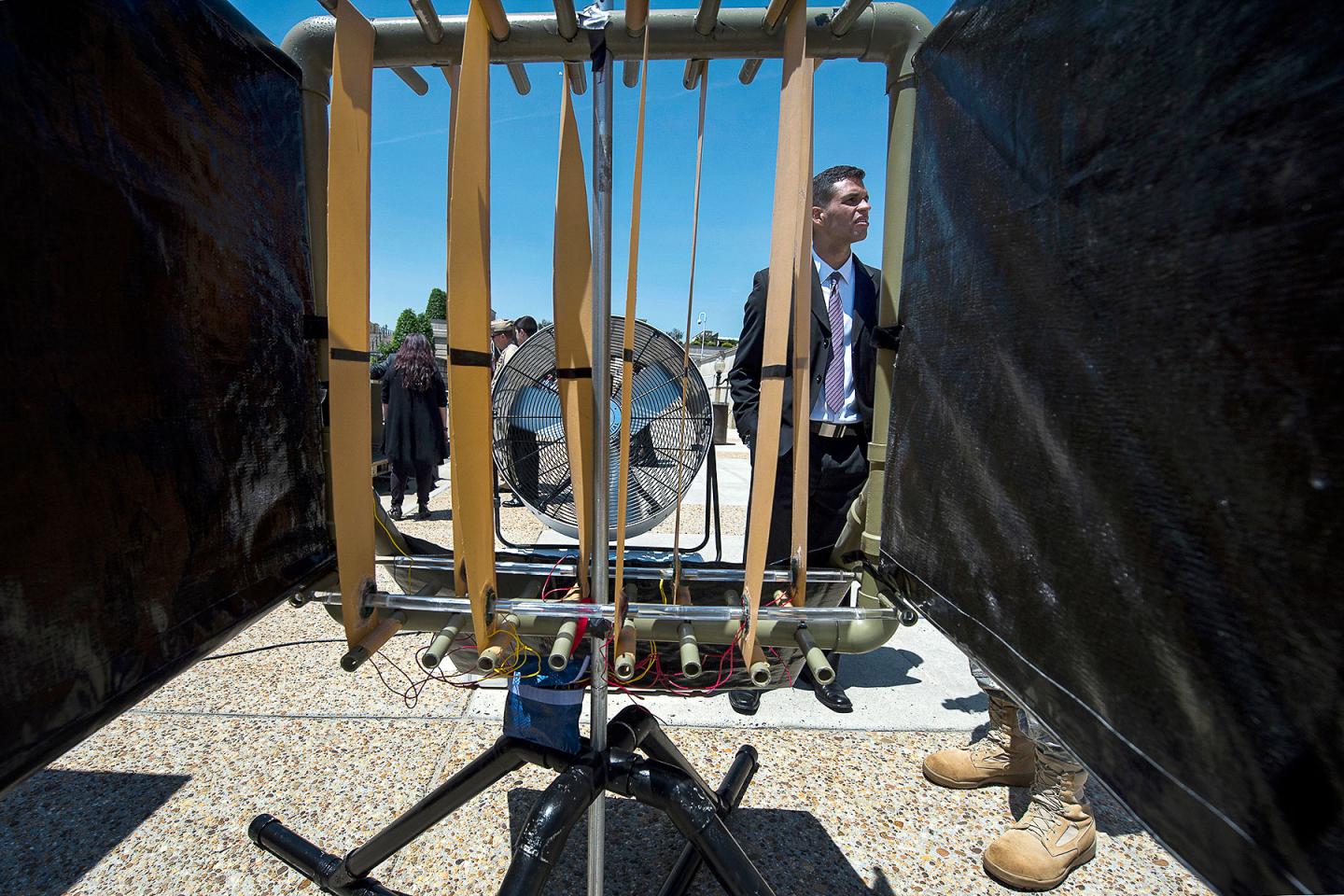
A patent was issued to the U.S. Army Corps of Engineers on Tuesday for a novel generator that buzzes in a light breeze.

Using low-velocity winds–less than nine miles per hour, which are not strong enough to turn a traditional wind turbine’s blades–the new generator creates power using “elastic tension gradient” strips.

The prototype generator, built at the Corps’ Engineer Research and Development Center, has a base structure made of PVC piping that supports eight elastic strips mounted vertically on rotating tensioning tubes.

The strips are positioned in parallel with the wind’s direction and their front-to-back elasticity gives them a constant serpentine wiggle, which moves an embedded copper induction coil across a smooth pipe containing magnets. Wiring transmits the induced electricity from the coil generators to a power converter and output where it can be used for all sorts of work.

Optionally, guide planes can be attached to funnel more air current over the flaps and a stiffening bar can be added to at the midpoint of the elastic flaps, which “enhances the generation of serpentine motion by providing an increased surface area for the fluid without hindering the serpentine motion,” according to the patent.

The Army’s patent lists 10 inventors: Charles Marsh, Axy Pagan-Vazquez, Carl Feickert, Aaron Averbuch, Meredith Sellers, Christopher Joel Foster, Scott Lux, Justin Hesterberg, Andy Friedl, and John Alexander Magerko, III.

In a 2014 report, Marsh and Feickert wrote that the idea for the fluid generator was initially inspired by “common Venetian blinds, fluttering in the gentle breeze of an open window…”

In coordination with the Army’s technology transfer program, Marti Elder, a senior technology manager at TechLink and invention licensing expert, is seeking entrepreneurs or businesses that would make, use, or sell the generator commercially.

Elder said that the Corps of Engineers’s technology, scaled up, could expand the geographic boundaries of wind energy production to places with historically low winds, and noted that the blade-less design has a reduced impact on birds and bats.

“The market for renewable energy isn’t going away, and neither is the military’s interest in powering expeditionary forces,” she said. “With a working prototype, the business opportunity is evident and exciting.”

###

Media Contact
Troy Carter
[email protected]

Original Source

https://techlinkcenter.org/this-new-invention-can-generate-power-from-the-softest-breeze/

Tags: Civil EngineeringElectrical Engineering/ElectronicsEnergy SourcesEnergy/Fuel (non-petroleum)Technology TransferTechnology/Engineering/Computer Science
Share12Tweet8Share2ShareShareShare2

Related Posts

From Farm Waste to Factory Catalysts: The Rise of Sustainable Biocatalysis

From Farm Waste to Factory Catalysts: The Rise of Sustainable Biocatalysis

September 25, 2026
How AI Is Speeding the Hunt for Cheaper, Safer Sodium-Ion Battery Materials

How AI Is Speeding the Hunt for Cheaper, Safer Sodium-Ion Battery Materials

September 25, 2026

Forever chemicals found in Vietnam’s fish, but regulation has yet to catch up

September 25, 2026

Chemists Use Vibrational Fingerprints to Sieve Carbon-13 Straight from CO2

September 25, 2026
Please login to join discussion

POPULAR NEWS

  • Digital Divide Leaves Millions of Older Adults in Türkiye Struggling to Reach Healthcare

    29 shares
    Share 12 Tweet 7
  • Fat Thieves: How Leishmania infantum Rewires Host Cell Lipids to Fuel Infection

    29 shares
    Share 12 Tweet 7
  • AI System Reads the Dark Web Across Text and Images to Spot Cyber Threats

    29 shares
    Share 12 Tweet 7
  • Fifteen Years of Alumni Data Reveal What Immersive Bioengineering Education Really Delivers

    29 shares
    Share 12 Tweet 7

About

We bring you the latest biotechnology news from best research centers and universities around the world. Check our website.

Follow us

Recent News

Digital Divide Leaves Millions of Older Adults in Türkiye Struggling to Reach Healthcare

Fat Thieves: How Leishmania infantum Rewires Host Cell Lipids to Fuel Infection

AI System Reads the Dark Web Across Text and Images to Spot Cyber Threats

Subscribe to Blog via Email

Enter your email address to subscribe to this blog and receive notifications of new posts by email.

Join 85 other subscribers
  • Contact Us

Bioengineer.org © Copyright 2023 All Rights Reserved.

Welcome Back!

Login to your account below

Forgotten Password?

Retrieve your password

Please enter your username or email address to reset your password.

Log In
No Result
View All Result
  • Homepages
    • Home Page 1
    • Home Page 2
  • News
  • National
  • Business
  • Health
  • Lifestyle
  • Science

Bioengineer.org © Copyright 2023 All Rights Reserved.