• HOME
  • NEWS
  • EXPLORE
    • CAREER
      • Companies
      • Jobs
    • EVENTS
    • iGEM
      • News
      • Team
    • PHOTOS
    • VIDEO
    • WIKI
  • BLOG
  • COMMUNITY
    • FACEBOOK
    • INSTAGRAM
    • TWITTER
Thursday, May 21, 2026
BIOENGINEER.ORG
No Result
View All Result
  • Login
  • HOME
  • NEWS
  • EXPLORE
    • CAREER
      • Companies
      • Jobs
        • Lecturer
        • PhD Studentship
        • Postdoc
        • Research Assistant
    • EVENTS
    • iGEM
      • News
      • Team
    • PHOTOS
    • VIDEO
    • WIKI
  • BLOG
  • COMMUNITY
    • FACEBOOK
    • INSTAGRAM
    • TWITTER
  • HOME
  • NEWS
  • EXPLORE
    • CAREER
      • Companies
      • Jobs
        • Lecturer
        • PhD Studentship
        • Postdoc
        • Research Assistant
    • EVENTS
    • iGEM
      • News
      • Team
    • PHOTOS
    • VIDEO
    • WIKI
  • BLOG
  • COMMUNITY
    • FACEBOOK
    • INSTAGRAM
    • TWITTER
No Result
View All Result
Bioengineer.org
No Result
View All Result
Home NEWS Science News Biology

New electron microscopy technique limits membrane destruction

Bioengineer by Bioengineer
April 10, 2019
in Biology
Reading Time: 3 mins read
0
IMAGE
Share on FacebookShare on TwitterShare on LinkedinShare on RedditShare on Telegram

IMAGE

Credit: Purdue University/Rebecca Wilcox

Membrane proteins play an important role in many biological processes. Studies suggest they’re targeted by more than 50% of all modern medicinal drugs. Unfortunately for researchers, determining their structures has been a longstanding challenge because it’s difficult to track the protein without damaging the cellular membrane using current techniques. Not anymore.

Researchers at Purdue University have created an electron microscopy technique termed “cryoAPEX” that accurately tracks membrane proteins in a well-preserved cell. The new method is a hybrid of two commonly used methods in cell biology: high-pressure freezing and chemical fixation.

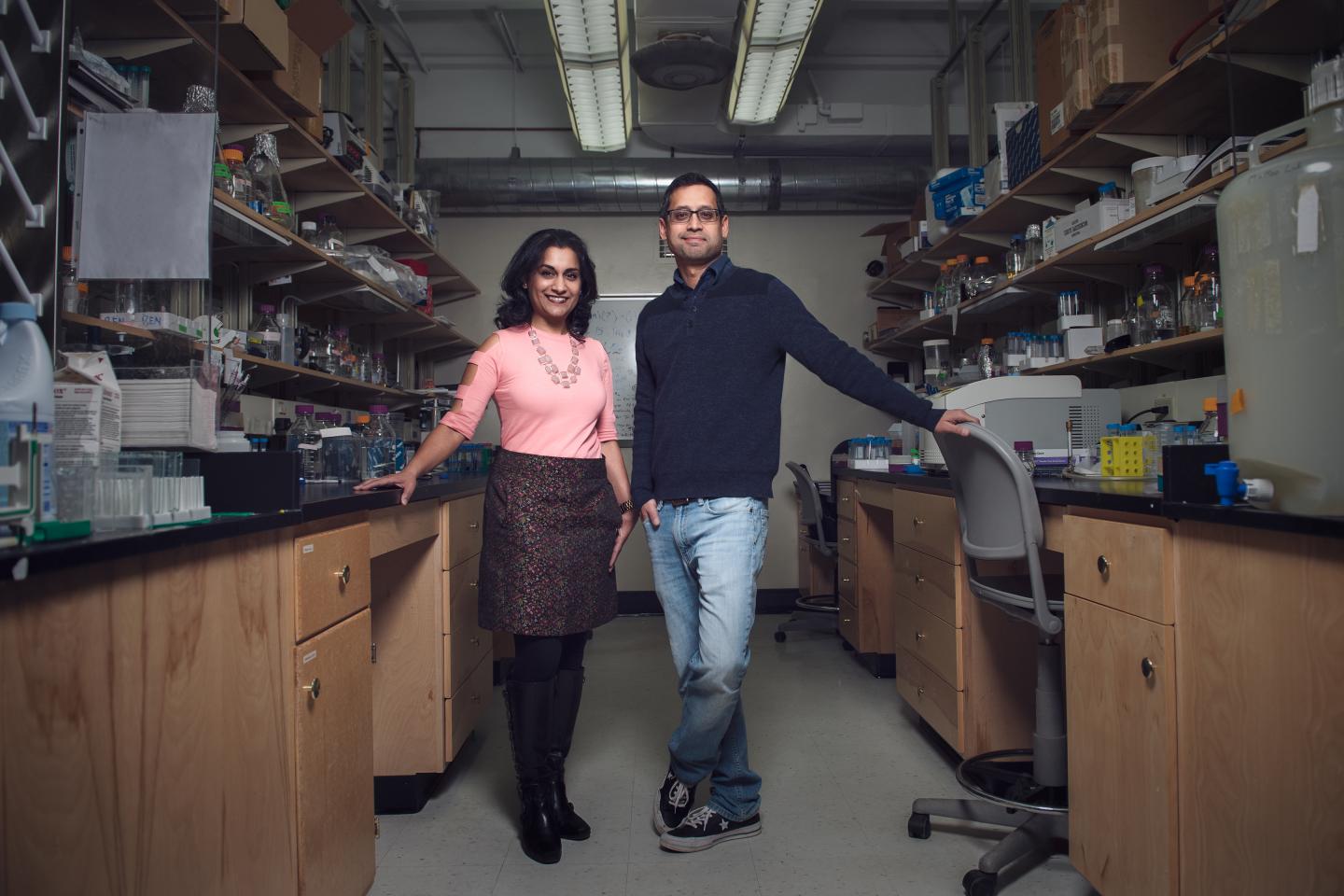
“We took the best features from each technique and played around with conditions until we found a happy medium where you could stain for your protein while maintaining membrane preservation,” said Seema Mattoo, an assistant professor of biological sciences at Purdue. “We were also able to use this information to develop a 3D image of the protein in the context of the cell.”

Chemical fixation uses antibodies to detect proteins, but to do that, the cells need to be “fixed” with alcohol. Alcohol breaks down the membrane, essentially creating holes in it and allowing the signal researchers are looking for to leak out. This produces faulty results.

High-pressure freezing, on the other hand, preserves the entire cell perfectly. But this method isn’t compatible with staining techniques, so there’s no way to pinpoint the protein of interest.

Membrane proteins play an important role in several biological processes, including relaying signals between a cell’s internal and external environments, transporting molecules and ions across the membrane, and allowing cells to identify and interact with each other. Being able to follow these proteins as they perform their duties in the cell will allow researchers to understand cell signaling mechanisms that regulate protein function.

“Virologists, for instance, will find this technique really useful because now they’ll be able to follow their viruses in the context of a particular viral protein within a cell,” said Mattoo, who is also a member of Purdue’s Center for Cancer Research and Institute of Inflammation, Immunology and Infectious Disease.

Mattoo’s research focuses on a class of enzymes called Fic proteins. The version present in humans, HYPE, is a critical regulator of whether cells under stress live or die. Her goal for developing this technique was to be able to see where HYPE goes once it enters the endoplasmic reticulum, she said.

The findings, which were published in the Journal of Cell Science, show that HYPE is strongly drawn to the lumen. This means that HYPE is tightly regulated, and if it ever does leave the endoplasmic reticulum, it would likely be under disease-specific conditions.

“As we’re trying to figure out how to manipulate HYPE to determine whether it can be used as a therapeutic, we’re going to focus a lot of our energy on the endoplasmic reticulum,” Mattoo said. “But the wider implications of these findings are predominantly in the technique. We developed it so that it can be applied to tissue culture cells and can be used by a wide range of researchers.”

###

Media Contact
Kayla Zacharias
[email protected]

Original Source

https://www.purdue.edu/newsroom/releases/2019/Q2/new-electron-microscopy-technique-limits-membrane-destruction.html

Related Journal Article

http://dx.doi.org/10.1242/jcs.222315

Tags: BiologyCell Biology
Share14Tweet8Share2ShareShareShare2

Related Posts

Early Delivery Improves Outcomes for Mothers and Babies in Hypertensive Pregnancies — Biology

Early Delivery Improves Outcomes for Mothers and Babies in Hypertensive Pregnancies

May 21, 2026
How Atlantic Herring Rewired Their Reproductive Strategy to Thrive in Changing Oceans — Biology

How Atlantic Herring Rewired Their Reproductive Strategy to Thrive in Changing Oceans

May 20, 2026

Study Finds Young Fraser River Chinook Salmon Swimming in Chemical Mixture

May 20, 2026

Thousands of UK Beekeepers Contribute Honey to Advance Environmental Science

May 20, 2026
Please login to join discussion

POPULAR NEWS

  • blank

    New Study Reveals Plants Can Detect the Sound of Rain

    733 shares
    Share 292 Tweet 183
  • ESMO 2025: mRNA COVID Vaccines Enhance Efficacy of Cancer Immunotherapy

    304 shares
    Share 122 Tweet 76
  • Research Indicates Potential Connection Between Prenatal Medication Exposure and Elevated Autism Risk

    846 shares
    Share 338 Tweet 212
  • Breastmilk Balances E. coli and Beneficial Bacteria in Infant Gut Microbiomes

    58 shares
    Share 23 Tweet 15

About

We bring you the latest biotechnology news from best research centers and universities around the world. Check our website.

Follow us

Recent News

Innovative Reusable Brick Walls Revolutionize Construction Industry

Nonlinear Atomic Tunneling Enhanced by Bright Squeezed Vacuum

Label-Free Super-Resolution Imaging of Live Cells

Subscribe to Blog via Email

Enter your email address to subscribe to this blog and receive notifications of new posts by email.

Join 82 other subscribers
  • Contact Us

Bioengineer.org © Copyright 2023 All Rights Reserved.

Welcome Back!

Login to your account below

Forgotten Password?

Retrieve your password

Please enter your username or email address to reset your password.

Log In
No Result
View All Result
  • Homepages
    • Home Page 1
    • Home Page 2
  • News
  • National
  • Business
  • Health
  • Lifestyle
  • Science

Bioengineer.org © Copyright 2023 All Rights Reserved.