• HOME
  • NEWS
  • EXPLORE
    • CAREER
      • Companies
      • Jobs
    • EVENTS
    • iGEM
      • News
      • Team
    • PHOTOS
    • VIDEO
    • WIKI
  • BLOG
  • COMMUNITY
    • FACEBOOK
    • INSTAGRAM
    • TWITTER
Wednesday, December 31, 2025
BIOENGINEER.ORG
No Result
View All Result
  • Login
  • HOME
  • NEWS
  • EXPLORE
    • CAREER
      • Companies
      • Jobs
        • Lecturer
        • PhD Studentship
        • Postdoc
        • Research Assistant
    • EVENTS
    • iGEM
      • News
      • Team
    • PHOTOS
    • VIDEO
    • WIKI
  • BLOG
  • COMMUNITY
    • FACEBOOK
    • INSTAGRAM
    • TWITTER
  • HOME
  • NEWS
  • EXPLORE
    • CAREER
      • Companies
      • Jobs
        • Lecturer
        • PhD Studentship
        • Postdoc
        • Research Assistant
    • EVENTS
    • iGEM
      • News
      • Team
    • PHOTOS
    • VIDEO
    • WIKI
  • BLOG
  • COMMUNITY
    • FACEBOOK
    • INSTAGRAM
    • TWITTER
No Result
View All Result
Bioengineer.org
No Result
View All Result
Home NEWS Science News Biology

Mechanism to form influenza A virus discovered

Bioengineer by Bioengineer
April 9, 2019
in Biology
Reading Time: 2 mins read
0
IMAGE
Share on FacebookShare on TwitterShare on LinkedinShare on RedditShare on Telegram

IMAGE

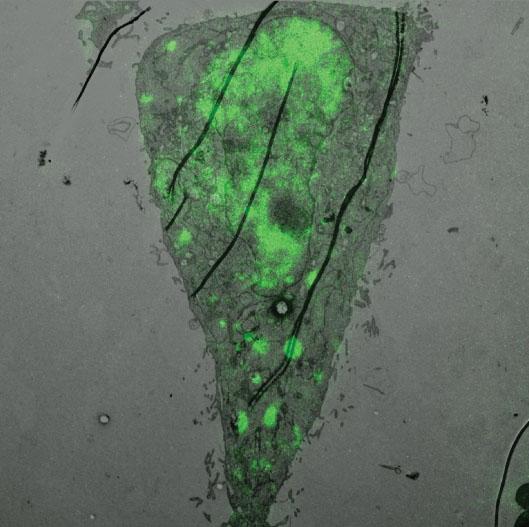
Credit: Sílvia Vale-Costa and Ana Laura Sousa.

The influenza A virus is known to form new strains every year. These strains are the result of small variations occurring at the level of the genome, which cause the virus to become different and no longer recognized by the immune system. A new study by Maria João Amorim’s team, from the Gulbenkian Institute of Science, now reveals where the genomes of the influenza A virus are assembled inside infected cells. The results will be published this week in the journal Nature Communications* and may contribute to therapies that prevent or combate new strains of influenza viruses.

Influenza A virus can only multiply within the cells of the body it infects, because it needs to use the cellular machinery of the host. When infection occurs, the virus enters into the cell and releases its genetic material and some proteins. But these viruses have an unusual peculiarity: their genome is segmented into eight distinct parts. Thus, during virus multiplication, the eight parts of the genetic material are replicated many times. The formation of new viruses requires that these eight segments are assembled into the same viral particle, which implies a very precise selection out of thousands of molecules that are mixed. Where this selection is made was unknown until now.

The study of the team of Maria João Amorim reveals that the selection of the genetic material is made in viral-induced compartments called viral inclusions. The researchers found that these compartments are not delimited by a membrane, as the traditional organelles in the cell. Instead, viral inclusions are separated from the surroundings by a process called liquid-liquid phase separation. This process is similar to what happens with vinegar and olive oil when placed together. In this way, the genetic material of the virus are segregated and confined to a small space where it is easier to assemble the sets of eight pieces that form the genome.

“Our results pave the way for alternative therapies that could target genome formation, or the place where the genome is formed,” says Maria João Amorim. The IGC researcher also explains that “this work is innovative because it is one of the initial observations that demonstrates that viral infections use phase separation processes.”

Phase separation in biology is a research area of increasing interest. Changes to this process are cause but also consequence of many diseases, mainly neurological diseases. The work published by the IGC team opens the door to investigate the role that phase separation plays in infections caused by influenza and other microorganisms.

###

Alenquer, M., Vale-Costa, S., Etibor, T.A., Ferreira, F., Sousa, A. L., Amorim, M.J. (2019) “Influenza A virus ribonucleoproteins form liquid organelles at endoplasmic reticulum exit sites” Nature Communications, doi: 10.1038/s41467-019-09549-4.

Media Contact
Ana Mena
[email protected]

Related Journal Article

http://dx.doi.org/10.1038/s41467-019-09549-4

Tags: BiologyCell BiologyVirology
Share12Tweet8Share2ShareShareShare2

Related Posts

Unraveling Safflower Spininess: EMS and QTL-Seq Insights

Unraveling Safflower Spininess: EMS and QTL-Seq Insights

December 30, 2025
blank

Gender Identity: Breaking Down Stereotypes and Cognition

December 30, 2025

Unlocking Embryonic Secrets: Nematode Chromatin Accessibility Revealed

December 30, 2025

Impact of Wildlife on Livestock Production in Zimbabwe

December 30, 2025
Please login to join discussion

POPULAR NEWS

  • blank

    PTSD, Depression, Anxiety in Childhood Cancer Survivors, Parents

    84 shares
    Share 34 Tweet 21
  • NSF funds machine-learning research at UNO and UNL to study energy requirements of walking in older adults

    71 shares
    Share 28 Tweet 18
  • Exploring Audiology Accessibility in Johannesburg, South Africa

    52 shares
    Share 21 Tweet 13
  • Nurses’ Views on Online Learning: Effects on Performance

    71 shares
    Share 28 Tweet 18

About

We bring you the latest biotechnology news from best research centers and universities around the world. Check our website.

Follow us

Recent News

Precision Therapeutics Target CKD via Shroom3-Rock Interaction

Boosting Nurse Wellbeing: The Power of Resilience Programs

Blocking IL-1 Receptor Eases Kidney Fibrosis Mechanisms

Subscribe to Blog via Email

Enter your email address to subscribe to this blog and receive notifications of new posts by email.

Join 71 other subscribers
  • Contact Us

Bioengineer.org © Copyright 2023 All Rights Reserved.

Welcome Back!

Login to your account below

Forgotten Password?

Retrieve your password

Please enter your username or email address to reset your password.

Log In
No Result
View All Result
  • Homepages
    • Home Page 1
    • Home Page 2
  • News
  • National
  • Business
  • Health
  • Lifestyle
  • Science

Bioengineer.org © Copyright 2023 All Rights Reserved.