• HOME
  • NEWS
  • EXPLORE
    • CAREER
      • Companies
      • Jobs
    • EVENTS
    • iGEM
      • News
      • Team
    • PHOTOS
    • VIDEO
    • WIKI
  • BLOG
  • COMMUNITY
    • FACEBOOK
    • INSTAGRAM
    • TWITTER
Thursday, March 26, 2026
BIOENGINEER.ORG
No Result
View All Result
  • Login
  • HOME
  • NEWS
  • EXPLORE
    • CAREER
      • Companies
      • Jobs
        • Lecturer
        • PhD Studentship
        • Postdoc
        • Research Assistant
    • EVENTS
    • iGEM
      • News
      • Team
    • PHOTOS
    • VIDEO
    • WIKI
  • BLOG
  • COMMUNITY
    • FACEBOOK
    • INSTAGRAM
    • TWITTER
  • HOME
  • NEWS
  • EXPLORE
    • CAREER
      • Companies
      • Jobs
        • Lecturer
        • PhD Studentship
        • Postdoc
        • Research Assistant
    • EVENTS
    • iGEM
      • News
      • Team
    • PHOTOS
    • VIDEO
    • WIKI
  • BLOG
  • COMMUNITY
    • FACEBOOK
    • INSTAGRAM
    • TWITTER
No Result
View All Result
Bioengineer.org
No Result
View All Result
Home NEWS Science News Chemistry

JILA’s 5-minute sample processing enhances DNA imaging and analysis

Bioengineer by Bioengineer
April 8, 2019
in Chemistry
Reading Time: 2 mins read
0
IMAGE
Share on FacebookShare on TwitterShare on LinkedinShare on RedditShare on Telegram

IMAGE

Credit: Heenan/JILA

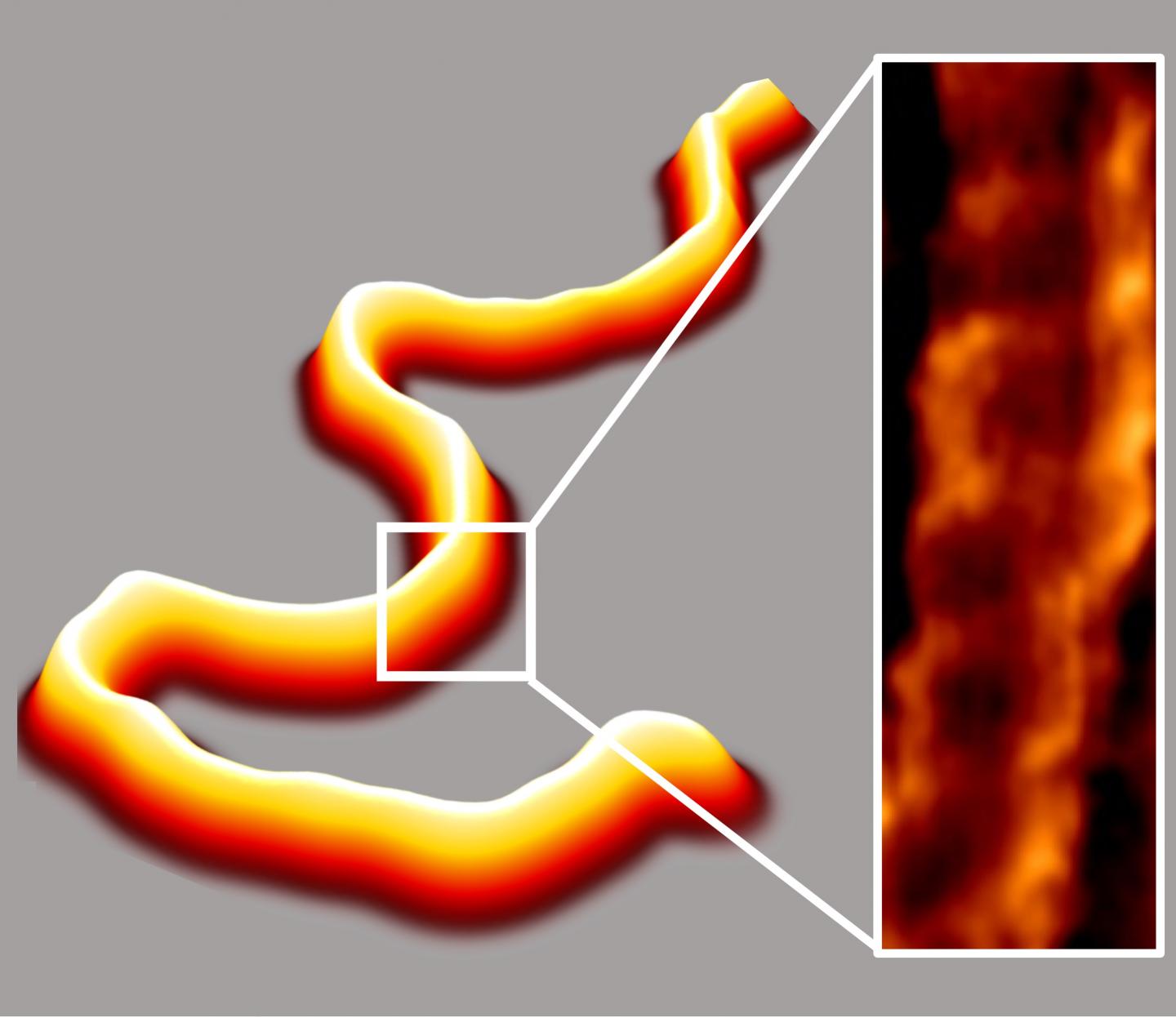
JILA scientists have developed a fast, simple sample preparation method that enhances imaging of DNA to better analyze its physical properties and interactions.

Described in ACS Nano, JILA’s gentle, yet effective process involves binding DNA to mica, a flat silicate mineral. This process extends the DNA’s configuration–similar to expanding the bellows of an accordion–so that eight times more of the molecule can be analyzed as compared to previous methods.

Atomic Force Microscopy (AFM) imaging of the extended structures in liquid improved the quality and quantity of biophysical data on DNA and its interactions with proteins. The method produced high-quality images over a wide range of salt concentrations, including ones similar to those found in a cell. This was previously thought impossible because different salts ordinarily compete to attach the DNA to the surface or interfere with that attachment. High-resolution images revealed the DNA’s iconic double helix structure, which looks like a twisted ladder.

JILA is jointly operated by the National Institute of Standards and Technology (NIST) and the University of Colorado Boulder.

“We expect this new sample preparation method to pave the way to tuning the binding strength of DNA to a surface, which should facilitate studying the dynamics of protein-DNA complexes,” NIST/JILA Fellow Tom Perkins said.

AFM imaging of DNA has previously been performed in both air and liquid, but there is no widely accepted method for preparing DNA in liquid, its normal environment. Mica is an appealing binding surface because it is so flat, but it also has a negative electrical charge, which repels DNA, so surface treatments are needed. Current sample prep methods can result in very compact pieces of DNA, poor images, or salt conditions that disrupt protein-DNA interactions.

JILA’s five-minute process includes pre-soaking the mica in a nickel-salt solution, gentle rinsing and drying, and binding of DNA to the mica in a solution containing magnesium chloride and potassium chloride. As in a cell, these salt conditions preserve the properties of proteins binding to DNA. After protein-DNA complexes bind to the mica, the final step before imaging involves rinsing the mica with a solution containing nickel-chloride, which traps the DNA structure by increasing the DNA-mica interaction strength.

For the first time in liquid, the method produced AFM images of DNA bound to the flat surface without any alterations to its well-known mechanical properties, including its width, length and native backbone stiffness. JILA scientists used the new method to make high-quality images of DNA and two protein-DNA complexes. Enhanced images of DNA-protein complexes will help researchers see new details of processes such as DNA repair and cellular metabolism.

###

The work was supported by the National Science Foundation and NIST.

Paper: P.R. Heenan and T.T. Perkins. 2019. Imaging DNA Equilibrated onto Mica in Liquid using Biochemically Relevant Deposition Conditions. ACS Nano. Published April 2. DOI: 10.1021/acsnano.8b09234

Media Contact
Laura Ost
[email protected]

Related Journal Article

http://dx.doi.org/10.1021/acsnano.8b09234

Tags: BiologyBiomechanics/BiophysicsCell BiologyChemistry/Physics/Materials SciencesNanotechnology/MicromachinesResearch/DevelopmentTechnology/Engineering/Computer Science
Share13Tweet8Share2ShareShareShare2

Related Posts

Isolated H2-Reduced Clusters Boost CO2-to-Methanol Catalysis

Isolated H2-Reduced Clusters Boost CO2-to-Methanol Catalysis

March 25, 2026
blank

Physicists Identify Electronic Drivers Behind Flat Band Quantum Materials

March 21, 2026

Würzburg Chemistry Professor Claudia Höbartner Receives Prestigious Honor

March 20, 2026

Scientists Reveal How Magnets Control Metamaterial Behavior

March 20, 2026
Please login to join discussion

POPULAR NEWS

  • blank

    Revolutionary AI Model Enhances Precision in Detecting Food Contamination

    96 shares
    Share 38 Tweet 24
  • Imagine a Social Media Feed That Challenges Your Views Instead of Reinforcing Them

    1003 shares
    Share 397 Tweet 248
  • Uncovering Functions of Cavernous Malformation Proteins in Organoids

    54 shares
    Share 22 Tweet 14
  • Promising Outcomes from First Clinical Trials of Gene Regulation in Epilepsy

    51 shares
    Share 20 Tweet 13

About

We bring you the latest biotechnology news from best research centers and universities around the world. Check our website.

Follow us

Recent News

In-Sensor Cryptography Links Physical Process to Digital Identity

Can Psychosocial Factors Influence Cancer Risk?

Depression Factors in Elderly: Pre vs. Post-COVID Analysis

Subscribe to Blog via Email

Success! An email was just sent to confirm your subscription. Please find the email now and click 'Confirm' to start subscribing.

Join 78 other subscribers
  • Contact Us

Bioengineer.org © Copyright 2023 All Rights Reserved.

Welcome Back!

Login to your account below

Forgotten Password?

Retrieve your password

Please enter your username or email address to reset your password.

Log In
No Result
View All Result
  • Homepages
    • Home Page 1
    • Home Page 2
  • News
  • National
  • Business
  • Health
  • Lifestyle
  • Science

Bioengineer.org © Copyright 2023 All Rights Reserved.