• HOME
  • NEWS
  • EXPLORE
    • CAREER
      • Companies
      • Jobs
    • EVENTS
    • iGEM
      • News
      • Team
    • PHOTOS
    • VIDEO
    • WIKI
  • BLOG
  • COMMUNITY
    • FACEBOOK
    • INSTAGRAM
    • TWITTER
Saturday, February 7, 2026
BIOENGINEER.ORG
No Result
View All Result
  • Login
  • HOME
  • NEWS
  • EXPLORE
    • CAREER
      • Companies
      • Jobs
        • Lecturer
        • PhD Studentship
        • Postdoc
        • Research Assistant
    • EVENTS
    • iGEM
      • News
      • Team
    • PHOTOS
    • VIDEO
    • WIKI
  • BLOG
  • COMMUNITY
    • FACEBOOK
    • INSTAGRAM
    • TWITTER
  • HOME
  • NEWS
  • EXPLORE
    • CAREER
      • Companies
      • Jobs
        • Lecturer
        • PhD Studentship
        • Postdoc
        • Research Assistant
    • EVENTS
    • iGEM
      • News
      • Team
    • PHOTOS
    • VIDEO
    • WIKI
  • BLOG
  • COMMUNITY
    • FACEBOOK
    • INSTAGRAM
    • TWITTER
No Result
View All Result
Bioengineer.org
No Result
View All Result
Home NEWS Science News Chemistry

Peptides with brominated tryptophan analogs could protect marine animals

Bioengineer by Bioengineer
April 4, 2019
in Chemistry
Reading Time: 2 mins read
0
Share on FacebookShare on TwitterShare on LinkedinShare on RedditShare on Telegram

This article by Dr. Elsie C. Jimenez is published in Protein & Peptide Letters, volume 26, issue 4 , 2019

Bromotryptophan is a noncoded amino acid that is rarely found in peptides formed in the cell’s ribosome. It is a product of post-translational modification. Bromotryptophan and its analogs seldom occur in peptides that are not produced through the ribosomal machinery.

Elsie C. Jimenez, a researcher from the University of the Philippines Baguio has studied marine bromopeptides in detail and published a review in Protein and Peptide Letters. Jimenez notes that, of the characterized peptides, the ribosomal peptides generally contain 6- bromo-L-tryptophan. Non-ribosomal peptides have brominated tryptophan analogs and unusual peptidic structures.

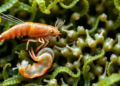
Peptide molecules are susceptible to proteolytic degradation, but the presence of brominated tryptophan analogs may provide structural stability that could prevent degradation due to the steric effect caused by the bromine atom. Brominated tryptophan analogs likely have important functions in the lives of marine animals, such as cone snails, ascidians, hagfish, annelids, sea urchins and sponges. The peptides containing brominated tryptophan analogs show important biological activities that the animals can use for chemical defenses. “Several peptides reveal pharmacological activities that can be further explored for medical applications”, says Jimenez.

“Some peptides cause excitatory activities while others bind to nervous system receptors. The rest show antimicrobial, insecticidal, hemolytic and cytotoxic activities.” The presence of brominated tryptophan analogs possibly makes these peptides ideally fit to target cell membranes. Peptides that show antimicrobial activities may be developed as antibiotics. Those that bind to specific receptors may be tapped for treatment of neurological disorders. Peptides with antitumor activity may be developed as cancer drugs.

So far, no brominated tryptophan-containing peptide from marine animal has been approved for therapeutic use. However, the distinct characteristics of these peptides are thought-provoking for further studies, including the investigation of their biosynthesis and mechanisms of action.

###

Media Contact
Faizan ul Haq
[email protected]
http://dx.doi.org/10.2174/0929866526666190119170020

Tags: Chemistry/Physics/Materials SciencesPharmaceutical SciencesPharmaceutical/Combinatorial Chemistry
Share12Tweet8Share2ShareShareShare2

Related Posts

blank

Breakthrough in Environmental Cleanup: Scientists Develop Solar-Activated Biochar for Faster Remediation

February 7, 2026
blank

Cutting Costs: Making Hydrogen Fuel Cells More Affordable

February 6, 2026

Scientists Develop Hand-Held “Levitating” Time Crystals

February 6, 2026

Observing a Key Green-Energy Catalyst Dissolve Atom by Atom

February 6, 2026
Please login to join discussion

POPULAR NEWS

  • Robotic Ureteral Reconstruction: A Novel Approach

    Robotic Ureteral Reconstruction: A Novel Approach

    82 shares
    Share 33 Tweet 21
  • Digital Privacy: Health Data Control in Incarceration

    63 shares
    Share 25 Tweet 16
  • Study Reveals Lipid Accumulation in ME/CFS Cells

    57 shares
    Share 23 Tweet 14
  • Breakthrough in RNA Research Accelerates Medical Innovations Timeline

    53 shares
    Share 21 Tweet 13

About

We bring you the latest biotechnology news from best research centers and universities around the world. Check our website.

Follow us

Recent News

Phage-Antibiotic Combo Beats Resistant Peritoneal Infection

Boosting Remote Healthcare: Stepped-Wedge Trial Insights

Barriers and Boosters of Seniors’ Physical Activity in Karachi

Subscribe to Blog via Email

Enter your email address to subscribe to this blog and receive notifications of new posts by email.

Join 73 other subscribers
  • Contact Us

Bioengineer.org © Copyright 2023 All Rights Reserved.

Welcome Back!

Login to your account below

Forgotten Password?

Retrieve your password

Please enter your username or email address to reset your password.

Log In
No Result
View All Result
  • Homepages
    • Home Page 1
    • Home Page 2
  • News
  • National
  • Business
  • Health
  • Lifestyle
  • Science

Bioengineer.org © Copyright 2023 All Rights Reserved.