• HOME
  • NEWS
  • EXPLORE
    • CAREER
      • Companies
      • Jobs
    • EVENTS
    • iGEM
      • News
      • Team
    • PHOTOS
    • VIDEO
    • WIKI
  • BLOG
  • COMMUNITY
    • FACEBOOK
    • INSTAGRAM
    • TWITTER
Sunday, January 25, 2026
BIOENGINEER.ORG
No Result
View All Result
  • Login
  • HOME
  • NEWS
  • EXPLORE
    • CAREER
      • Companies
      • Jobs
        • Lecturer
        • PhD Studentship
        • Postdoc
        • Research Assistant
    • EVENTS
    • iGEM
      • News
      • Team
    • PHOTOS
    • VIDEO
    • WIKI
  • BLOG
  • COMMUNITY
    • FACEBOOK
    • INSTAGRAM
    • TWITTER
  • HOME
  • NEWS
  • EXPLORE
    • CAREER
      • Companies
      • Jobs
        • Lecturer
        • PhD Studentship
        • Postdoc
        • Research Assistant
    • EVENTS
    • iGEM
      • News
      • Team
    • PHOTOS
    • VIDEO
    • WIKI
  • BLOG
  • COMMUNITY
    • FACEBOOK
    • INSTAGRAM
    • TWITTER
No Result
View All Result
Bioengineer.org
No Result
View All Result
Home NEWS Science News Chemistry

Computational model of a human kinase may provide insights for cancer treatment

Bioengineer by Bioengineer
April 3, 2019
in Chemistry
Reading Time: 2 mins read
0
IMAGE
Share on FacebookShare on TwitterShare on LinkedinShare on RedditShare on Telegram

IMAGE

Credit: Kimberly Sabsay

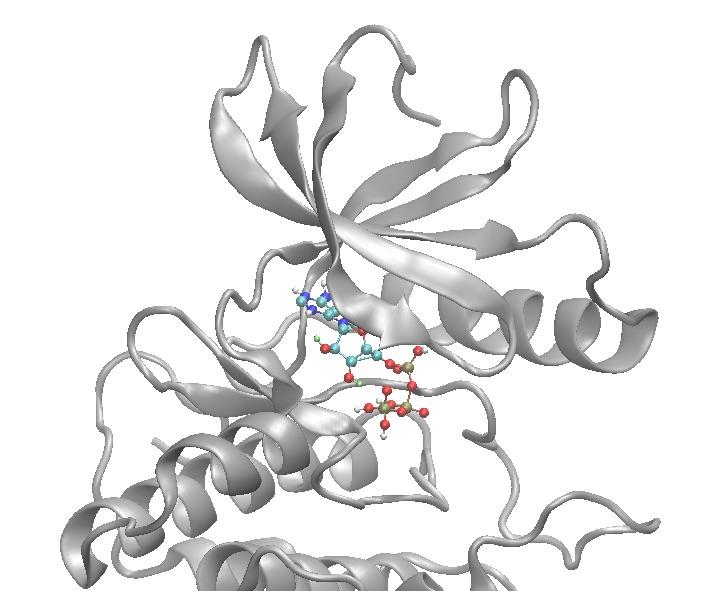
Researchers have developed a computational model for human MEK1, a protein with potential as a drug target for a variety of human cancers.

The initiation and progression of cancer cells occur when molecular signals involved in cellular proliferation go awry. MEK1 plays an essential role in signaling within both healthy and cancer cells. While much is known about the key role of MEK1 in such signaling events, scientists still don’t know the structural features of MEK1 that lead to its activation in those events.

As reported in the Journal of Chemical Information and Modeling, a group of researchers at Cal Poly San Luis Obispo led by Ashley McDonald and collaborator Javin Oza have developed computational models for the structure of the human MEK1 enzyme.

“Since we don’t know the structure of MEK1, we identified other proteins that had similar features and mechanisms of action,” said McDonald. “Using those structures as templates, we could construct models of MEK1, and then validate those models against key characteristics identified by our biochemist collaborators.”

Biochemical characterization of proteins like MEK1 remains particularly challenging because they undergo modifications called phosphorylation, which can significantly change the protein’s structure and function. In the case of MEK1, phosphorylation activates the enzyme and propagates the signal for cellular proliferation.

“Our gap in understanding the biochemistry of phosphorylated enzymes like MEK1 is in part due to technical challenges in obtaining useful quantities of pure, active enzyme,” said Oza. “Computational modeling has allowed us to bridge this gap and has provided insights into what MEK1 may look like inside of a cancer cell.”

These insights into the structure of MEK1 open the door to the development of new classes of inhibitors that could have potential as cancer therapeutics.

“This research shows that there’s great promise for combining computational and experimental science to provide unique insights into problems that are hard to study,” said McDonald.

With models of active MEK1 now available, scientists can follow up with experimental methods to discover how the protein’s structure governs its function. The combination of computational modeling and biochemical characterization of MEK1 and enzymes like it has the potential to provide new insights into drug development for tumor-specific therapeutics.

###

This work is published in the “Women in Computational Chemistry” special issue of the Journal of Chemical Information and Modeling. Cal Poly is a primarily undergraduate university, and the research was conducted primarily by female undergraduate students.

Read the paper in the Journal of Chemical Information and Modeling.

Media Contact
Ashley McDonald
[email protected]

Related Journal Article

http://dx.doi.org/10.1021/acs.jcim.8b00989

Tags: BiochemistryBiomechanics/BiophysicscancerChemistry/Physics/Materials Sciences
Share12Tweet8Share2ShareShareShare2

Related Posts

blank

New Route to Strychnos Alkaloids via Thiophene Cycloadditions

January 23, 2026
Lithium Metal Powers Electrochemical PFAS Reduction Breakthrough

Lithium Metal Powers Electrochemical PFAS Reduction Breakthrough

January 20, 2026

Creating Synthetic Protein-Binding DNA Systems in Cells

January 17, 2026

Chiral Catalysis Powers Rotary Molecular Motors

January 16, 2026
Please login to join discussion

POPULAR NEWS

  • Enhancing Spiritual Care Education in Nursing Programs

    156 shares
    Share 62 Tweet 39
  • PTSD, Depression, Anxiety in Childhood Cancer Survivors, Parents

    149 shares
    Share 60 Tweet 37
  • Robotic Ureteral Reconstruction: A Novel Approach

    80 shares
    Share 32 Tweet 20
  • Digital Privacy: Health Data Control in Incarceration

    62 shares
    Share 25 Tweet 16

About

We bring you the latest biotechnology news from best research centers and universities around the world. Check our website.

Follow us

Recent News

Interoceptive Awareness Linked to Eating Disorder Symptoms

Cancer Survivors’ Views on Cognitive Intervention Formats

Impaired Vasculogenesis in Stem Cells from SCI Patients

Subscribe to Blog via Email

Enter your email address to subscribe to this blog and receive notifications of new posts by email.

Join 71 other subscribers
  • Contact Us

Bioengineer.org © Copyright 2023 All Rights Reserved.

Welcome Back!

Login to your account below

Forgotten Password?

Retrieve your password

Please enter your username or email address to reset your password.

Log In
No Result
View All Result
  • Homepages
    • Home Page 1
    • Home Page 2
  • News
  • National
  • Business
  • Health
  • Lifestyle
  • Science

Bioengineer.org © Copyright 2023 All Rights Reserved.