Credit: University of Exeter
Artefacts such as bows and arrows do not necessarily prove our ancestors had sophisticated reasoning and understanding of how these tools worked, new research suggests.
Instead, such items could have emerged from an “accumulation of improvements made across generations” – with each generation understanding no more than the last.
The new study, by the University of Exeter and the Catholic University of Lille, does not question humanity’s capacity for “enhanced causal reasoning” – but argues this did not necessarily drive the development of technologies such as bows, boats and houses.
Researchers used “chains” of volunteers to tackle an engineering problem, with each volunteer able to learn from the last. Solutions improved with each “generation” – but those at the end of the chain had no more understanding of key concepts than their predecessors.
“We tend to explain the existence of complex technologies by saying humans have big brains and superior causal reasoning abilities,” said Dr Maxime Derex, of the University of Exeter and the Catholic University of Lille.
“But – as our study shows – you don’t have to understand how something works in order to improve it.
“Artefacts from hundreds or thousands of years ago do not necessarily show that their makers had a plan or a theory about how something would work.”
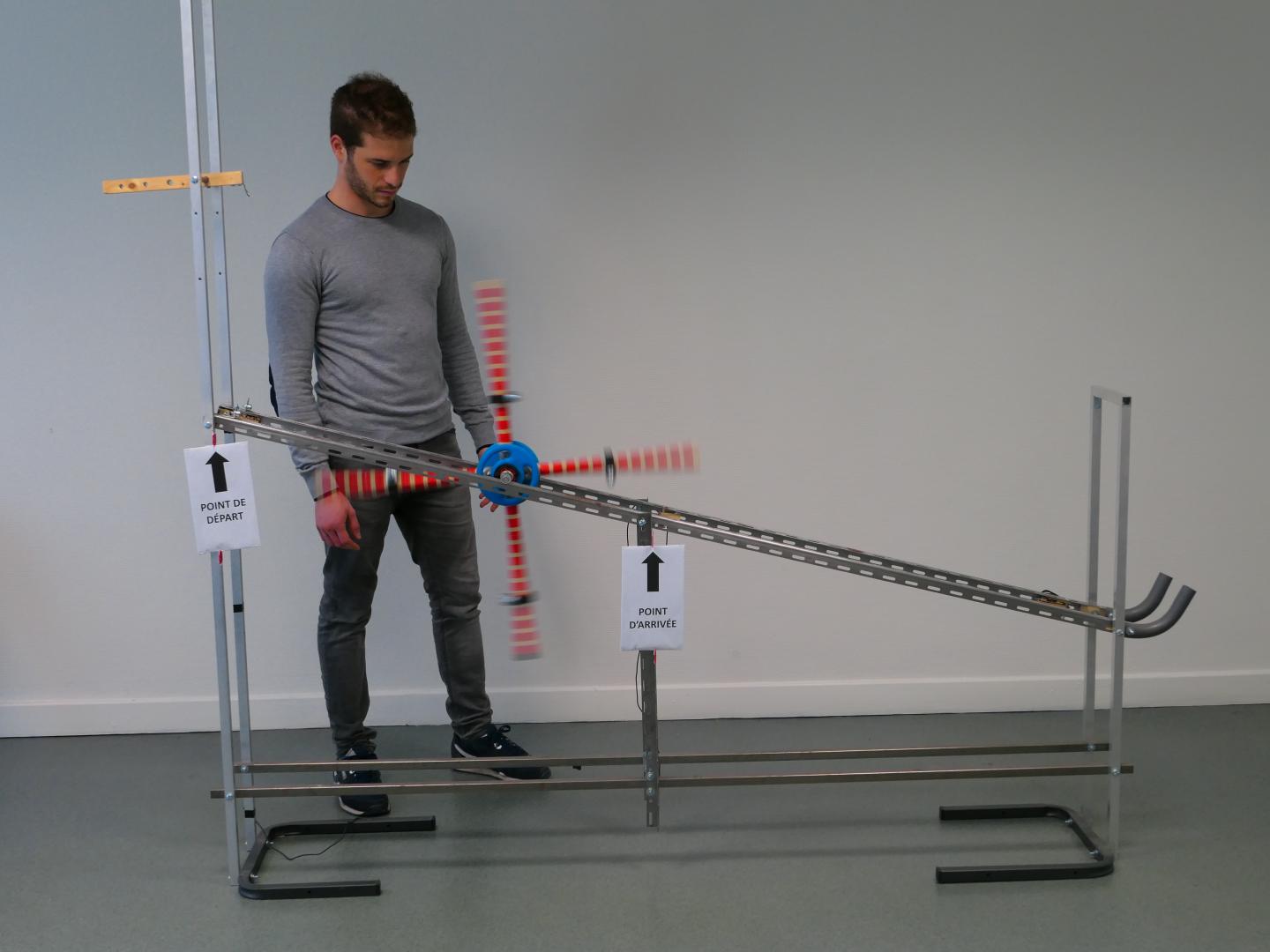
The study used 14 chains of five French university students, each aiming to optimise a wheel that rolled down a track – moving faster or slower depending on the adjustment of moveable weights on its four spokes.
Each participant had five attempts to minimise the time it took for the wheel the reach the end of the track, and all but the first participant in each chain got details of the last two configurations used by the previous person.
Afterwards, researchers tested each participant’s understanding by asking them to predict which of two wheels would cover the distance faster.
The study found: “The average wheel speed increased across generations while participants’ understanding did not.”
A further 14 chains of students completed the same process, but this time they could write down a theory to pass to the next participant.
Wheel speed rose at a similar rate as that seen in groups who passed on no written instructions, but once again understanding “barely changed across generations”.
The researchers said: “Most participants actually produced incorrect or incomplete theories despite the relative simplicity of the physical system.”
The findings prove the power of “cultural transmission, without the need for an accurate causal understanding of the system”, they said.
“Our experiment indicates that one should be cautious when interpreting complex archaeological materials as evidence for sophisticated cognitive abilities such as reasoning, problem solving or planning, since these abilities are not the sole driver of technological sophistication,” said Dr Alex Mesoudi, of the University of Exeter.
###
The project received funding from the European Union’s Horizon 2020 research and innovation programme under a Marie Sklodowska-Curie grant.
The paper, published in Nature Human Behaviour, is entitled: “Causal understanding is not necessary for the improvement of culturally evolving technology.”
Media Contact
Alex Morrison
[email protected]
Related Journal Article
http://dx.