• HOME
  • NEWS
  • EXPLORE
    • CAREER
      • Companies
      • Jobs
    • EVENTS
    • iGEM
      • News
      • Team
    • PHOTOS
    • VIDEO
    • WIKI
  • BLOG
  • COMMUNITY
    • FACEBOOK
    • INSTAGRAM
    • TWITTER
Wednesday, February 4, 2026
BIOENGINEER.ORG
No Result
View All Result
  • Login
  • HOME
  • NEWS
  • EXPLORE
    • CAREER
      • Companies
      • Jobs
        • Lecturer
        • PhD Studentship
        • Postdoc
        • Research Assistant
    • EVENTS
    • iGEM
      • News
      • Team
    • PHOTOS
    • VIDEO
    • WIKI
  • BLOG
  • COMMUNITY
    • FACEBOOK
    • INSTAGRAM
    • TWITTER
  • HOME
  • NEWS
  • EXPLORE
    • CAREER
      • Companies
      • Jobs
        • Lecturer
        • PhD Studentship
        • Postdoc
        • Research Assistant
    • EVENTS
    • iGEM
      • News
      • Team
    • PHOTOS
    • VIDEO
    • WIKI
  • BLOG
  • COMMUNITY
    • FACEBOOK
    • INSTAGRAM
    • TWITTER
No Result
View All Result
Bioengineer.org
No Result
View All Result
Home NEWS Science News Chemistry

A new accurate computational method designed to enhance drug target stability

Bioengineer by Bioengineer
March 29, 2019
in Chemistry
Reading Time: 2 mins read
0
IMAGE
Share on FacebookShare on TwitterShare on LinkedinShare on RedditShare on Telegram

IMAGE

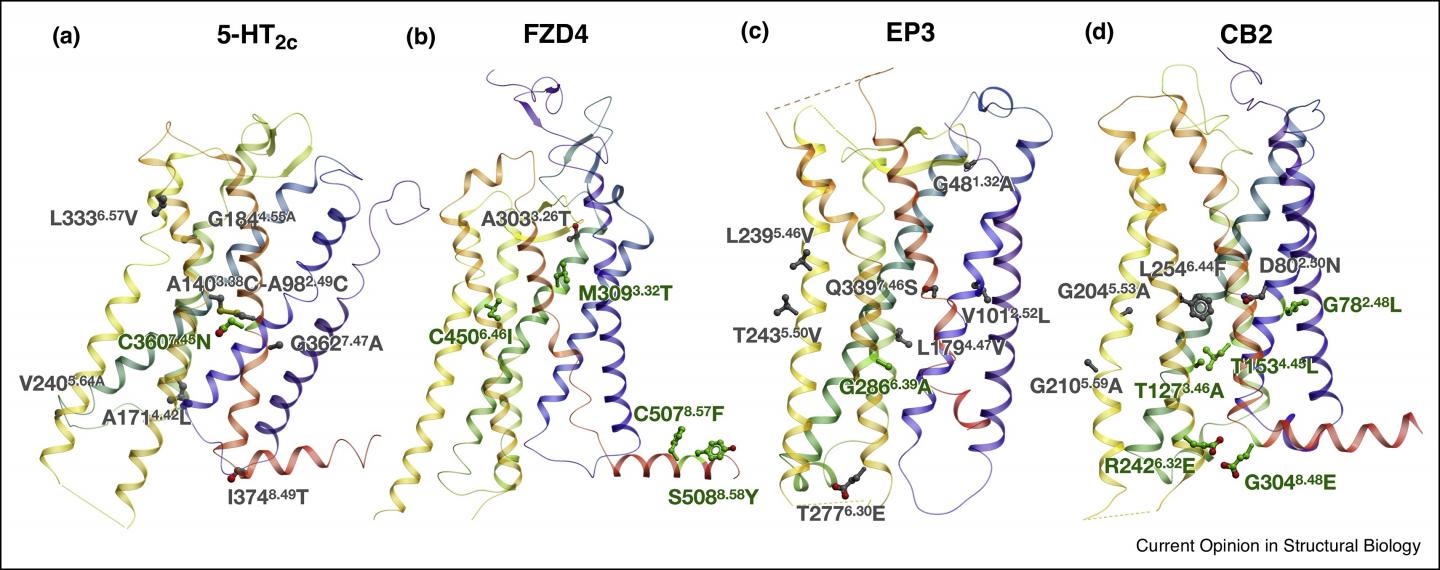
Credit: Petr Popov et al./Current Opinion in Structural Biology

Scientists from the Moscow Institute of Physics and Technology (MIPT), the Skolkovo Institute of Science and Technology (Skoltech), and the University of Southern California (USC) have developed a new computational method for the design of thermally stable G protein-coupled receptors (GPCR) that are of great help in creating new drugs. The method has already proved useful in obtaining the structures of several principal human receptors. An overview of the new method was published in the prestigious science journal Current Opinion on Structural Biology.

Receptors are molecules that capture and transmit signals and play a key role in the human body regulation. GPCRs are among the best-known human protein families involved in vision, olfaction, immune response, and brain processes, making them an important drug target. For a receptor to serve as a target, the researchers need to understand its structure in great detail, just as a locksmith needs to know the lock’s inner structure to make a key that fits. Studying a receptor that becomes unstable when detached from the cell membrane is a much more challenging task, which is largely facilitated by the computational methods that help to accurately predict the receptor’s soft spots and the changes that will make it more stable.

“The structural studies of GPCRs are of high scientific and applied value, since these proteins are the target for 30 to 40 percent of drugs. Our method relies on several approaches, including machine learning, molecular modeling, and bioinformatics, that are tailored specifically to GPCRs. These approaches are complementary, which enables effectively predicting the smallest possible changes that can enhance the receptor’s stability and make it easier to obtain its molecular structure,” explains professor Petr Popov of MIPT’s Laboratory of Structural Biology of G Protein-Coupled Receptors and the Skoltech Center for Computational and Data-Intensive Science and Engineering.

The new method developed at MIPT, Skoltech, and USC allowed researchers to obtain the structures of four important human receptors, including the cannabinoid receptor involved in brain signal transmission and pain perception, and the prostaglandin receptor implicated in inflammatory processes in the human body. The results of the study were published in the top international science journals Cell and Nature Chemical Biology.

###

Media Contact
Varvara Bogomolova
[email protected]

Original Source

https://mipt.ru/english/news/a_new_accurate_computational_method_designed_to_enhance_drug_target_stability

Related Journal Article

http://dx.doi.org/10.1016/j.sbi.2019.02.010

Tags: BiochemistryBiologyBiomedical/Environmental/Chemical EngineeringCell BiologyPain
Share12Tweet8Share2ShareShareShare2

Related Posts

Researchers Reveal How Biochar Microzones Shield Crops from Toxic Cadmium Exposure

Researchers Reveal How Biochar Microzones Shield Crops from Toxic Cadmium Exposure

February 3, 2026
blank

Could We Have Witnessed a Black Hole Explosion? Physicists at UMass Amherst Say Yes—and It Might Explain Nearly Everything

February 3, 2026

Cavendish Laboratory and FormationQ Partner to Launch Applied Quantum Program Powered by IonQ Technology

February 3, 2026

Breakthrough in Solving a Classic Magnetism Mystery

February 3, 2026
Please login to join discussion

POPULAR NEWS

  • Enhancing Spiritual Care Education in Nursing Programs

    158 shares
    Share 63 Tweet 40
  • Robotic Ureteral Reconstruction: A Novel Approach

    81 shares
    Share 32 Tweet 20
  • Digital Privacy: Health Data Control in Incarceration

    63 shares
    Share 25 Tweet 16
  • Study Reveals Lipid Accumulation in ME/CFS Cells

    57 shares
    Share 23 Tweet 14

About

We bring you the latest biotechnology news from best research centers and universities around the world. Check our website.

Follow us

Recent News

KRICT Achieves 100 kg Daily Production of Sustainable Aviation Fuel from Landfill Gas

Stacking the Genetic Deck: How Certain Plant Hybrids Defy the Odds

High Intake of Ultraprocessed Foods Potentially Increases Mortality Risk Among Cancer Survivors

Subscribe to Blog via Email

Enter your email address to subscribe to this blog and receive notifications of new posts by email.

Join 73 other subscribers
  • Contact Us

Bioengineer.org © Copyright 2023 All Rights Reserved.

Welcome Back!

Login to your account below

Forgotten Password?

Retrieve your password

Please enter your username or email address to reset your password.

Log In
No Result
View All Result
  • Homepages
    • Home Page 1
    • Home Page 2
  • News
  • National
  • Business
  • Health
  • Lifestyle
  • Science

Bioengineer.org © Copyright 2023 All Rights Reserved.