• HOME
  • NEWS
  • EXPLORE
    • CAREER
      • Companies
      • Jobs
    • EVENTS
    • iGEM
      • News
      • Team
    • PHOTOS
    • VIDEO
    • WIKI
  • BLOG
  • COMMUNITY
    • FACEBOOK
    • INSTAGRAM
    • TWITTER
Tuesday, February 3, 2026
BIOENGINEER.ORG
No Result
View All Result
  • Login
  • HOME
  • NEWS
  • EXPLORE
    • CAREER
      • Companies
      • Jobs
        • Lecturer
        • PhD Studentship
        • Postdoc
        • Research Assistant
    • EVENTS
    • iGEM
      • News
      • Team
    • PHOTOS
    • VIDEO
    • WIKI
  • BLOG
  • COMMUNITY
    • FACEBOOK
    • INSTAGRAM
    • TWITTER
  • HOME
  • NEWS
  • EXPLORE
    • CAREER
      • Companies
      • Jobs
        • Lecturer
        • PhD Studentship
        • Postdoc
        • Research Assistant
    • EVENTS
    • iGEM
      • News
      • Team
    • PHOTOS
    • VIDEO
    • WIKI
  • BLOG
  • COMMUNITY
    • FACEBOOK
    • INSTAGRAM
    • TWITTER
No Result
View All Result
Bioengineer.org
No Result
View All Result
Home NEWS Science News Chemistry

Dalian Coherent Light Source reveals hydroxyl super rotors from water photochemistry

Bioengineer by Bioengineer
March 19, 2019
in Chemistry
Reading Time: 2 mins read
0
IMAGE
Share on FacebookShare on TwitterShare on LinkedinShare on RedditShare on Telegram

IMAGE

Credit: YUAN Kaijun

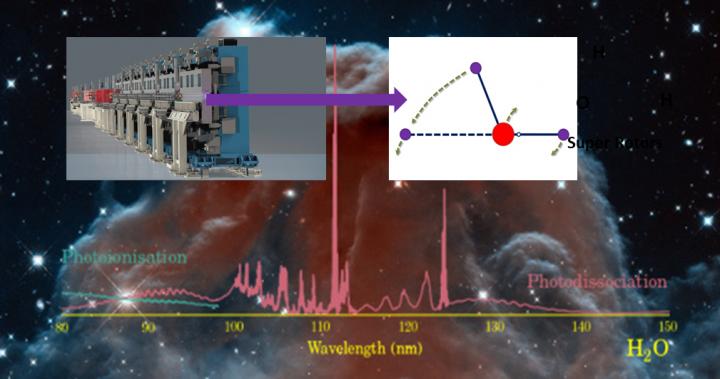
Scientists at the Dalian Institute of Chemical Physics of the Chinese Academy of Sciences recently revealed hydroxyl super rotors from water photochemistry by using the Dalian Coherent Light Source (DCLS). The researchers, under the direction of Prof. YUAN Kaijun and Prof. YANG Xueming, published their findings in Nature Communications.

Hydroxyl (OH) is a key radical in interstellar oxygen chemistry due to its capacity to react with most gases in the interstellar medium. OH radicals with extraordinarily high rotational levels of excitation were observed by astronomers in emission from HH 211(one of the youngest known stellar outflows) and the T Tauri star DG Tau. It is very unlikely such rotationally “hot” OH radicals would be formed from any chemical reactions, but they could originate from short wavelength photolysis of H2O. In the present work, the production mechanism of rotationally hot OH radicals was identified by systematic studies of vacuum ultraviolet (VUV) water photochemistry.

“The advent of the intense, pulsed VUV free electron laser at the DCLS opens the way for state-of-the-art molecular photodissociation dynamics studies at any user-selected VUV wavelength,” said YUAN.

“Highly rotationally excited OH radicals, so-called ‘super rotors’ existing above the bond dissociation energy, were observed from the photodissociation of water at 115.2 nm. Such peculiar dissociation dynamics were only observed at around 115.2 nm, which reveals interesting dissociation mechanisms,” YUAN added.

The free electron laser facility provides a chance to investigate the VUV photochemistry of small molecules. The dissociation processes of these molecules are ubiquitous in interstellar space and should be recognized in appropriate interstellar chemistry models.

###

The research work was supported by the Strategic Priority Research Program of the Chinese Academy of Sciences, the Chemical Dynamics Research Center, and the National Natural Science Foundation of China.

Media Contact
WANG Yongjin
[email protected]

Related Journal Article

http://dx.doi.org/10.1038/s41467-019-09176-z

Tags: Atomic/Molecular/Particle PhysicsChemistry/Physics/Materials SciencesOpticsParticle Physics
Share12Tweet8Share2ShareShareShare2

Related Posts

Theoretical Insights into Cluster Radioactivity Under Intense Laser Fields

Theoretical Insights into Cluster Radioactivity Under Intense Laser Fields

February 3, 2026
Breakthrough in Highly Selective Asymmetric 1,6-Addition of Aliphatic Grignard Reagents to Unsaturated Carbonyl Compounds

Breakthrough in Highly Selective Asymmetric 1,6-Addition of Aliphatic Grignard Reagents to Unsaturated Carbonyl Compounds

February 2, 2026

Enhancing Efficiency in Robotic Joint Design

February 2, 2026

The Hidden Chemistry of Ozone: Unlocking the Secrets Behind Clean Air

February 2, 2026
Please login to join discussion

POPULAR NEWS

  • Enhancing Spiritual Care Education in Nursing Programs

    157 shares
    Share 63 Tweet 39
  • Robotic Ureteral Reconstruction: A Novel Approach

    81 shares
    Share 32 Tweet 20
  • Digital Privacy: Health Data Control in Incarceration

    63 shares
    Share 25 Tweet 16
  • Study Reveals Lipid Accumulation in ME/CFS Cells

    57 shares
    Share 23 Tweet 14

About

We bring you the latest biotechnology news from best research centers and universities around the world. Check our website.

Follow us

Recent News

Machine Learning Predicts Fontan Failure and Liver Disease

Zinc-Induced Stress Causes β-Cell Identity Loss

Monitoring Avibacterium paragallinarum in Hens and Waterfowl

Subscribe to Blog via Email

Enter your email address to subscribe to this blog and receive notifications of new posts by email.

Join 73 other subscribers
  • Contact Us

Bioengineer.org © Copyright 2023 All Rights Reserved.

Welcome Back!

Login to your account below

Forgotten Password?

Retrieve your password

Please enter your username or email address to reset your password.

Log In
No Result
View All Result
  • Homepages
    • Home Page 1
    • Home Page 2
  • News
  • National
  • Business
  • Health
  • Lifestyle
  • Science

Bioengineer.org © Copyright 2023 All Rights Reserved.