

• HOME
  • NEWS
  • EXPLORE
    • CAREER
      • Companies
      • Jobs
    • EVENTS
    • iGEM
      • News
      • Team
    • PHOTOS
    • VIDEO
    • WIKI
  • BLOG
  • COMMUNITY
    • FACEBOOK
    • INSTAGRAM
    • TWITTER
Wednesday, December 31, 2025
BIOENGINEER.ORG
No Result
View All Result
  • Login
  • HOME
  • NEWS
  • EXPLORE
    • CAREER
      • Companies
      • Jobs
        • Lecturer
        • PhD Studentship
        • Postdoc
        • Research Assistant
    • EVENTS
    • iGEM
      • News
      • Team
    • PHOTOS
    • VIDEO
    • WIKI
  • BLOG
  • COMMUNITY
    • FACEBOOK
    • INSTAGRAM
    • TWITTER
  • HOME
  • NEWS
  • EXPLORE
    • CAREER
      • Companies
      • Jobs
        • Lecturer
        • PhD Studentship
        • Postdoc
        • Research Assistant
    • EVENTS
    • iGEM
      • News
      • Team
    • PHOTOS
    • VIDEO
    • WIKI
  • BLOG
  • COMMUNITY
    • FACEBOOK
    • INSTAGRAM
    • TWITTER
No Result
View All Result
Bioengineer.org
No Result
View All Result
Home NEWS Science News Science

Herbivorous mammals have bigger bellies

Bioengineer by Bioengineer
November 4, 2016
in Science
Reading Time: 2 mins read
0
Share on FacebookShare on TwitterShare on LinkedinShare on RedditShare on Telegram
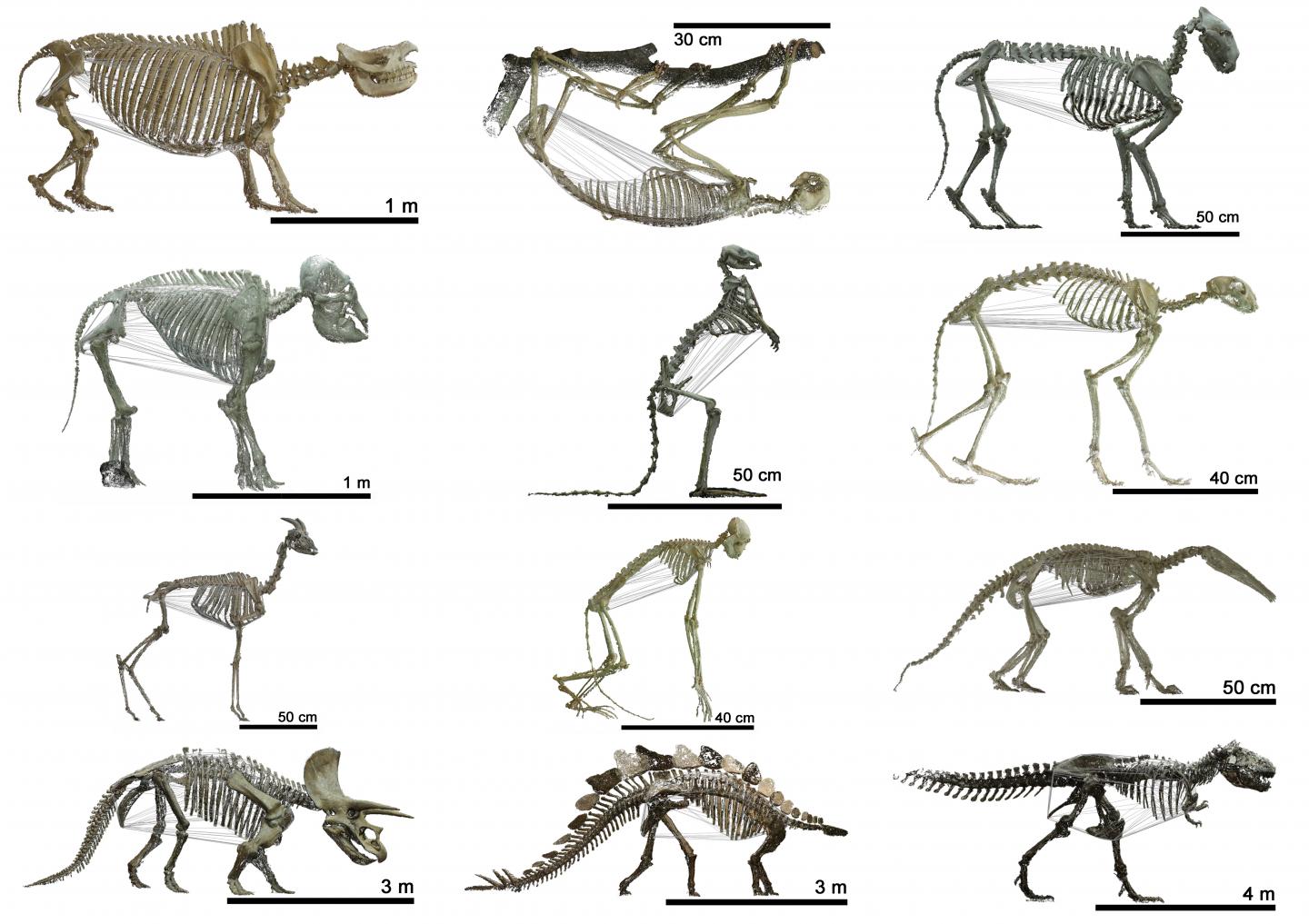
IMAGE

Credit: image: UZH

What do enormous dinosaurs have in common with tiny shrews? They are both four-legged vertebrates, otherwise known as tetrapods. In the course of evolution, tetrapods developed various body shapes and sizes – from the mouse to the dinosaur – to adapt to different environments. Their feeding habits range from pure herbivory to fierce carnivory, and their body structure reflects this feeding diversity. As plants are usually more difficult to digest than meat, herbivores are thought to need larger guts and more voluminous bellies. Nevertheless, this hypothesis had never been tested scientifically.

No difference in dinosaurs

A European team of researchers headed by the University of Zurich and the Technical University Berlin has now studied the shape of the ribcage in more than 120 tetrapods – from prehistoric times up to the present day. With the aid of photogrammetry and computer imaging techniques, the scientists produced a 3D database for skeletons of dinosaurs, reptiles, birds, mammals and fossil synapsids (mammal-like reptiles). Using the computer-based visual evaluation of this data, they reconstructed the volume of the body cavity, which is delineated by the spinal column, the ribcage and the pelvis.

The result: On average, herbivorous mammals have a body cavity that is twice as big as carnivores of a similar body size. "This is clear evidence that plant-eating mammals actually have larger guts," explains Marcus Clauss, a professor of comparative digestive physiology in wild animals at UZH. Far more surprising, however, is the fact that this pattern is not evident among the remaining tetrapods. "We were amazed that there wasn't even the slightest indication of a difference between herbivores and carnivores in dinosaurs," explains the first author. Numerous fossilized species were examined in the study – from the earliest amphibians to the largest herbivorous dinosaurs and mammoths.

Fundamental difference in morphology

On the one hand, the results can indicate that it is difficult to reconstruct dinosaur skeletons reliably. "On the other hand," explains Clauss, "the discovery reveals that there's a fundamental difference in morphological principles between mammals and other tetrapods." For instance, the scientist suspects that a different respiratory system might be responsible for the divergent effect of the diet on the body structure in mammals and dinosaurs.

###

Literature:

Clauss M, Nurutdinova I, Meloro C, Gunga H-C, Jiang D, Koller J, Herkner B, Sander PM, Hellwich O. &laquoReconstruction of body cavity volume in terrestrial tetrapods». November 4, 2016, Journal of Anatomy. doi: 10.1111/joa.12557

Media Contact

Marcus Clauss
[email protected]
41-446-358-376
@uzh_news

http://www.uzh.ch
Share12Tweet8Share2ShareShareShare2

Related Posts

Five or more hours of smartphone usage per day may increase obesity

July 25, 2019
IMAGE

NASA’s terra satellite finds tropical storm 07W’s strength on the side

July 25, 2019

NASA finds one burst of energy in weakening Depression Dalila

July 25, 2019

Researcher’s innovative flood mapping helps water and emergency management officials

July 25, 2019
Please login to join discussion

POPULAR NEWS

  • blank

    PTSD, Depression, Anxiety in Childhood Cancer Survivors, Parents

    101 shares
    Share 40 Tweet 25
  • NSF funds machine-learning research at UNO and UNL to study energy requirements of walking in older adults

    71 shares
    Share 28 Tweet 18
  • Exploring Audiology Accessibility in Johannesburg, South Africa

    52 shares
    Share 21 Tweet 13
  • Nurses’ Views on Online Learning: Effects on Performance

    71 shares
    Share 28 Tweet 18

About

We bring you the latest biotechnology news from best research centers and universities around the world. Check our website.

Follow us

Recent News

Study Reveals Neonatal MIS-N Linked to Maternal COVID-19

TP53-LGALS4 Axis Enhances Anti-PD-L1 Colorectal Cancer Therapy

Rethinking Gender Inference in Health Algorithms

Subscribe to Blog via Email

Enter your email address to subscribe to this blog and receive notifications of new posts by email.

Join 71 other subscribers
  • Contact Us

Bioengineer.org © Copyright 2023 All Rights Reserved.

Welcome Back!

Login to your account below

Forgotten Password?

Retrieve your password

Please enter your username or email address to reset your password.

Log In
No Result
View All Result
  • Homepages
    • Home Page 1
    • Home Page 2
  • News
  • National
  • Business
  • Health
  • Lifestyle
  • Science

Bioengineer.org © Copyright 2023 All Rights Reserved.
