• HOME
  • NEWS
  • EXPLORE
    • CAREER
      • Companies
      • Jobs
    • EVENTS
    • iGEM
      • News
      • Team
    • PHOTOS
    • VIDEO
    • WIKI
  • BLOG
  • COMMUNITY
    • FACEBOOK
    • INSTAGRAM
    • TWITTER
Wednesday, November 18, 2026
BIOENGINEER.ORG
No Result
View All Result
  • Login
  • HOME
  • NEWS
  • EXPLORE
    • CAREER
      • Companies
      • Jobs
        • Lecturer
        • PhD Studentship
        • Postdoc
        • Research Assistant
    • EVENTS
    • iGEM
      • News
      • Team
    • PHOTOS
    • VIDEO
    • WIKI
  • BLOG
  • COMMUNITY
    • FACEBOOK
    • INSTAGRAM
    • TWITTER
No Result
View All Result
Bioengineer.org
No Result
View All Result
Home NEWS Science News Biology

Tiny ‘blinkers’ enable simultaneous imaging of multiple biomolecules

Bioengineer by Bioengineer
March 13, 2019
in Biology
Reading Time: 2 mins read
0
IMAGE
Share on FacebookShare on TwitterShare on LinkedinShare on RedditShare on Telegram

IMAGE

Credit: American Chemical Society

In everyday life, blinking lights can send signals — for example, that a car is going to turn. Now, researchers have engineered tiny “blinkers” that reveal single molecules of RNA or protein inside cells based on the duration and frequency of each flash. The research, published in the ACS journal Nano Letters, could allow scientists to see the locations of many different biomolecules in a cell simultaneously, possibly leading to better diagnostics and treatments.

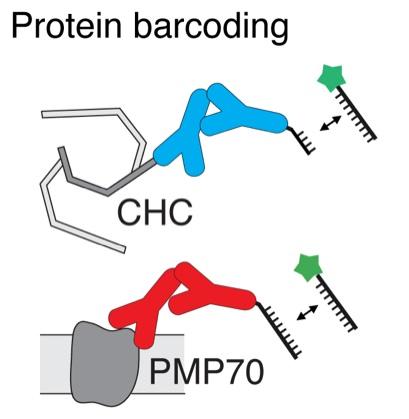
Recently, scientists have developed super-resolution microscopes that can image single molecules that are only a few nanometers in size. To discriminate a specific nucleic acid or protein, they typically add a fluorescent probe that binds to that molecule and emits a certain wavelength of light. However, because the emission wavelengths of different fluorescent probes can overlap, researchers can usually only detect three or four unique proteins or nucleic acids at a time, instead of the thousands that exist in cells. Ralf Jungmann and colleagues wondered if they could use fluorescent probes that blink with light at a variable duration and frequency to detect dozens of biomolecules at once. That way, they could use a single fluorophore to image many different molecules.

The researchers based their system on complementary sequences of DNA that come together to link a fluorophore with a target biomolecule and then fall apart again, generating a blinking fluorescent signal. By varying the length and number of DNA sequences bound to the target, the researchers could adjust how long the blink lasted, as well as how often blinks occurred. To test their approach in cells, the researchers imaged two different RNA molecules and two proteins. Then, they used three fluorescent probes to image 124 distinct DNA structures that contained different numbers of target DNAs so that they blinked at different frequencies. The procedure took only a few minutes and had an accuracy of 97.6 percent, the researchers say.

###

The authors acknowledge funding from the German Research Foundation, the European Research Council, the Allen Distinguished Investigator Program, the Max Planck Society, the Max Planck Foundation, the National Science Foundation, the National Institutes of Health, the Graduate School of Quantitative Biosciences Munich (QBM) and the International Max Planck Research School for Molecular Life Sciences (IMPRS-LS).

The paper’s abstract will be available on March 13 at 8 a.m. Eastern time here: http://pubs.acs.org/doi/abs/10.1021/acs.nanolett.9b00508

The American Chemical Society, the world’s largest scientific society, is a not-for-profit organization chartered by the U.S. Congress. ACS is a global leader in providing access to chemistry-related information and research through its multiple databases, peer-reviewed journals and scientific conferences. ACS does not conduct research, but publishes and publicizes peer-reviewed scientific studies. Its main offices are in Washington, D.C., and Columbus, Ohio.

To automatically receive news releases from the American Chemical Society, contact newsroom@acs.org.

Follow us: Twitter | Facebook

Media Contact
Katie Cottingham
k_cottingham@acs.org

Tags: BioinformaticsCell BiologyChemistry/Physics/Materials SciencesGenesNanotechnology/MicromachinesResearch/Development
Share12Tweet8Share2ShareShareShare2

Related Posts

GABA Treatment Associated With Modulated Drought Responses in Contrasting Flax Varieties

GABA Treatment Associated With Modulated Drought Responses in Contrasting Flax Varieties

November 18, 2026
Urban Biodiversity Plans Systematically Exclude Marginalized Populations and Genuine Decision-Making Power

Urban Biodiversity Plans Systematically Exclude Marginalized Populations and Genuine Decision-Making Power

November 18, 2026

Definitive Records Confirm Giant Ruby Snapper Range in Japan and Taiwan

November 18, 2026

Chemical Screening Detects Psilocybin in Seven Chinese Psilocybe Specimens Across Genera

November 18, 2026
Please login to join discussion

POPULAR NEWS

  • Electroacupuncture Mobilizes Unique CD34-Positive Stem-Like Cells in Healthy Dogs

    Electroacupuncture Mobilizes Unique CD34-Positive Stem-Like Cells in Healthy Dogs

    29 shares
    Share 12 Tweet 7
  • Specialists Outline Cervical Cancer Screening Principles for Resource-Limited Settings

    29 shares
    Share 12 Tweet 7
  • Modified Halpern Proximal Algorithm Solves Multi-Structured Problems in Curved Hadamard Spaces

    29 shares
    Share 12 Tweet 7
  • Machine Learning Outperforms Pharmacokinetic Models Predicting Initial Vancomycin Concentrations in Septic Patients

    29 shares
    Share 12 Tweet 7

About

We bring you the latest biotechnology news from best research centers and universities around the world. Check our website.

Follow us

Recent News

Surgeons Perform Hybrid Thoracoscopic and Endoscopic Enucleation for Rare Esophageal Foregut Cyst

Vine Tea Transcriptome Analysis Identifies Key Regulators of High Dihydromyricetin Biosynthesis

Carbapenem-Resistant Klebsiella Infections Surge 72 Percent Across Europe Since 2019

Subscribe to Blog via Email

Enter your email address to subscribe to this blog and receive notifications of new posts by email.

Join 88 other subscribers
  • Contact Us

Bioengineer.org © Copyright 2023 All Rights Reserved.

Welcome Back!

Login to your account below

Forgotten Password?

Retrieve your password

Please enter your username or email address to reset your password.

Log In
No Result
View All Result
  • Homepages
    • Home Page 1
    • Home Page 2
  • News
  • National
  • Business
  • Health
  • Lifestyle
  • Science

Bioengineer.org © Copyright 2023 All Rights Reserved.