• HOME
  • NEWS
  • EXPLORE
    • CAREER
      • Companies
      • Jobs
    • EVENTS
    • iGEM
      • News
      • Team
    • PHOTOS
    • VIDEO
    • WIKI
  • BLOG
  • COMMUNITY
    • FACEBOOK
    • INSTAGRAM
    • TWITTER
Thursday, March 26, 2026
BIOENGINEER.ORG
No Result
View All Result
  • Login
  • HOME
  • NEWS
  • EXPLORE
    • CAREER
      • Companies
      • Jobs
        • Lecturer
        • PhD Studentship
        • Postdoc
        • Research Assistant
    • EVENTS
    • iGEM
      • News
      • Team
    • PHOTOS
    • VIDEO
    • WIKI
  • BLOG
  • COMMUNITY
    • FACEBOOK
    • INSTAGRAM
    • TWITTER
  • HOME
  • NEWS
  • EXPLORE
    • CAREER
      • Companies
      • Jobs
        • Lecturer
        • PhD Studentship
        • Postdoc
        • Research Assistant
    • EVENTS
    • iGEM
      • News
      • Team
    • PHOTOS
    • VIDEO
    • WIKI
  • BLOG
  • COMMUNITY
    • FACEBOOK
    • INSTAGRAM
    • TWITTER
No Result
View All Result
Bioengineer.org
No Result
View All Result
Home NEWS Science News Health

Two for the price of one: Mechanistic insights lead to drug repositioning

Bioengineer by Bioengineer
March 7, 2019
in Health
Reading Time: 2 mins read
0
IMAGE
Share on FacebookShare on TwitterShare on LinkedinShare on RedditShare on Telegram

Researchers at University of Tsukuba clarify the molecular mechanisms involved in the early stage of lung cancer, and identify two drugs with other clinical uses that could also be applied effectively in this disease
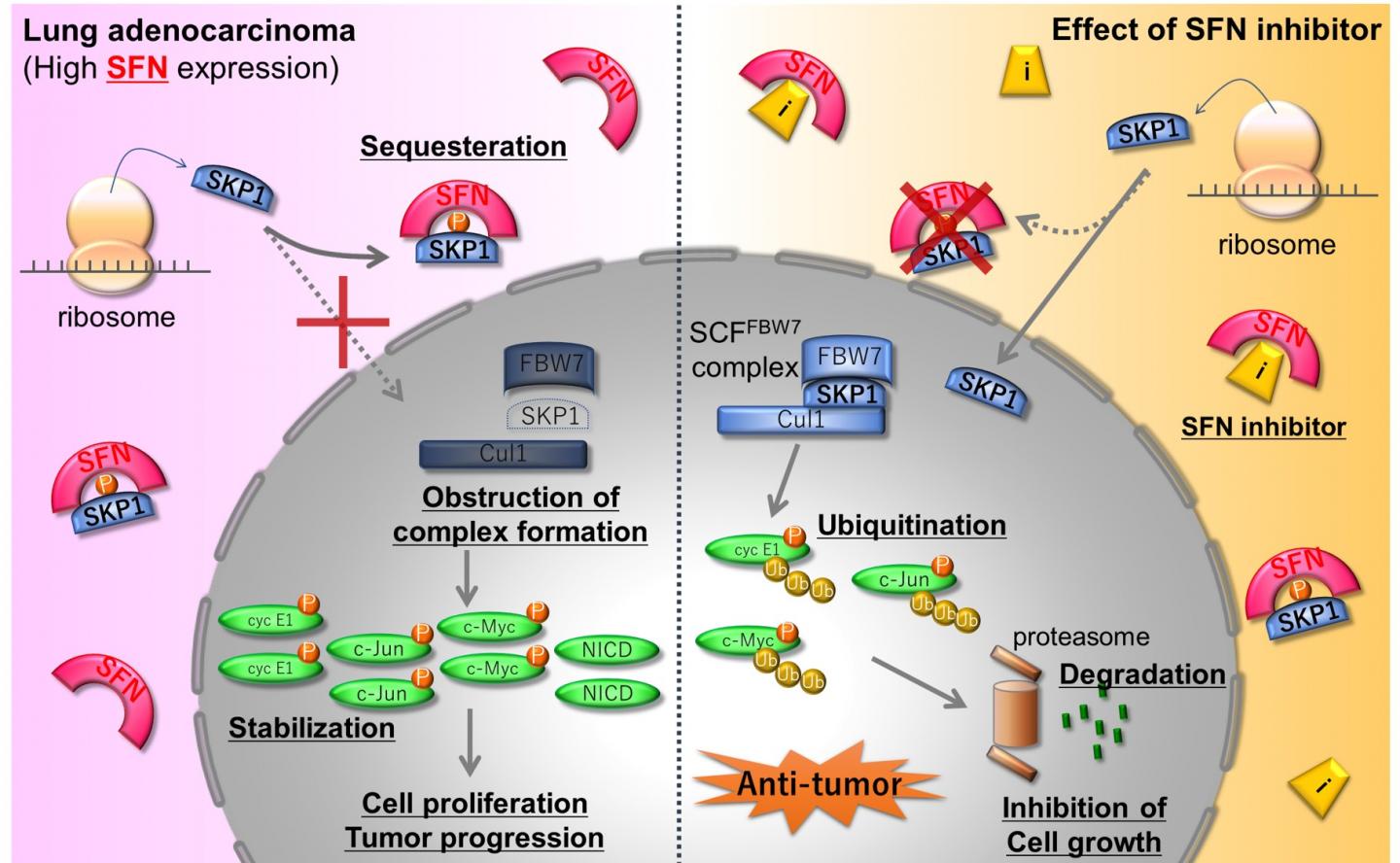
IMAGE

Credit: University of Tsukuba

Tsukuba, Japan – Lung adenocarcinoma is the most common type of lung cancer. Although various targeted drugs have been developed to treat it, they do not markedly improve the survival of patients. Part of the explanation for this impasse is a poor understanding of the molecular causes of this disease during the early stages.

A new study reported in the journal Clinical Cancer Research has raised hopes in this field by revealing how a cancer-promoting protein called stratifin causes lung adenocarcinoma to emerge. This finding by researchers at University of Tsukuba also enabled the identification of two drugs, currently used for treating other health conditions, which are promising for treating this type of lung cancer.

Building on previous work, the team analyzed how and when stratifin binds to SKP1. SKP1 is one component of a larger cellular complex that normally labels molecules in a process called ubiquitination, which condemns these labeled molecules to degradation. The researchers showed that a reversible modification of SKP1 promotes its binding to stratifin, rather than its typical inclusion within the ubiquitination-related complex.

“We used the overexpression of stratifin as well as its blocking by siRNA to clarify the effects on SKP1 in a lung adenocarcinoma cell line,” Masayuki Noguchi says. “The blocking of stratifin meant that SKP1 remained stable and could function in promoting the ubiquitination of errant proteins, some of which could be cancerous if not degraded by this process.”

Based on these findings, the team then undertook computer-based drug screening to find plausible candidates that could inhibit stratifin and prevent its binding to SKP1 and consequent disruption of ubiquitination. This screening of a database of drugs already in clinical use identified four promising candidates that were then narrowed down to two after testing their efficacy on lung cancer cells.

“We then performed additional testing of these two drugs on mice that had been injected with lung cancer cells,” lead author Aya Shiba-Ishii says. “We administered each of these drugs either the day after this injection or once tumor establishment had been confirmed. Our findings showed their success at blocking tumor formation or stopping or reversing the progression of tumors once they had formed.”

This novel approach of focusing on epigenetic changes early in adenocarcinogenesis raises hopes about more powerful tools to treat this condition. This work also shows the value of drug repositioning for lung cancer, given that such drugs have already passed through clinical trials and had their safety in humans confirmed.

###

Media Contact
Masataka Watanabe
[email protected]

Related Journal Article

http://dx.doi.org/10.1158/1078-0432.CCR-18-3631

Tags: BioinformaticsBiologycancerMolecular BiologyPharmaceutical SciencePulmonary/Respiratory Medicine
Share12Tweet8Share2ShareShareShare2

Related Posts

Aversive Learning Hijacks Brain Sugar Sensor

March 25, 2026

Can Psychosocial Factors Influence Cancer Risk?

March 23, 2026

Depression Factors in Elderly: Pre vs. Post-COVID Analysis

March 23, 2026

Hidden Health Crises Among US and UK Volunteers in Ukraine Uncovered in New Study

March 23, 2026
Please login to join discussion

POPULAR NEWS

  • blank

    Revolutionary AI Model Enhances Precision in Detecting Food Contamination

    96 shares
    Share 38 Tweet 24
  • Imagine a Social Media Feed That Challenges Your Views Instead of Reinforcing Them

    1003 shares
    Share 397 Tweet 248
  • Uncovering Functions of Cavernous Malformation Proteins in Organoids

    54 shares
    Share 22 Tweet 14
  • Promising Outcomes from First Clinical Trials of Gene Regulation in Epilepsy

    51 shares
    Share 20 Tweet 13

About

We bring you the latest biotechnology news from best research centers and universities around the world. Check our website.

Follow us

Recent News

In-Sensor Cryptography Links Physical Process to Digital Identity

Can Psychosocial Factors Influence Cancer Risk?

Depression Factors in Elderly: Pre vs. Post-COVID Analysis

Subscribe to Blog via Email

Success! An email was just sent to confirm your subscription. Please find the email now and click 'Confirm' to start subscribing.

Join 78 other subscribers
  • Contact Us

Bioengineer.org © Copyright 2023 All Rights Reserved.

Welcome Back!

Login to your account below

Forgotten Password?

Retrieve your password

Please enter your username or email address to reset your password.

Log In
No Result
View All Result
  • Homepages
    • Home Page 1
    • Home Page 2
  • News
  • National
  • Business
  • Health
  • Lifestyle
  • Science

Bioengineer.org © Copyright 2023 All Rights Reserved.