• HOME
  • NEWS
  • EXPLORE
    • CAREER
      • Companies
      • Jobs
    • EVENTS
    • iGEM
      • News
      • Team
    • PHOTOS
    • VIDEO
    • WIKI
  • BLOG
  • COMMUNITY
    • FACEBOOK
    • INSTAGRAM
    • TWITTER
Thursday, April 2, 2026
BIOENGINEER.ORG
No Result
View All Result
  • Login
  • HOME
  • NEWS
  • EXPLORE
    • CAREER
      • Companies
      • Jobs
        • Lecturer
        • PhD Studentship
        • Postdoc
        • Research Assistant
    • EVENTS
    • iGEM
      • News
      • Team
    • PHOTOS
    • VIDEO
    • WIKI
  • BLOG
  • COMMUNITY
    • FACEBOOK
    • INSTAGRAM
    • TWITTER
  • HOME
  • NEWS
  • EXPLORE
    • CAREER
      • Companies
      • Jobs
        • Lecturer
        • PhD Studentship
        • Postdoc
        • Research Assistant
    • EVENTS
    • iGEM
      • News
      • Team
    • PHOTOS
    • VIDEO
    • WIKI
  • BLOG
  • COMMUNITY
    • FACEBOOK
    • INSTAGRAM
    • TWITTER
No Result
View All Result
Bioengineer.org
No Result
View All Result
Home NEWS Science News

Rewritable material could help reduce paper waste

Bioengineer by Bioengineer
November 3, 2016
in Science News
Reading Time: 2 mins read
0
Share on FacebookShare on TwitterShare on LinkedinShare on RedditShare on Telegram
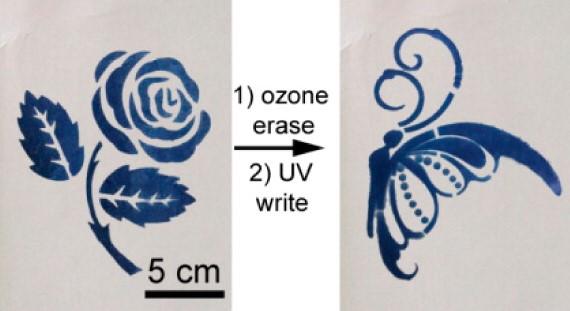
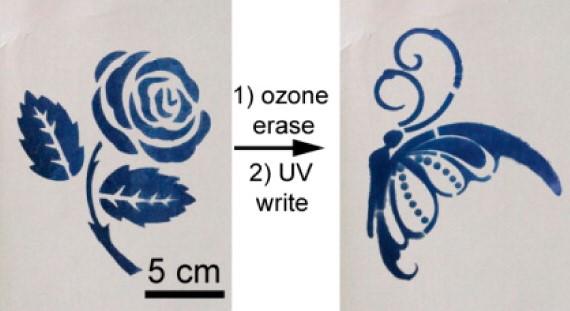
IMAGE

Credit: American Chemical Society

Even in today's digital age, the world still relies on paper and ink, most of which ends up in landfills or recycling centers. To reduce this waste, scientists have now developed a low-cost, environmentally friendly way to create printed materials with rewritable paper. Their report on the material, which is made out of tungsten oxide and a common polymer used in medicines and food, appears in the journal ACS Applied Materials & Interfaces.

The U.S. has been working to reduce paper waste by increasing recycling efforts for years. According to the Environmental Protection Agency, more paper is now recovered for recycling than almost all other materials combined. This saves energy, water, landfill space and greenhouse gas emissions. But even more waste could be avoided if consumers could reuse paper many times before recycling or trashing it. So far, however, such products under development often are made with toxic, expensive organic dyes. Ting Wang, Dairong Chen and colleagues wanted to come up with a better solution.

The researchers created a film by mixing low-toxicity tungsten oxide with polyvinyl pyrrolidone. To "print" on it, they exposed the material to ultraviolet light for 30 seconds or more, and it changed from white to a deep blue. To make pictures or words, a stencil can be used so that only the exposed parts turn blue. To erase them, the material can simply sit in ambient conditions for a day or two. To speed up the erasing, the researchers added heat to make the color disappear in 30 minutes. Alternatively, adding a small amount of polyacrylonitrile to the material can make designs last for up to 10 days. Testing showed the material could be printed on and erased 40 times before the quality started to decline.

###

The authors acknowledge funding from Shandong University and Shandong Province.

The abstract that accompanies this study is available here.

The American Chemical Society is a nonprofit organization chartered by the U.S. Congress. With nearly 157,000 members, ACS is the world's largest scientific society and a global leader in providing access to chemistry-related research through its multiple databases, peer-reviewed journals and scientific conferences. Its main offices are in Washington, D.C., and Columbus, Ohio.

To automatically receive news releases from the American Chemical Society, contact [email protected].

Follow us: Twitter Facebook

Media Contact

Michael Bernstein
[email protected]
202-872-6042
@ACSpressroom

http://www.acs.org

Share12Tweet8Share2ShareShareShare2

Related Posts

Suicide Myths and Preparedness in Swedish Care Staff

April 2, 2026

Hydrogel with AAV8-sTβRII Reduces Skin Scars

April 2, 2026

Interpretable AI Boosts Cardiovascular Disease Diagnosis

April 2, 2026

Global Consensus on Active Surveillance for Low-Grade NMIBC

April 2, 2026
Please login to join discussion

POPULAR NEWS

  • blank

    Revolutionary AI Model Enhances Precision in Detecting Food Contamination

    96 shares
    Share 38 Tweet 24
  • Imagine a Social Media Feed That Challenges Your Views Instead of Reinforcing Them

    1007 shares
    Share 398 Tweet 249
  • Promising Outcomes from First Clinical Trials of Gene Regulation in Epilepsy

    51 shares
    Share 20 Tweet 13
  • Popular Anti-Aging Compound Linked to Damage in Corpus Callosum, Study Finds

    44 shares
    Share 18 Tweet 11

About

We bring you the latest biotechnology news from best research centers and universities around the world. Check our website.

Follow us

Recent News

Suicide Myths and Preparedness in Swedish Care Staff

Hydrogel with AAV8-sTβRII Reduces Skin Scars

Interpretable AI Boosts Cardiovascular Disease Diagnosis

Subscribe to Blog via Email

Enter your email address to subscribe to this blog and receive notifications of new posts by email.

Join 78 other subscribers
  • Contact Us

Bioengineer.org © Copyright 2023 All Rights Reserved.

Welcome Back!

Login to your account below

Forgotten Password?

Retrieve your password

Please enter your username or email address to reset your password.

Log In
No Result
View All Result
  • Homepages
    • Home Page 1
    • Home Page 2
  • News
  • National
  • Business
  • Health
  • Lifestyle
  • Science

Bioengineer.org © Copyright 2023 All Rights Reserved.