• HOME
  • NEWS
  • EXPLORE
    • CAREER
      • Companies
      • Jobs
    • EVENTS
    • iGEM
      • News
      • Team
    • PHOTOS
    • VIDEO
    • WIKI
  • BLOG
  • COMMUNITY
    • FACEBOOK
    • INSTAGRAM
    • TWITTER
Saturday, February 7, 2026
BIOENGINEER.ORG
No Result
View All Result
  • Login
  • HOME
  • NEWS
  • EXPLORE
    • CAREER
      • Companies
      • Jobs
        • Lecturer
        • PhD Studentship
        • Postdoc
        • Research Assistant
    • EVENTS
    • iGEM
      • News
      • Team
    • PHOTOS
    • VIDEO
    • WIKI
  • BLOG
  • COMMUNITY
    • FACEBOOK
    • INSTAGRAM
    • TWITTER
  • HOME
  • NEWS
  • EXPLORE
    • CAREER
      • Companies
      • Jobs
        • Lecturer
        • PhD Studentship
        • Postdoc
        • Research Assistant
    • EVENTS
    • iGEM
      • News
      • Team
    • PHOTOS
    • VIDEO
    • WIKI
  • BLOG
  • COMMUNITY
    • FACEBOOK
    • INSTAGRAM
    • TWITTER
No Result
View All Result
Bioengineer.org
No Result
View All Result
Home NEWS Science News Biology

Researchers determine how nerve fibers enter spinal cord during early development

Bioengineer by Bioengineer
February 27, 2019
in Biology
Reading Time: 2 mins read
0
IMAGE
Share on FacebookShare on TwitterShare on LinkedinShare on RedditShare on Telegram

IMAGE

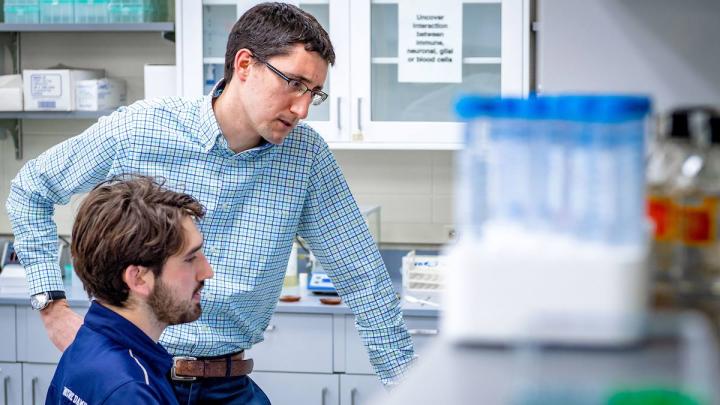
Credit: Photo by Matt Cashore/University of Notre Dame.

New research into the way nerve fibers enter the wall of the spinal cord during early development in zebrafish could lead to regenerative therapies for people with injuries to their brachial plexus, a group of nerves that starts at the spinal cord and goes into the arm.

In the study, published in Nature Communications, researchers at the University of Notre Dame determined a widely dismissed hypothesis developed in the early 20th century is actually correct, and serves as the first step in a two-pronged approach by which the fibers, called axons, enter the spinal cord.

“It turns out that axons enter the spinal cord for many days during development,” said Cody J. Smith, the Elizabeth and Michael Gallagher Assistant Professor of Biological Sciences at Notre Dame and at the University’s Center for Stem Cells and Regenerative Medicine. Smith is co-author of the study with Evan Nichols, also at Notre Dame, who is currently studying neuroscience and behavior.

Those nerve fibers send messages to other cells. Axons in the hand and fingertips, for example, help the brain determine what is hot or cold to the touch. When those nerves are stretched, compressed or torn, such as in the case of a brachial plexus injury, it could cause permanent damage and loss of function.

Smith and Nichols used zebrafish larvae to evaluate two hypotheses, one posed by Santiago Ramon y Cajal, a pioneer in modern cellular neuroscience, in the 20th century. Cajal suggested axons used a “battering ram” approach during early development, breaking a hole in the spinal cord wall. The hypothesis turned out to be correct. The results were surprising because Cajal didn’t have access to today’s microscopes, which can show in real time how the fiber enters the wall.

The battering ram approach, however, is just the first step. For several years, scientists have thought boundary cap cells, located within the boundary of the central and peripheral nervous system, were the driving force behind moving axons into the spinal cord.

During the study, Smith’s group found axons break into the spinal cord using Cajal’s battering ram approach, and boundary cap cells serve as a bridge for other axons to travel into the wall.

Knowing this could be important when designing strategies to repair brachial plexus injuries.

“We went into this research interested in the basic science,” Smith said. “How do these axons enter the wall of the spinal cord? But this is a lesson for the general public. Sometimes basic science can lead to discoveries that are completely unexpected, but have a potential and exciting benefit.”

###

The Alfred P. Sloan Foundation Fellowship of Neuroscience funded the study.

Media Contact
Jessica Sieff
[email protected]

Original Source

https://news.nd.edu/news/researchers-determine-how-nerve-fibers-enter-spinal-cord-during-early-development/

Tags: Biology
Share12Tweet8Share2ShareShareShare2

Related Posts

Florida Cane Toad: Complex Spread and Selective Evolution

Florida Cane Toad: Complex Spread and Selective Evolution

February 7, 2026
New Study Uncovers Mechanism Behind Burn Pit Particulate Matter–Induced Lung Inflammation

New Study Uncovers Mechanism Behind Burn Pit Particulate Matter–Induced Lung Inflammation

February 6, 2026

DeepBlastoid: Advancing Automated and Efficient Evaluation of Human Blastoids with Deep Learning

February 6, 2026

Navigating the Gut: The Role of Formic Acid in the Microbiome

February 6, 2026
Please login to join discussion

POPULAR NEWS

  • Robotic Ureteral Reconstruction: A Novel Approach

    Robotic Ureteral Reconstruction: A Novel Approach

    82 shares
    Share 33 Tweet 21
  • Digital Privacy: Health Data Control in Incarceration

    63 shares
    Share 25 Tweet 16
  • Study Reveals Lipid Accumulation in ME/CFS Cells

    57 shares
    Share 23 Tweet 14
  • Breakthrough in RNA Research Accelerates Medical Innovations Timeline

    53 shares
    Share 21 Tweet 13

About

We bring you the latest biotechnology news from best research centers and universities around the world. Check our website.

Follow us

Recent News

Phage-Antibiotic Combo Beats Resistant Peritoneal Infection

Boosting Remote Healthcare: Stepped-Wedge Trial Insights

Barriers and Boosters of Seniors’ Physical Activity in Karachi

Subscribe to Blog via Email

Enter your email address to subscribe to this blog and receive notifications of new posts by email.

Join 73 other subscribers
  • Contact Us

Bioengineer.org © Copyright 2023 All Rights Reserved.

Welcome Back!

Login to your account below

Forgotten Password?

Retrieve your password

Please enter your username or email address to reset your password.

Log In
No Result
View All Result
  • Homepages
    • Home Page 1
    • Home Page 2
  • News
  • National
  • Business
  • Health
  • Lifestyle
  • Science

Bioengineer.org © Copyright 2023 All Rights Reserved.