• HOME
  • NEWS
  • EXPLORE
    • CAREER
      • Companies
      • Jobs
    • EVENTS
    • iGEM
      • News
      • Team
    • PHOTOS
    • VIDEO
    • WIKI
  • BLOG
  • COMMUNITY
    • FACEBOOK
    • INSTAGRAM
    • TWITTER
Saturday, March 28, 2026
BIOENGINEER.ORG
No Result
View All Result
  • Login
  • HOME
  • NEWS
  • EXPLORE
    • CAREER
      • Companies
      • Jobs
        • Lecturer
        • PhD Studentship
        • Postdoc
        • Research Assistant
    • EVENTS
    • iGEM
      • News
      • Team
    • PHOTOS
    • VIDEO
    • WIKI
  • BLOG
  • COMMUNITY
    • FACEBOOK
    • INSTAGRAM
    • TWITTER
  • HOME
  • NEWS
  • EXPLORE
    • CAREER
      • Companies
      • Jobs
        • Lecturer
        • PhD Studentship
        • Postdoc
        • Research Assistant
    • EVENTS
    • iGEM
      • News
      • Team
    • PHOTOS
    • VIDEO
    • WIKI
  • BLOG
  • COMMUNITY
    • FACEBOOK
    • INSTAGRAM
    • TWITTER
No Result
View All Result
Bioengineer.org
No Result
View All Result
Home NEWS Science News Biology

Linking sensing to signaling during plant immunity

Bioengineer by Bioengineer
February 15, 2019
in Biology
Reading Time: 2 mins read
0
IMAGE
Share on FacebookShare on TwitterShare on LinkedinShare on RedditShare on Telegram

IMAGE

Credit: Deepak Bhandari & Dmitry Lapin


Plant defense against invading pathogens relies upon effective recognition of non-self organisms and a subsequent signaling response characterized by reprogramming of host gene expression and localized cell death to combat infection and provide resistance. At a molecular level, plant responses are initiated by the recognition of so-called effectors by intracellular receptors in a process known as effector-triggered immunity (ETI). While the importance of the recognition itself and the transcriptional reprogramming are well accepted, less is known about how the two are linked, i.e., how recognition is translated into resistance?

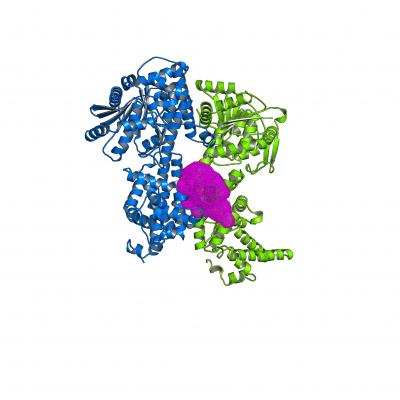
Jane Parker and her group at the MPIPZ study a protein called enhanced disease susceptibility 1 (EDS1), a key player in the plant’s immune arsenal. By promoting reprogramming of gene expression, cell death and resistance upon effector recognition, EDS1 acts as a link between the recognition and signaling modules of plant immunity. It carries out this function, at least in part, by partnering up with two other proteins, phytoalexin deficient 4 (PAD4) and senescence-associated gene 101 (SAG101) and by promoting accumulation of the defense hormone salicylic acid (SA) as well as blocking the detrimental actions of a bacterial virulence molecule. In work just published in the journal Nature Communications, Deepak Bhandari, Parker, and her group have identified a key surface in the EDS1 protein that enables it to carry out its functions in plant immunity.

To better characterize the role of EDS1 in immune signaling, the authors focused on a previously uncharacterized portion of the EDS1 protein at the surface of a cavity formed between EDS1 and its partners. When the authors switched one of the positively charged amino acids lining this cavity to a neutral one, they found that plants were as susceptible to infection as those lacking EDS1 completely. These plants failed to accumulate SA in a timely manner, and transcriptional reprogramming was also sluggish. EDS1 still provided some resistance in experiments where both the effects of SA and transcriptional reprogramming were abrogated, indicating that EDS1, and specifically the positively charged cavity, promotes an as yet uncharacterized third branch of ETI.

In protein-protein interaction experiments, the authors observed that the mutant EDS1 could still bind its partner PAD4 but was defective even if expressed at high levels in plant cells. What then is the importance of the positive charge if it is not crucial for EDS1 to bind its partners? “Most likely the positive charge in the cavity is important for the binding of EDS1 and its partners to yet other molecules”, says Jane Parker. In the future, the authors plan to discover the identity of these molecules and to better characterize the newly uncovered third branch of EDS1 immune signaling.

###

Media Contact
Prof. Jane E. Parker
[email protected]

Related Journal Article

http://dx.doi.org/10.1038/s41467-019-08783-0

Tags: BiologyPlant Sciences
Share12Tweet8Share2ShareShareShare2

Related Posts

How to sway group opinions: Encourage opponents to stay undecided

How to sway group opinions: Encourage opponents to stay undecided

March 23, 2026
Deep Learning Model Maps How Individual Cells Shape Disease Outcomes

Deep Learning Model Maps How Individual Cells Shape Disease Outcomes

March 20, 2026

Removing only 15 female sharks annually could endanger the entire population, scientists warn

March 20, 2026

Scientists Urge Fragrance Industry to Transition from Sustainability Talk to Active Funding of Plant Conservation

March 20, 2026
Please login to join discussion

POPULAR NEWS

  • blank

    Revolutionary AI Model Enhances Precision in Detecting Food Contamination

    96 shares
    Share 38 Tweet 24
  • Imagine a Social Media Feed That Challenges Your Views Instead of Reinforcing Them

    1004 shares
    Share 397 Tweet 248
  • Uncovering Functions of Cavernous Malformation Proteins in Organoids

    54 shares
    Share 22 Tweet 14
  • Promising Outcomes from First Clinical Trials of Gene Regulation in Epilepsy

    51 shares
    Share 20 Tweet 13

About

We bring you the latest biotechnology news from best research centers and universities around the world. Check our website.

Follow us

Recent News

In-Sensor Cryptography Links Physical Process to Digital Identity

Can Psychosocial Factors Influence Cancer Risk?

Depression Factors in Elderly: Pre vs. Post-COVID Analysis

Subscribe to Blog via Email

Enter your email address to subscribe to this blog and receive notifications of new posts by email.

Join 78 other subscribers
  • Contact Us

Bioengineer.org © Copyright 2023 All Rights Reserved.

Welcome Back!

Login to your account below

Forgotten Password?

Retrieve your password

Please enter your username or email address to reset your password.

Log In
No Result
View All Result
  • Homepages
    • Home Page 1
    • Home Page 2
  • News
  • National
  • Business
  • Health
  • Lifestyle
  • Science

Bioengineer.org © Copyright 2023 All Rights Reserved.