Credit: Photo: Working groups Becker and Pfanner
The research labs of the associate professor Dr. Thomas Becker and Prof. Dr. Nikolaus Pfanner from the Institute for Biochemistry and Molecular Biology at the University of Freiburg discovered a function of the metabolite channel of the mitochondrial outer membrane in protein transport. The researchers published their findings in Molecular Cell.
Mitochondria play a fundamental role for the metabolism of the cell. They produce the main energy for cellular functions and are therefore known as powerhouse of the cell. Defects in mitochondrial metabolism cause a number of severe diseases of the heart muscle or nerve systems. Mitochondrial function depends on the exchange of metabolites with the surrounding cell. Therefore, metabolites have to be transported across the two surrounding membranes. The voltage-dependent anion channel porin/VDAC allows transfer of metabolites across the outer membrane. The inner membrane is equipped with specific transporters, the carrier proteins, which transport metabolites across the inner membrane.
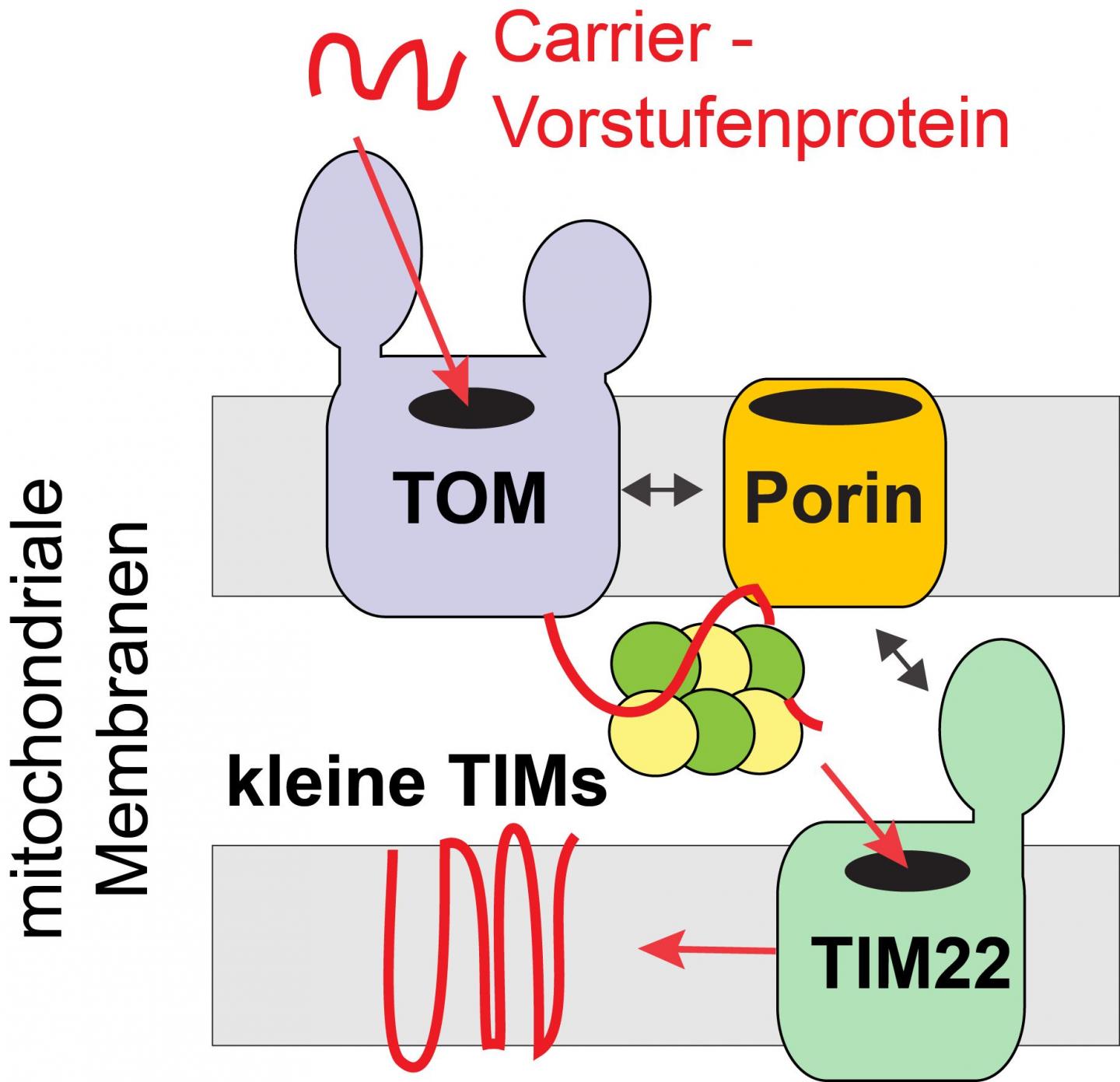
Mitochondria further depend on the import of about 1.000 different proteins from the cytosol. The translocase of the outer membrane, also termed TOM complex, forms the entry gate for the precursor proteins. The import of carrier proteins is particularly important for mitochondrial metabolism. Carrier precursors pass the outer membrane via the TOM channel. Subsequently, helper proteins, the small TIM proteins, guide the precursors to the inner membrane. The carrier translocase, the TIM22 complex, integrates the precursors into the inner membrane. How the single transport steps of the carrier import pathway are connected to each other, was not known.
Researchers from the collaborative research center “Functional Specificity by Coupling and Modification of Proteins”, the research training group “Transport Across and Into Membranes”, and the cluster of excellence CIBBS Center for Integrative Biological Signalling at the University of Freiburg discovered an unexpected function of the metabolite channel porin/VDAC in protein import into mitochondria. Dr. Lars Ellerieder from Thomas Becker`s research lab showed that porin/VDAC stimulates the import of carrier proteins into the inner membrane. The function of porin/VDAC in protein transport occurs independently of its channel activity. Instead, porin/VDAC acts as coupling factor. The proteins binds to carrier precursors in the intermembrane space, to the TOM complex and the carrier translocase. Thus, porin/VDAC spatially links the single transport steps and thereby stimulate import of carrier proteins.
The researchers demonstrate that mitochondrial metabolite and protein transport are connected: “The role of porin/VDAC in protein transport could represent an elegant mechanism to fine-tune import of carrier proteins and therefore eventually metabolite transport to meet the requirements of the cell”, explains Becker.
###
Original publikation:
Ellenrieder, L., Dieterle, M.P., Doan, K.N., Mårtensson, C.U., Floerchinger, A., Campo, M.L., Pfanner, N., and Becker, T. (2019): Dual role of mitochondrial porin in metabolite transport across the outer membrane and protein transfer to inner membrane. In: Molecular Cell.
Media Contact
Dr. Thomas Becker
[email protected]
49-761-203-5243
Related Journal Article
http://dx.