• HOME
  • NEWS
  • EXPLORE
    • CAREER
      • Companies
      • Jobs
    • EVENTS
    • iGEM
      • News
      • Team
    • PHOTOS
    • VIDEO
    • WIKI
  • BLOG
  • COMMUNITY
    • FACEBOOK
    • INSTAGRAM
    • TWITTER
Saturday, February 7, 2026
BIOENGINEER.ORG
No Result
View All Result
  • Login
  • HOME
  • NEWS
  • EXPLORE
    • CAREER
      • Companies
      • Jobs
        • Lecturer
        • PhD Studentship
        • Postdoc
        • Research Assistant
    • EVENTS
    • iGEM
      • News
      • Team
    • PHOTOS
    • VIDEO
    • WIKI
  • BLOG
  • COMMUNITY
    • FACEBOOK
    • INSTAGRAM
    • TWITTER
  • HOME
  • NEWS
  • EXPLORE
    • CAREER
      • Companies
      • Jobs
        • Lecturer
        • PhD Studentship
        • Postdoc
        • Research Assistant
    • EVENTS
    • iGEM
      • News
      • Team
    • PHOTOS
    • VIDEO
    • WIKI
  • BLOG
  • COMMUNITY
    • FACEBOOK
    • INSTAGRAM
    • TWITTER
No Result
View All Result
Bioengineer.org
No Result
View All Result
Home NEWS Science News Biology

Improved plastics recycling thanks to spectral imaging

Bioengineer by Bioengineer
January 22, 2019
in Biology
Reading Time: 2 mins read
0
IMAGE
Share on FacebookShare on TwitterShare on LinkedinShare on RedditShare on Telegram

IMAGE

Credit: D. Caballero, M. Bevilacqua and J.M. Amigo


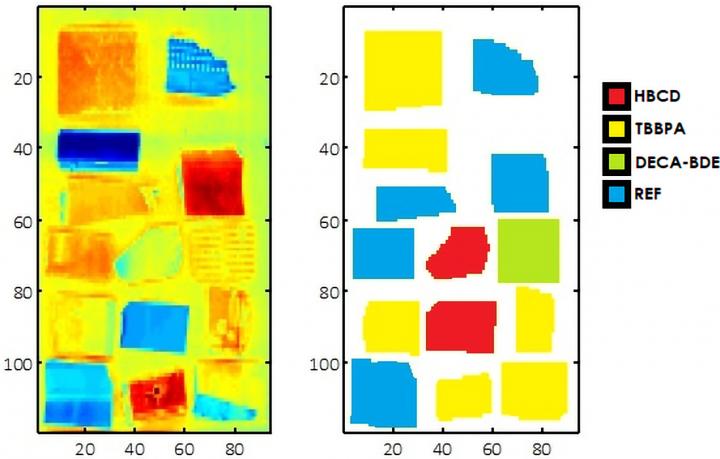
If we are ever to reduce the quantity of plastics being dumped into the environment, efficient recycling is essential. Currently, many plastics cannot be economically sorted to enable their recycling. For example, many plastics contain flame retardants to increase their resistance to ignition, reduce flames spreading, minimise smoke formation and to prevent the plastic from dripping. The amount of flame retardant added to plastics and the type used can vary considerably, due to the need to tailor the plastic to its particular application and to meet safety standards. However, only plastics of the same type and with similar flame retardants can be recycled together. Therefore, before recycling can occur, plastics need to be sorted, not only by the type of plastic (acrylonitrile butadiene styrene and polystyrene in this study) but also by any flame retardant added. Without sorting, recycling cannot take place.

In a paper published in JSI–Journal of Spectral Imaging, an Open Access, peer-review journal published by IM Publications Open, José Amigo and co-authors detail a method using near infrared hyperspectral imaging and chemometrics that can sort between different types of plastic and between different additions of flame retardant.

Hyperspectral imaging collects an image of an area and, at the same time, a spectrum for each individual pixel of that image. Chemometrics is a data analysis technique that can discover hidden patterns within data (in this case spectral data) and help build a model to identify parts of the image by their chemical composition. Using an imaging technique for this recycling application is important, since it can identify individual pieces of plastic and any flame retardant they may contain from among many others, for example, on a conveyor belt in a recycling plant.

José Amigo commented “Recycling plastics has been studied for many years. Indeed, some commercial cameras separating a limited number of plastic types have been available for some time. However, in this research, we wanted to go a step further to separate plastics containing flame retardants. Moreover, the proposed methodology was tested with real samples that can be found in current recycling lines.”

###

Media Contact
José Amigo

[email protected]

Original Source

https://www.impopen.com/pr/improved-plastics-recycling-thanks-spectral-imaging

Related Journal Article

http://dx.doi.org/10.1255/jsi.2019.a1

Tags: Chemistry/Physics/Materials SciencesPollution/Remediation
Share12Tweet8Share2ShareShareShare2

Related Posts

Florida Cane Toad: Complex Spread and Selective Evolution

Florida Cane Toad: Complex Spread and Selective Evolution

February 7, 2026
New Study Uncovers Mechanism Behind Burn Pit Particulate Matter–Induced Lung Inflammation

New Study Uncovers Mechanism Behind Burn Pit Particulate Matter–Induced Lung Inflammation

February 6, 2026

DeepBlastoid: Advancing Automated and Efficient Evaluation of Human Blastoids with Deep Learning

February 6, 2026

Navigating the Gut: The Role of Formic Acid in the Microbiome

February 6, 2026
Please login to join discussion

POPULAR NEWS

  • Robotic Ureteral Reconstruction: A Novel Approach

    Robotic Ureteral Reconstruction: A Novel Approach

    82 shares
    Share 33 Tweet 21
  • Digital Privacy: Health Data Control in Incarceration

    63 shares
    Share 25 Tweet 16
  • Study Reveals Lipid Accumulation in ME/CFS Cells

    57 shares
    Share 23 Tweet 14
  • Breakthrough in RNA Research Accelerates Medical Innovations Timeline

    53 shares
    Share 21 Tweet 13

About

We bring you the latest biotechnology news from best research centers and universities around the world. Check our website.

Follow us

Recent News

Evaluating Pediatric Emergency Care Quality in Ethiopia

TPMT Expression Predictions Linked to Azathioprine Side Effects

Improving Dementia Care with Enhanced Activity Kits

Subscribe to Blog via Email

Enter your email address to subscribe to this blog and receive notifications of new posts by email.

Join 73 other subscribers
  • Contact Us

Bioengineer.org © Copyright 2023 All Rights Reserved.

Welcome Back!

Login to your account below

Forgotten Password?

Retrieve your password

Please enter your username or email address to reset your password.

Log In
No Result
View All Result
  • Homepages
    • Home Page 1
    • Home Page 2
  • News
  • National
  • Business
  • Health
  • Lifestyle
  • Science

Bioengineer.org © Copyright 2023 All Rights Reserved.