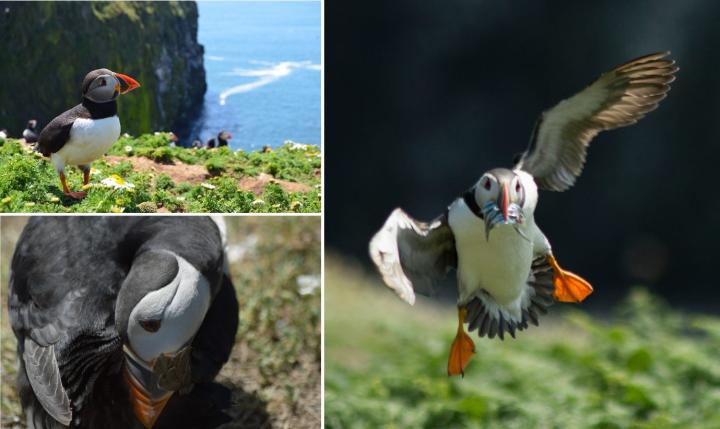
Credit: Photographs were taken by Sergio Martínez-Nebreda and Paula Medina-García in Skomer Island over the summer months of 2017 and 2018.
A study, led by the University of Bristol, has shed some new light on how the beaks of birds have adapted over time.
The observation that Galapagos finch species possessed different beak shapes to obtain different foods was central to the theory of evolution by natural selection, and it has been assumed that this form-function relationship holds true across all species of bird.
However, a new study published in the journal Evolution suggests the beaks of birds are not as adapted to the food types they feed on as it is generally believed.
An international team of scientists from the United Kingdom, Spain and the US used computational and mathematical techniques to better understand the connection between beak shapes and functions in living birds.
By measuring beak shape in a wide range of modern bird species from museum collections and looking at information about how the beak is used by different species to eat different foods, the team were able to assess the link between beak shape and feeding behaviour.
Professor Emily Rayfield, from the University of Bristol’s School of Earth Sciences, and senior author of the study, said: “This is, to our knowledge, the first approach to test a long-standing principle in biology: that the beak shape and function of birds is tightly linked to their feeding ecologies.”
Guillermo Navalón, lead author of the study and a final year PhD student at Bristol’s School of Earth Sciences, added: “The connection between beak shapes and feeding ecology in birds was much weaker and more complex than we expected and that while there is definitely a relationship there, many species with similarly shaped beaks forage in entirely different ways and on entirely different kinds of food.
“This is something that has been shown in other animal groups, but in birds this relationship was always assumed to be stronger.”
Co-author, Dr Jesús Marugán-Lobón from Universidad Autónoma de Madrid, said: “These results only made sense when you realise birds use the beak for literally everything!
“Therefore, also makes sense they evolved a versatile tool not just for getting food, but also to accomplish many other tasks.”
The study is part of a larger research effort by the team in collaboration with researchers from other universities across Europe and the US to better understand the main drivers of the evolution of the skull in birds.
Dr Jen Bright, co-author from the University of South Florida, said: “We have seen similar results before in birds of prey, but this is the first time we studied the link between beak shape and ecology across all bird groups.
“We looked at a huge range of beak shapes and feeding ecologies: hummingbirds, eagles, parrots, puffins, flamingos, pretty much every beak you can think of.”
Guillermo Navalón added: “These results have important implications for the study of fossil birds.
“We have to be careful about inferring ecology in ancient birds, which we often assume based solely on the shape of the beak.
“Really, we’re just starting to scratch the surface, and a lot more research is needed to fully understand the drivers behind beak shape evolution.”
###
This research was funded by The Alumni Foundation, University of Bristol; the Spanish MINECO and the RCUK BBSRC funding.
Media Contact
Guillermo Navalón
[email protected]
Related Journal Article
http://dx.