• HOME
  • NEWS
  • EXPLORE
    • CAREER
      • Companies
      • Jobs
    • EVENTS
    • iGEM
      • News
      • Team
    • PHOTOS
    • VIDEO
    • WIKI
  • BLOG
  • COMMUNITY
    • FACEBOOK
    • INSTAGRAM
    • TWITTER
Thursday, June 25, 2026
BIOENGINEER.ORG
No Result
View All Result
  • Login
  • HOME
  • NEWS
  • EXPLORE
    • CAREER
      • Companies
      • Jobs
        • Lecturer
        • PhD Studentship
        • Postdoc
        • Research Assistant
    • EVENTS
    • iGEM
      • News
      • Team
    • PHOTOS
    • VIDEO
    • WIKI
  • BLOG
  • COMMUNITY
    • FACEBOOK
    • INSTAGRAM
    • TWITTER
  • HOME
  • NEWS
  • EXPLORE
    • CAREER
      • Companies
      • Jobs
        • Lecturer
        • PhD Studentship
        • Postdoc
        • Research Assistant
    • EVENTS
    • iGEM
      • News
      • Team
    • PHOTOS
    • VIDEO
    • WIKI
  • BLOG
  • COMMUNITY
    • FACEBOOK
    • INSTAGRAM
    • TWITTER
No Result
View All Result
Bioengineer.org
No Result
View All Result
Home NEWS Science News Health

Researchers diversify drug development options with new metal catalyst

Bioengineer by Bioengineer
January 9, 2019
in Health
Reading Time: 2 mins read
0
IMAGE
Share on FacebookShare on TwitterShare on LinkedinShare on RedditShare on Telegram

IMAGE

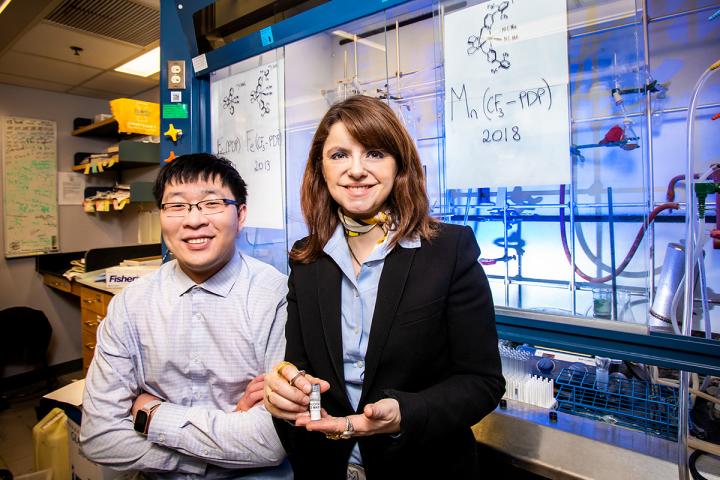
Credit: Photo by Fred Zwicky

CHAMPAIGN, Ill. — A University of Illinois team of researchers led by chemistry professor M. Christina White has developed a new manganese-based catalyst that can change the structure of druglike molecules to make new drugs, advancing the pace and efficiency of drug development.

Their findings appear in the journal Nature Chemistry.

Many pharmaceuticals contain aliphatic and aromatic carbon-hydrogen scaffolds to which chemists introduce oxygen atoms in precise locations to dictate the behavior of the drug. Aliphatic molecules have carbon-hydrogen bonds that are strong, ubiquitous and difficult to manipulate without affecting other, more reactive parts of the molecule. For example, aromatics have a type of bond that is often more reactive than aliphatic carbon-hydrogen bonds.

“Nature tells us in examples of drugs such as erythromycin and Taxol that by swapping out specific hydrogen atoms with oxygen atoms at strategic locations, chemists can control the function of a drug,” White said. “However, carbon-hydrogen bonds in aliphatic structures are some of the strongest in nature, and our previously developed methods to convert them to carbon-oxygen bonds – a process called oxidation – tend not to tolerate aromatics, which also are very prevalent in drugs.”

“We have developed a synthetic manganese catalyst that can oxidize aliphatic scaffolds in the presence of aromatics that serve as frameworks for most drugs,” White said. White often refers to what her group does as “molecular surgery.” Think of this manganese catalyst as analogous to a saw that can cut the skull without touching the brain, she said.

“Our new catalyst does the work of a complex enzyme, but is a simple substance that uses basic principles and can be stored in a refrigerator,” she said. “It will allow drug developers to replace a hydrogen atom with an oxygen atom without having to make a new drug from scratch.”

The team has used the new manganese catalyst to successfully demonstrate oxidation in 50 molecules, four of which are drug scaffolds, with the potential to rapidly produce derivatives having different biological activities or metabolites. This is important because metabolites – the byproducts of metabolizing a drug – sometimes cause side effects or are more active than the original drug, White said.

“Moving forward, we believe this catalyst may enable chemists to expedite the drug discovery process by producing new drugs from old ones and identifying metabolites without having to do new syntheses,” she said.

###

The National Institutes of Health, Uehara Memorial Foundation and the Conselho Nacional de Desenvolvimento Cientifico e Tecnologico supported this research.

Editor’s notes:
To reach M. Christina White, call 217-333-6173; [email protected].
The paper “Chemoselective methylene oxidation in aromatic
molecules” is available online and from the U. of I. News Bureau.
DOI: 10.1038/s41557-018-0175-8.

Media Contact
Lois Yoksoulian
[email protected]
217-244-2788

Original Source

https://news.illinois.edu/view/6367/737770

Related Journal Article

http://dx.doi.org/10.1038/s41557-018-0175-8

Tags: Chemistry/Physics/Materials SciencesPharmaceutical ChemistryPharmaceutical Sciences
Share12Tweet8Share2ShareShareShare2

Related Posts

Tracking Lanthanide-Labeled Microplastics in Plants

June 25, 2026

Neural Design Enables Zero-Shot Drug-Binding Proteins

June 25, 2026

Genomic Insights into Human Skin Fungi Diversity

June 25, 2026

Chiral Laser Gyroscopes Surpass Lock-In Limit

June 25, 2026
Please login to join discussion

POPULAR NEWS

  • Saying Goodbye to PGY-6: Pediatric Fellowship Realities

    103 shares
    Share 41 Tweet 26
  • Multi-Hospital Study Reveals Long Covid Burden Is Twice as High as Current Estimates

    92 shares
    Share 36 Tweet 23
  • Detection of EDCs in Breast Milk and Infant Urine Up to Six Months Highlights Early Exposure Risks

    77 shares
    Share 31 Tweet 19
  • New Drug Candidate Developed at McMaster Shows Potential for Treating Brain Cancer

    58 shares
    Share 23 Tweet 15

About

We bring you the latest biotechnology news from best research centers and universities around the world. Check our website.

Follow us

Recent News

Tracking Lanthanide-Labeled Microplastics in Plants

POSTECH Researchers Slash Cost of Reconstituted Cell-Free Systems by 95%

AI and Physics Collaborate to Design Advanced Hydrogen Storage Materials

Subscribe to Blog via Email

Success! An email was just sent to confirm your subscription. Please find the email now and click 'Confirm' to start subscribing.

Join 82 other subscribers
  • Contact Us

Bioengineer.org © Copyright 2023 All Rights Reserved.

Welcome Back!

Login to your account below

Forgotten Password?

Retrieve your password

Please enter your username or email address to reset your password.

Log In
No Result
View All Result
  • Homepages
    • Home Page 1
    • Home Page 2
  • News
  • National
  • Business
  • Health
  • Lifestyle
  • Science

Bioengineer.org © Copyright 2023 All Rights Reserved.