


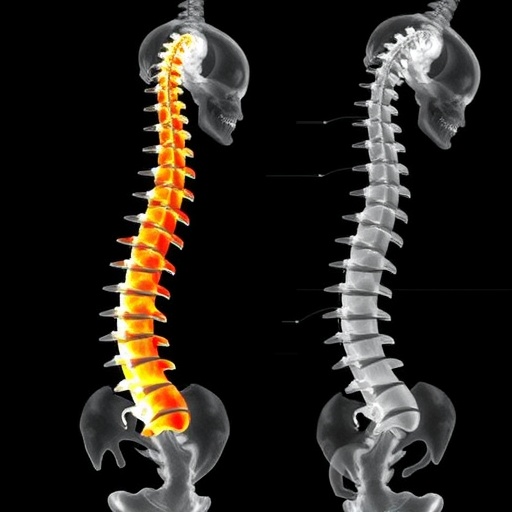
In an age where technology continually transforms medical practices, the integration of 3D printing into healthcare has gained considerable attention. A recent study conducted by a team of researchers, including Xia, Xing, and Zhang, delves into this revolutionary technology’s application in teaching ultrasound-guided puncture procedures specifically designed for scoliotic spines. This advancement holds promise for improving the efficacy and precision of medical training for ultrasound-guided techniques.
At the heart of the research is the pressing need to enhance the educational frameworks used to train medical practitioners in complex procedures. Traditionally, medical training heavily relies on cadaveric models or two-dimensional images, which can often fall short of conveying the intricacies involved in navigating the unique anatomical variations of patients with spinal muscular atrophy. By leveraging 3D printing technologies, the study proposes a moreimmersive and practical approach to markedly improve the understanding and skills of medical students and professionals.
The study outlines a notable application of 3D printing in producing detailed anatomical models that mimic the unique structural variations found in the spines of patients suffering from scoliosis and spinal muscular atrophy. These models not only provide a tactile experience but also allow for the opportunity to visualize and practice ultrasound-guided procedures in a simulated environment. The authors contend that this method significantly enhances the learning curve and prepares practitioners for real clinical situations.
One of the pivotal benefits of using 3D printed models is the ability to customize each model to replicate an individual patient’s anatomy. This personalized approach ensures that medical trainees can engage with representations that closely resemble the specific challenges they may encounter in actual practice. Such replicative simulations are not just beneficial for skills acquisition but also help reduce the anxiety and uncertainty that often accompany the first real-life encounters with complex medical procedures.
The methodology employed in the study involved the creation of these models through advanced 3D printing techniques, which include the use of various materials that closely mimic human anatomy. This technology enables the production of models that are both structurally sound and biologically relevant, thus providing the authenticity required for high-quality training. The transitional shift from traditional learning methods to those incorporating digital technology has been well documented, yet the focus on 3D printing in this context opens new avenues for medical education.
Participants in the study underwent a series of training sessions where they utilized the 3D printed models for practicing ultrasound-guided puncture procedures. Feedback gathered from these sessions highlighted several advantages, including improved spatial awareness and better hand-eye coordination. Trainees expressed increased confidence in their abilities, indicating that simulated practice using the models mirrors the experiential learning that occurs during more conventional forms of training.
Additionally, the research emphasizes the role of collaborative learning facilitated by these 3D printed models. Trainees were able to work in small groups, share insights, and learn from one another, thus enriching the educational process. This collaborative environment fosters a community of practice where skills are honed, questions are answered, and new techniques are discussed—all crucial components of effective medical training.
The study’s findings reveal the potential for 3D printing not just to supplement traditional training, but perhaps to eventually replace some aspects of it. As the costs associated with 3D printing technologies decrease and accessibility improves, medical schools may find themselves increasingly adopting these innovative solutions as standard practice. This adoption could fundamentally alter how future medical professionals are trained, potentially influencing patient outcomes positively as well.
Furthermore, the researchers propose that beyond the specific application discussed in their study, there’s ample room for expansion in other areas of medical education. By applying 3D printing in various specialties—ranging from surgical training to orthopedics—there lies an opportunity to standardize and elevate training experiences across disciplines. This modernization aligns with the ongoing push toward incorporating technology deeply into healthcare practices.
Ethical considerations around the use of highly realistic models in training also merit discussion. The provision for training in safer environments enhances not only the skills of practitioners but also ensures that patients benefit from increased correctness and safety in procedural applications. Fostering an ethical framework surrounding this new educational approach will be crucial as it gains traction within the medical training landscape.
As we look to the future, the implications of this study extend far beyond mere educational methodologies. The combination of ultrasound technology with 3D printed models demonstrates a significant leap toward enriching the capabilities of caregivers and improving clinical performances. Thus, this research may very well represent just the beginning of a series of developments aimed at integrating advanced technology into healthcare education.
The ongoing evolution of medical training prompted by studies such as this one speaks to the broader narrative of innovation in healthcare. As these practices become both widespread and standardized, the visionary advancements outlined by Xia, Xing, and Zhang may redefine how we perceive medical training entirely, setting a new precedent for what is possible in the realm of educational pedagogy for future healthcare professionals.
In conclusion, the utilization of 3D printing modeling techniques in the training of ultrasound-guided procedures has the potential to radically transform medical education. By fostering improved skills among practitioners and promoting an environment of collaborative learning, this approach not only deepens the understanding of complex anatomical details but also enhances the confidence and competencies of those entering the medical field. It is imperative for educational institutions to embrace this technology, paving the way for groundbreaking advancements in training methodologies moving forward.
Subject of Research: Utilization of 3D printing in ultrasound-guided puncture procedures on scoliotic spines of spinal muscular atrophy.
Article Title: Utilization of 3D printing modeling techniques in the simulation instruction of ultrasound-guided puncture procedures on scoliotic spines of spinal muscular atrophy.
Article References:
Xia, D., Xing, F., Zhang, J. et al. Utilization of 3D printing modeling techniques in the simulation instruction of ultrasound-guided puncture procedures on scoliotic spines of spinal muscular atrophy. 3D Print Med 11, 19 (2025). https://doi.org/10.1186/s41205-025-00266-x
Image Credits: AI Generated
DOI: https://doi.org/10.1186/s41205-025-00266-x
Keywords: 3D printing, medical training, ultrasound-guided procedures, scoliotic spines, spinal muscular atrophy, educational innovation, anatomical modeling.



