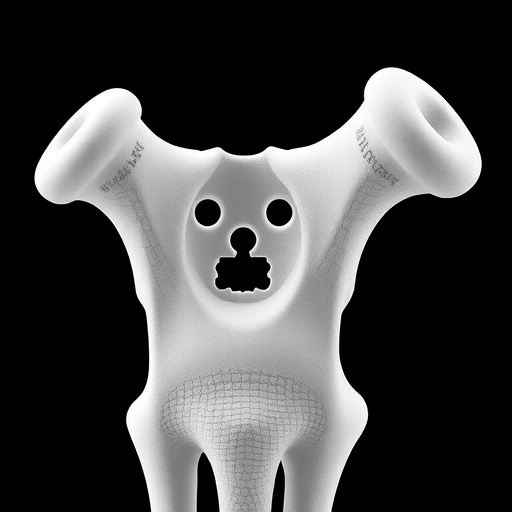
In the pursuit of advancing bone tissue engineering, researchers at the Soft Materials Laboratory (SMaL) of EPFL’s School of Engineering have pioneered a groundbreaking approach to fabricate hydroxyapatite (HA)-based scaffolds using 3D printing technology at room temperature. This innovation heralds a significant departure from conventional techniques that rely on high-temperature processing, which not only consumes considerable energy but also limits the integration of biologically active components crucial for bone regeneration. By harnessing enzymatic mineralization, the team has achieved a method that combines mechanical robustness, biological functionality, and environmentally considerate processing—all essential criteria for next-generation bone repair materials.
Bone, a naturally resilient and self-healing material, owes much of its mechanical performance to the intricate distribution of hydroxyapatite crystals embedded within its organic matrix. Replicating the structural complexity and mechanical properties of bone synthetically has remained a formidable challenge for decades. Most synthetic materials based on HA require sintering at elevated temperatures, which precludes the inclusion of living enzymes or growth factors that could enhance cellular incorporation and promote tissue remodeling. The SMaL team’s approach overcomes these limitations by producing scaffolds at ambient conditions, where enzyme-functionalized gelatin microparticles initiate rapid mineralization, preserving the biological activity that drives in situ bone regeneration.
The crux of this new methodology lies in an ingeniously formulated bioink, consisting of gelatin microparticles embedded with alkaline phosphatase, a pivotal enzyme in bone mineralization. When this ink is extruded via 3D printing into high aspect-ratio structures, the enzymatic activity within catalyzes the precipitation of hydroxyapatite directly onto the scaffold matrix. This mineralization progresses swiftly, with substantial crystal growth observed within seven days, endowing the scaffold with load-bearing capacities comparable to human trabecular bone. Remarkably, these porous constructs withstand pressures equal to or surpassing that of natural bone tissue, demonstrating the potential for immediate structural support after implantation.
Beyond mechanical strength, the scaffold architecture is expertly designed to foster biological integration. The team incorporated enzyme-free gelatin microfragments into the ink, which dissolve during incubation and create an interconnected porous network within the scaffold’s interior. These pores occupy approximately half of the scaffold volume, creating optimal channels for cellular infiltration, vascularization, and nutrient diffusion—all critical factors for successful bone remodeling and regeneration in vivo. Such customizable porosity controlled by microfragment density provides a versatile platform to tailor the scaffold microenvironment to diverse clinical needs and anatomical sites.
In vitro experiments further validate the bioactivity of the enzymatically mineralized scaffolds. When human stem cells are seeded onto these structures and cultured in osteogenic medium, there is robust expression of collagen and osteocalcin after only two weeks. These proteins are fundamental to the extracellular matrix and mineral deposition, indicating that the scaffolds support the initial stages of bone matrix formation and maturation. This biological response underscores the promise of these scaffolds as not merely inert supports, but as active participants in orchestrating bone healing processes.
From an engineering standpoint, the room-temperature enzymatic mineralization process possesses numerous advantages over traditional methods. Its energy efficiency dramatically reduces carbon footprint and production costs, paving the way for scalable manufacturing. Additionally, retaining enzymatic functionality within the scaffold enables dynamic mineral growth post-printing, offering unique possibilities for in situ scaffold maturation tailored to patient-specific conditions. Furthermore, compatibility with existing commercial bioprinters enhances accessibility and integration within current biomedical fabrication workflows.
The highly porous yet mechanically robust nature of the scaffolds mimics the hierarchical structure of trabecular bone, which predominantly cushions and supports mechanical loads within vertebrae and long bones such as femurs. By matching these parameters, the scaffolds may allow orthopedic patients to bear weight sooner post-implantation, accelerating rehabilitation timelines and improving overall outcomes. The precisely engineered microstructure also facilitates gradual resorption and replacement by natural bone, potentially eliminating the need for secondary surgeries associated with non-resorbable materials.
The breakthrough also opens avenues for further exploration of multifunctional biomaterials. The platform supports incorporation of diverse bioactive agents beyond enzymes, including growth factors, antibiotics, or signaling peptides, enhancing scaffold functionality for complex clinical scenarios such as infected or critical-size defects. Additionally, adapting the mineralization chemistry could customize scaffold properties for other mineralized tissues, expanding applications into dental or craniofacial repair.
Esther Amstad, leading the SMaL project, envisions that this technology will fundamentally transform approaches to bone tissue engineering by harmonizing mechanical integrity, biological responsiveness, and sustainable fabrication. Their work establishes a new paradigm where printed biomaterials are not static implants but living, evolving constructs that actively engage with the host tissue to drive healing. This alignment of engineering precision with biological complexity represents a monumental leap forward in biomedical manufacturing.
As research progresses toward clinical translation, challenges remain, including long-term in vivo validation, ensuring consistent scaffold performance across diverse patient populations, and integrating imaging or sensor capabilities for post-implantation monitoring. Nonetheless, the foundational insights into enzymatic mineralization within 3D printed matrices represent a versatile platform that could revolutionize personalized bone repair solutions worldwide.
In conclusion, the EPFL Soft Materials Laboratory’s development of room-temperature, enzyme-driven hydroxyapatite scaffolds signals a new era for regenerative medicine. This technology promises not only to enhance patient recovery through stronger, bioactive, and porous scaffolds but also to contribute to sustainable and scalable manufacturing processes. By bridging biological functionality with mechanical performance and manufacturing feasibility, this innovation could ultimately reshape how the medical community approaches bone healing and reconstruction.
Subject of Research: Bone tissue engineering using enzymatic mineralization for 3D-printed hydroxyapatite scaffolds.
Article Title: 3D-Printed Porous Hydroxyapatite Formed via Enzymatic Mineralization
News Publication Date: 27-Feb-2026
Web References: https://advanced.onlinelibrary.wiley.com/doi/10.1002/adfm.202526568
Image Credits: SMaL EPFL CC BY SA
Keywords
Tissue growth, Fabrication, Skeleton, Wound healing
Tags: 3D-printed hydroxyapatite scaffoldsbiologically active bone scaffoldsbone tissue engineering innovationsenergy-efficient scaffold manufacturingenzymatic mineralization in bone repairenzyme-functionalized gelatin microparticleshydroxyapatite crystal distributionin situ bone tissue remodelingmechanical properties of synthetic bonenext-generation bone repair technologyroom temperature scaffold fabricationsustainable bone regeneration materials