A groundbreaking study published in the esteemed journal PLOS One reveals how a 3D-printed robotic rattlesnake provokes pronounced avoidance behaviors in zoo animals, particularly those species that naturally coexist with rattlesnakes in the wild. This innovative research contributes significantly to our understanding of multimodal signaling in animal behavior and highlights the evolutionary importance of sensory cues in predator-prey interactions.
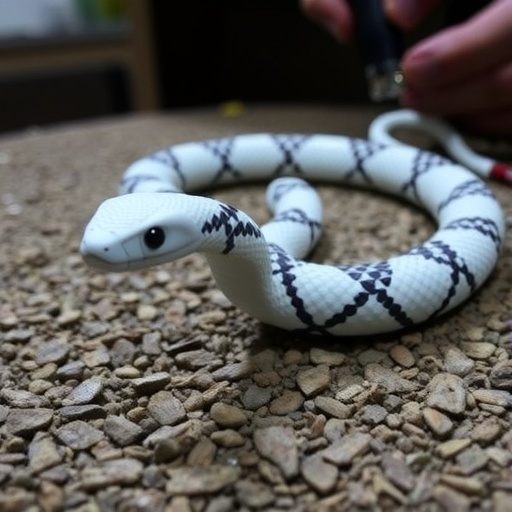
The researchers engineered a highly realistic robotic snake, meticulously designed to emulate both the visual appearance and the signature rattle sound of a live rattlesnake. By deploying this robotic surrogate in controlled experimental settings, scientists were able to observe and quantify the behavioral responses of captive animals, thereby isolating the effects of particular multimodal warning signals in an unprecedented way.
The centerpiece of the study involved three distinct experimental conditions to rigorously test the influence of rattlesnake cues on collared peccaries (Pecari tajacu), animals known to share habitats with rattlesnakes in natural ecosystems. Initially, peccaries were allowed to access a food reward without any snake model present, establishing baseline approach behaviors. Subsequently, a silent robotic rattlesnake was introduced near the food source to assess the effect of visual cues alone. Finally, the rattle mechanism was remotely activated, combining auditory and visual alarms to mimic an authentic rattlesnake warning.
Results demonstrated a striking pattern: peccaries exhibited the greatest avoidance behavior when both visual and auditory signals were present. The robotic rattlesnake’s rattle sound elicited a rapid retreat, highlighting the critical role of acoustic signaling in deterring potential threats. Conversely, the silent snake model induced a mild hesitation but did not prevent animals from approaching altogether, underscoring that the rattle display’s potency lies in its multimodal nature.
Intriguingly, species that do not share evolutionary history or geographical overlap with rattlesnakes showed significantly weaker responses to the robotic model. This finding supports the hypothesis that co-evolution and sympatry enhance the effectiveness of deterrent signals. Such sensory adaptations, fine-tuned through millennia of predator-prey dynamics, emphasize the nuanced interplay between ecological context and animal behavior.
The use of advanced 3D printing technology in this research exemplifies a new frontier in experimental ethology. The ability to create lifelike robotic animals allows scientists to meticulously manipulate and isolate sensory stimuli while maintaining ecological validity. This methodological innovation opens doors for future studies exploring complex communication systems in various taxa under controlled yet realistic conditions.
On a technical front, the robot rattlesnake was constructed using state-of-the-art 3D printers with materials replicating the texture and appearance of snake scales. The rattle sound was mechanically generated, controlled by remote operation to ensure precise timing during animal approach. Behavioral observations were meticulously recorded using high-definition video cameras and analyzed using sophisticated software to quantify approach latency, retreat distance, and avoidance duration.
Moreover, this research provides compelling evidence supporting the multimodal signal hypothesis, which posits that animals integrate multiple sensory modalities—such as visual, auditory, and vibrational cues—to assess and respond to threats effectively. The rattlesnake’s simultaneous use of visual mimicry and distinctive rattling exemplifies an evolved strategy to maximize communication efficiency and predator deterrence.
The implications extend beyond academic circles, as understanding species-specific responses to predator cues can influence zoo and wildlife management practices. For instance, enrichment protocols and safety measures can be tailored to leverage natural avoidance behaviors, thereby reducing stress and enhancing the welfare of captive animals. Additionally, such findings can inform conservation strategies for rattlesnake species by illuminating their ecological interactions with sympatric fauna.
This study notably did not rely on external funding, reflecting the researchers’ dedication to advancing foundational knowledge in behavioral ecology. Their transparent declaration of no conflicts of interest adds credibility to the findings and underscores the scientific rigor of their experimental design and analysis.
Published on March 11, 2026, this work stands as a milestone contribution to the field, merging technological innovation with ecological theory. The fusion of robotics with behavioral science not only enriches our understanding of animal communication but also pioneers novel methodologies for probing the complexities of nature’s signaling networks.
In summary, the study convincingly demonstrates that multimodal displays by rattlesnakes serve as highly effective deterrents, especially for species sharing evolutionary histories and habitats. The robotic rattlesnake, a sophisticated blend of bioengineering and ethology, validates long-standing theories about predator-prey signaling while inspiring future interdisciplinary research that bridges biology, technology, and conservation.
Subject of Research: Multimodal signaling and avoidance responses in sympatric zoo animals triggered by a 3D-printed robotic rattlesnake.
Article Title: The multimodal display of rattlesnakes is a deterring signal that works best with sympatric species
News Publication Date: 11-Mar-2026
Web References: http://dx.doi.org/10.1371/journal.pone.0343121
Image Credits: Da Cunha et al., 2026, PLOS One, CC-BY 4.0
Keywords: robotic rattlesnake, antipredator behavior, multimodal signaling, sympatry, predator-prey interaction, 3D printing, auditory deterrent, visual mimicry, animal behavior, behavioral ecology
Tags: 3D-printed robotic rattlesnakeanimal avoidance behaviorauditory and visual predator cuesbehavioral ecology in captivitycollared peccaries rattlesnake responseexperimental animal behavior analysismultimodal signaling in animalspredator-prey interaction researchrattlesnake habitat species interactionrobotic animal surrogates in experimentssensory cues in wildlifezoo animal behavior study