


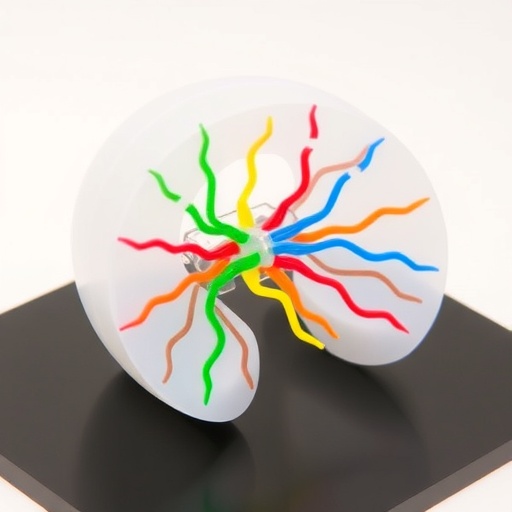
In a remarkable intersection of advanced technology and medical education, researchers have embarked on a groundbreaking project that utilizes 3D printing to create a detailed optic pathway model derived from high-resolution 7T magnetic resonance imaging (MRI). This innovation, spearheaded by an adept team led by Black, J.A., and supported by colleagues including Blezek, D.J. and Hanson, C.R., aims not only to enhance pedagogical methods in medical training but also seeks to offer tangible anatomical constructs for both students and professionals alike. The study, which is set to be published in the journal 3D Print Med, represents a significant leap toward improving the understanding of complex neural pathways, specifically those connected with vision.
The reliance on 7T MRI technology demonstrates the commitment to precision in capturing intricate anatomical details. Unlike conventional MRI machines that operate at lower field strengths, the 7T MRI scanner provides a heightened level of clarity and resolution. This technology allows healthcare professional educators to garner precise imaging that can then be translated into a comprehensive three-dimensional model. The accuracy of such imaging not only helps in creating extremely detailed 3D prints but serves to revolutionize the way medical professionals can visualize and interact with the human body.
3D printing technology itself has evolved rapidly, with its applications now penetrating numerous fields including surgery, prosthetics, and anatomical modeling. The introduction of the optic pathway model marks an innovative application geared towards neurology and ophthalmology education. Students are often challenged to comprehend the complex networking of the optic pathways involved in vision; thus, tangible models allow for enhanced spatial understanding. By having a physical representation of these pathways, learners can engage in hands-on exploration and experimentation that fosters deeper learning.
The creation of 3D printed models from MRI scans necessitates a sophisticated understanding of both the printing technology and the biological structures involved. The team utilized software that converts the data gleaned from the MRI scans into a format suitable for 3D printing, transforming abstract images into real-world, manipulable educational tools. This methodology not only streamlines the learning process but also addresses common learning impediments associated with viewing 2D images in textbooks or lecture slides.
As part of this project, the researchers undertook extensive validation of the printed models. They compared the dimensions and structures from the printed items against those seen on the original MRI scans. This meticulous process ensured that the final models were not only visually appealing but also structurally accurate. Validation is critical in medical education; it underpins the need for reliability and authenticity in teaching materials, especially when it involves complex structures such as those in the human brain.
The pedagogical implications of this research cannot be overstated. In an era where traditional educational approaches are being augmented by technology, the potential for 3D printed models in medical training is vast. Students can engage with their studies in ways that were previously unattainable. Through tangible interaction with these models, learners can enhance their comprehension of neuroanatomy, leading to improved diagnostic and surgical capabilities in their future clinical practices.
Moreover, this initiative highlights the need for interdisciplinary collaboration. The integration of imaging professionals, biomedical engineers, and medical educators has culminated in a cutting-edge resource that can be immediately applied in various educational settings. By fostering such collaboration, medical schools can utilize innovative educational tools that reflect the advancements in both technology and science, thereby better preparing students for the complexities of modern medicine.
Another significant aspect of utilizing 3D printed optic pathway models is that it opens up avenues for research and development within the field. By employing these models, researchers can simulate surgeries or neurological assessments with precise representations of anatomical variations. This adaptability underscores the potential for 3D printed models to not only assist in education but also drive forward clinical and research endeavors.
Furthermore, the success of this project may pave the way for similar undertakings in other areas of anatomy where 3D printing can offer supplemental educational aids. The possibility of constructing models of other intricate networks, such as the circulatory or respiratory systems, could vastly enhance medical curricula. This expansion reflects the broader trend of embracing innovative technologies within educational spaces to cater to diverse learning styles and improve academic outcomes.
In summary, the collaboration between Black, Blezek, and Hanson signifies a promising advancement in medical education through the integration of cutting-edge technologies. By creating a 3D printed model from MRI data, they have laid the groundwork for an educational revolution that emphasizes visual learning and hands-on practice. As medical education continues to evolve, such innovations are crucial in its pursuit of excellence in training the next generation of healthcare professionals.
The implications of this study extend far beyond the immediate educational benefits. The accessibility of advanced imaging and printing technologies brings to light an era where complex anatomical models can be crafted affordably and efficiently. Whether in urban centers or remote areas, the potential democratization of medical education tools signifies a welcome shift toward inclusive and comprehensive learning opportunities. The ability to provide quality education, enhanced even further through the use of detailed visual aids, aligns seamlessly with the global push for better healthcare education.
As educators look to the future, the role of 3D printing in medical training remains a topic of intense interest and exploration. The work done by this team serves as a beacon for other researchers and institutions eager to adapt to the changing landscape of teaching and learning in medicine. It demonstrates that with the right technologies, commitment, and cross-disciplinary efforts, the possibilities for enhancing medical education are endless.
This journey does not mark the end, but a significant chapter in the story of merging technology with education. Exciting advancements lie on the horizon, and the continuous exploration of 3D printing in various fields, including medicine, will yield dividends for years to come. The optic pathway model is merely the beginning, as it signifies a broader commitment to enhancing the effectiveness of medical education through innovation.
Subject of Research: Enhanced medical education through 3D printing of anatomical models.
Article Title: 3D printing of an optic pathway model from 7T MRI for education.
Article References:
Black, J.A., Blezek, D.J., Hanson, C.R. et al. 3D printing of an optic pathway model from 7T MRI for education.
3D Print Med 11, 47 (2025). https://doi.org/10.1186/s41205-025-00297-4
Image Credits: AI Generated
DOI: https://doi.org/10.1186/s41205-025-00297-4
Keywords: 3D printing, medical education, MRI technology, neuroanatomy, pedagogical tools.
Tags: 3D printing in medical educationadvanced imaging techniques in healthcareanatomical constructs for medical professionalsapplications of 3D printing in healthcareeducational tools for anatomy visualizationenhancing medical training with 3D modelshigh-resolution 7T MRI technologyinnovative approaches to medical pedagogyneural pathways in vision educationoptic pathway model MRIprecision in medical imagingrevolutionizing medical education with technology



