Researchers at the University of Arizona College of Medicine – Tucson were awarded a $1.8 million grant by the National Institute of General Medical Sciences, a division of the National Institutes of Health, to learn how human papillomavirus makes its way to a cell’s nucleus.
Human papillomavirus, or HPV, which can cause warts and certain cancers, has been with us since the dawn of humanity and causes about 5% of cancers worldwide. It also is an important source of information about human biology, according to Samuel K. Campos, PhD, an associate professor of immunobiology at the University of Arizona College of Medicine – Tucson and member of the BIO5 Institute.
“These viruses take advantage of pathways the cell has and tweak them. What better cell biologists to teach us how cells work than the viruses that have evolved with us for eons?” Campos said about how HPV illuminates the inner workings of our bodies. “Follow the biology of the virus, and we’ll learn some cool new cell biology.”
Campos said there are more than 600 known strains of human papillomavirus, with more yet to be discovered. His lab mainly focuses on HPV16, the type that causes the majority of cervical, anal and head and neck cancers.
HPV has found its niche in certain types of epithelial cells, which cover our body as skin and line our body cavities as mucous membranes. The virus moves from the lower layers of the epithelium to the upper layers and once it’s close to the surface, replication kicks into high gear as it prepares for to leave one body and infect another.
“We are constantly shedding dead skin — it just comes off our body,” Campos said. “That is how HPVs have so successfully spread throughout the human population.”
HPV’s genes are packaged in a protein shell. The Campos Lab focuses on the role of one of these shell proteins, L2, which can insert itself into the membranes of our cells, like a key into a lock, and let itself inside. Upon entry, the virus is escorted along a twisted path to the nucleus, where it hijacks the cell to make copies of itself.
Campos said his lab’s prior research revealed that, from the cell’s point of view, L2 looks like another part of the cell.
“We learned that the virus is really sneaky,” Campos said. “L2 can actually stick through the cell membrane without rupturing it, and HPV stays hidden behind these membranes. It’s able to avoid sensors that detect danger signals, like a wolf in sheep’s clothing.”
Previous research published by the Campos Lab and other groups suggested that HPV may be able to hide until the cell’s machinery whirs into action during cell division, at which point it sheds its “sheep’s clothing” and hitches a ride to the nucleus.
“Once the virus has successfully delivered its DNA genome into the nucleus, it can begin expressing its own genes to take over the cell,” Campos said. “That will lead to immune evasion, alteration of the cell cycle, the generation of new viral particles and transmission to another host. If the virus sticks around long enough, these infections can sometimes alter the cell in a way that leads to cancer.”
The five-year, R35 grant Campos received is reserved for scientists with outstanding research records and the potential to make major contributions to their fields. It gives investigators the flexibility to follow their research in whatever direction it takes them. The grant will support the Campos Lab as researchers attempt to uncover how HPV takes advantage of cell division to move from its hiding place in the cell to the nucleus.
“It’s a complete black box. It’d be really neat to figure that out,” Campos said, adding that following the virus’s path will shed light on the intricacies of cell division and how things move in and out of cells.
These unknowns are what keep Campos coming to work each day.
“It’s tough and it’s frustrating, but it’s also satisfying — like solving a puzzle,” he said. “You don’t know where the science will take you. You don’t know what the ending is going to be. That’s exciting.”
This research is supported by the National Institute of General Medical Sciences, a division of the National Institutes of Health, under award No. 1R35GM152143-01.
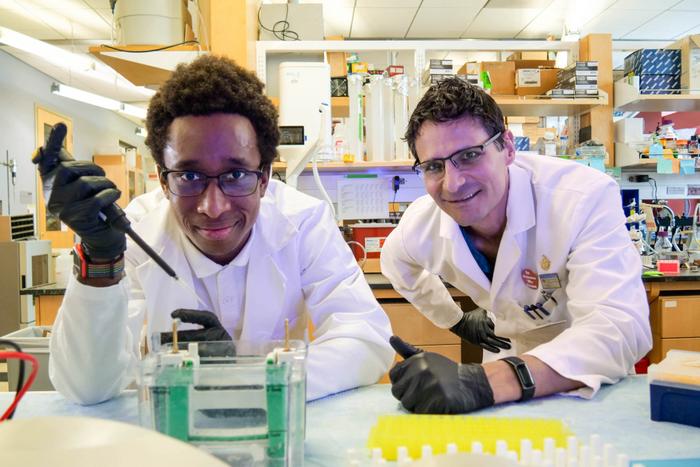
Credit: UArizona Health Sciences
Researchers at the University of Arizona College of Medicine – Tucson were awarded a $1.8 million grant by the National Institute of General Medical Sciences, a division of the National Institutes of Health, to learn how human papillomavirus makes its way to a cell’s nucleus.
Human papillomavirus, or HPV, which can cause warts and certain cancers, has been with us since the dawn of humanity and causes about 5% of cancers worldwide. It also is an important source of information about human biology, according to Samuel K. Campos, PhD, an associate professor of immunobiology at the University of Arizona College of Medicine – Tucson and member of the BIO5 Institute.
“These viruses take advantage of pathways the cell has and tweak them. What better cell biologists to teach us how cells work than the viruses that have evolved with us for eons?” Campos said about how HPV illuminates the inner workings of our bodies. “Follow the biology of the virus, and we’ll learn some cool new cell biology.”
Campos said there are more than 600 known strains of human papillomavirus, with more yet to be discovered. His lab mainly focuses on HPV16, the type that causes the majority of cervical, anal and head and neck cancers.
HPV has found its niche in certain types of epithelial cells, which cover our body as skin and line our body cavities as mucous membranes. The virus moves from the lower layers of the epithelium to the upper layers and once it’s close to the surface, replication kicks into high gear as it prepares for to leave one body and infect another.
“We are constantly shedding dead skin — it just comes off our body,” Campos said. “That is how HPVs have so successfully spread throughout the human population.”
HPV’s genes are packaged in a protein shell. The Campos Lab focuses on the role of one of these shell proteins, L2, which can insert itself into the membranes of our cells, like a key into a lock, and let itself inside. Upon entry, the virus is escorted along a twisted path to the nucleus, where it hijacks the cell to make copies of itself.
Campos said his lab’s prior research revealed that, from the cell’s point of view, L2 looks like another part of the cell.
“We learned that the virus is really sneaky,” Campos said. “L2 can actually stick through the cell membrane without rupturing it, and HPV stays hidden behind these membranes. It’s able to avoid sensors that detect danger signals, like a wolf in sheep’s clothing.”
Previous research published by the Campos Lab and other groups suggested that HPV may be able to hide until the cell’s machinery whirs into action during cell division, at which point it sheds its “sheep’s clothing” and hitches a ride to the nucleus.
“Once the virus has successfully delivered its DNA genome into the nucleus, it can begin expressing its own genes to take over the cell,” Campos said. “That will lead to immune evasion, alteration of the cell cycle, the generation of new viral particles and transmission to another host. If the virus sticks around long enough, these infections can sometimes alter the cell in a way that leads to cancer.”
The five-year, R35 grant Campos received is reserved for scientists with outstanding research records and the potential to make major contributions to their fields. It gives investigators the flexibility to follow their research in whatever direction it takes them. The grant will support the Campos Lab as researchers attempt to uncover how HPV takes advantage of cell division to move from its hiding place in the cell to the nucleus.
“It’s a complete black box. It’d be really neat to figure that out,” Campos said, adding that following the virus’s path will shed light on the intricacies of cell division and how things move in and out of cells.
These unknowns are what keep Campos coming to work each day.
“It’s tough and it’s frustrating, but it’s also satisfying — like solving a puzzle,” he said. “You don’t know where the science will take you. You don’t know what the ending is going to be. That’s exciting.”
This research is supported by the National Institute of General Medical Sciences, a division of the National Institutes of Health, under award No. 1R35GM152143-01.