• HOME
  • NEWS
  • EXPLORE
    • CAREER
      • Companies
      • Jobs
    • EVENTS
    • iGEM
      • News
      • Team
    • PHOTOS
    • VIDEO
    • WIKI
  • BLOG
  • COMMUNITY
    • FACEBOOK
    • INSTAGRAM
    • TWITTER
Friday, November 27, 2026
BIOENGINEER.ORG
No Result
View All Result
  • Login
  • HOME
  • NEWS
  • EXPLORE
    • CAREER
      • Companies
      • Jobs
        • Lecturer
        • PhD Studentship
        • Postdoc
        • Research Assistant
    • EVENTS
    • iGEM
      • News
      • Team
    • PHOTOS
    • VIDEO
    • WIKI
  • BLOG
  • COMMUNITY
    • FACEBOOK
    • INSTAGRAM
    • TWITTER
No Result
View All Result
Bioengineer.org
No Result
View All Result
Home NEWS Science News Health

Can’t resist temptation? That may not be a bad thing

Bioengineer by Bioengineer
May 24, 2016
in Health
Reading Time: 2 mins read
0
Share on FacebookShare on TwitterShare on LinkedinShare on RedditShare on Telegram
IMAGE

Researchers from the University of Rochester suggest that children raised in poverty may have been mistakenly labeled as “maladapted” for what appears to be a lack of self-control. The new study finds that what looks like selfishness may actually be beneficial behavior that’s based on a child’s environmental context–that is to say, from being raised in a resource-poor environment.

The classic 1970s “marshmallow tests” assessed impulse control in preschoolers. Children were given a choice to take a single marshmallow immediately, or to wait several minutes and earn two of the puffy treats as a reward. Children who displayed an apparent lack of self-control–demonstrated by taking the single treat–were deemed “maladapted.” Follow-up studies identified children who are raised in poverty are far less likely to postpone such sweet temptations than their economically better-off counterparts.

“What looks like impulsiveness may actually be an adaptive strategy–kids who are brought up in homes with limited resources have learned it’s advantageous to seize the moment,” said Melissa Sturge-Apple, associate professor of psychology at the University of Rochester and clinical researcher at Mt. Hope Family Center (MHFC).

For the new study, Sturge-Apple and her colleagues measured the vagal tone of preschoolers before they participated in reward-based experiments. The vagus nerve streams information from the heart, lungs, stomach, and other organs to the brain. It’s associated with the moderation of moods including fear and anxiety. High vagal tone is a physiological indicator of what we would call “grace under fire”–the body’s ability to slow down heart rate, blood pressure, and respiration, which can allow for a thoughtful response.

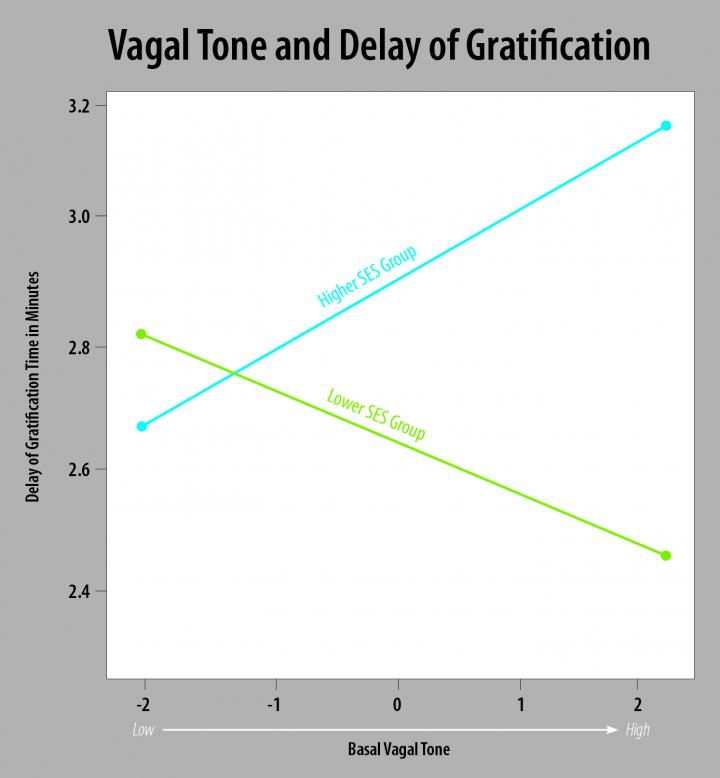
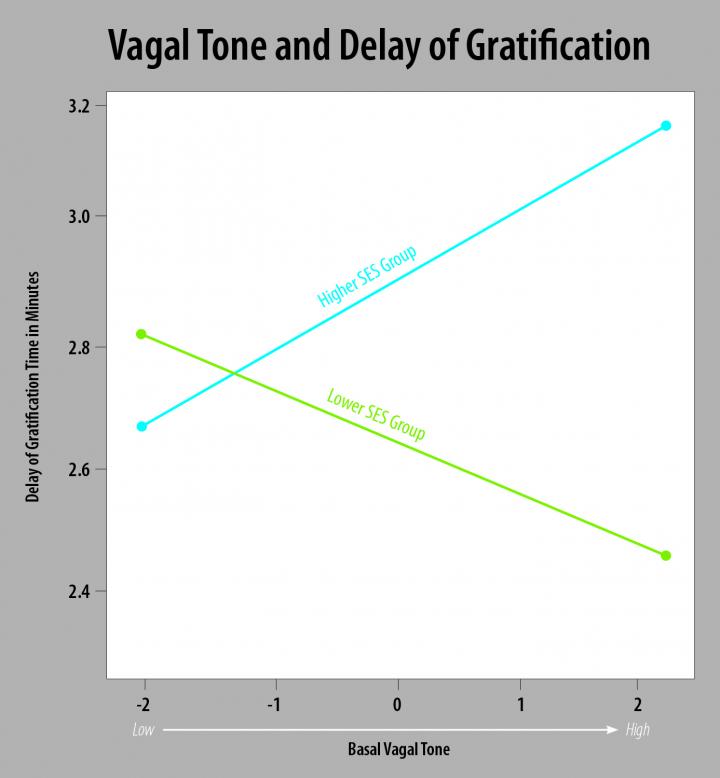
Previous research in reward-based studies has shown that for children from high-resource households, high vagal tone is predictive of their ability to delay gratification. The higher their vagal tone, the longer these children can delay–they are able to keep calm, wait, and earn additional rewards.

In the Rochester study published in Psychological Science, however, children from low-resource households that have high vagal tone did not demonstrate the same behavior as middle class children. In fact, it was just the opposite. For children living in poverty, the higher their vagal tone, the quicker they decided to take the single treat–M&Ms candies in this case–and not wait despite the promise of more.

“From a normative model of psychology, this result makes no sense. But when we considered what would be the most optimal behavior in a high-risk environment, then this makes complete sense–it’s survival of the quickest,” Sturge-Apple explained. “Context means everything. When all is well and prosperous, kids who are highly attuned to what is going on around them can wait, but when things are scarce and unpredictable, then the question becomes “why wait?”

Jennifer Suor and Patrick Davies from Rochester, Dante Cicchetti of the University of Minnesota, Michael Skibo of Westchester Community College, and Fred Rogosch of Mt. Hope Family Center co-authored the study. The National Institute of Nursing Research and the National Institute of Mental Health supported the research.

###

Media Contact

Monique Patenaude
monique.patenaude@rochester.ed
585-276-3693
@UofR

http://www.rochester.edu

The post Can’t resist temptation? That may not be a bad thing appeared first on Scienmag.

Share12Tweet8Share2ShareShareShare2

Related Posts

Higher Physical Activity and Morning Movement Linked to Lower Osteoporosis Risk

Higher Physical Activity and Morning Movement Linked to Lower Osteoporosis Risk

November 27, 2026
Cardiac Ultrasound Nomogram Predicts Composite Adverse Outcomes in Ischemic Cardiomyopathy Patients

Cardiac Ultrasound Nomogram Predicts Composite Adverse Outcomes in Ischemic Cardiomyopathy Patients

November 27, 2026

Child Marriage Linked to Elevated Lifetime Partner Violence Among Women in Nepal

November 27, 2026

Fick and Magnetic Resonance Methods Yield Differing Pre-Fontan Pulmonary Vascular Resistance Estimates

November 27, 2026
Please login to join discussion

POPULAR NEWS

  • Global Hepatitis B Fibrosis Research Reaches 3,684 Studies With Shift Toward Precision Medicine

    Global Hepatitis B Fibrosis Research Reaches 3,684 Studies With Shift Toward Precision Medicine

    29 shares
    Share 12 Tweet 7
  • High Drug-Loading Amorphous Nanoparticles Balance Physical Stability and Passive Membrane Permeability

    29 shares
    Share 12 Tweet 7
  • Spectroscopic Model Predicts Wine Tannin Polymerization and Links Fractions to Dynamic Astringency

    29 shares
    Share 12 Tweet 7
  • Attention-Based Model Reduces Highway Trajectory Prediction Error by Six Percent

    29 shares
    Share 12 Tweet 7

About

We bring you the latest biotechnology news from best research centers and universities around the world. Check our website.

Follow us

Recent News

Open-Source Thin-Film Solver Simulates Evaporating Liquid Coatings in Lubrication Approximation

Elastic Quadruped Robot Generates Diverse Natural Gaits Through Nonlinear Body Oscillations

Higher Physical Activity and Morning Movement Linked to Lower Osteoporosis Risk

Subscribe to Blog via Email

Enter your email address to subscribe to this blog and receive notifications of new posts by email.

Join 89 other subscribers
  • Contact Us

Bioengineer.org © Copyright 2023 All Rights Reserved.

Welcome Back!

Login to your account below

Forgotten Password?

Retrieve your password

Please enter your username or email address to reset your password.

Log In
No Result
View All Result
  • Homepages
    • Home Page 1
    • Home Page 2
  • News
  • National
  • Business
  • Health
  • Lifestyle
  • Science

Bioengineer.org © Copyright 2023 All Rights Reserved.