A controlled laboratory investigation has demonstrated that manipulating photoperiod alongside precise thermal regimes selectively governs the biosynthesis of high-value antioxidant carotenoids in the unicellular green microalga Haematococcus pluvialis. Conducted through a structured two-stage cultivation protocol, the empirical study evaluated how abiotic stressors applied during a secondary stress-induction phase steer metabolic flux between astaxanthin and its direct biochemical precursor, beta-carotene. The research team identified that an abbreviated eight-hour photoperiod using combined blue and red light served as the single most decisive environmental driver for pigment induction across all experimental treatments. When this shortened light exposure was coupled with an elevated temperature of 27 degrees Celsius in the absence of supplemental salt, microalgal cultures synthesized astaxanthin at a peak concentration of 7.92 micrograms per milliliter. Conversely, maintaining an identical eight-hour blue-red light cycle under a cooled temperature regime of 16 degrees Celsius redirected secondary metabolism toward beta-carotene, yielding a maximum concentration of 5.84 micrograms per milliliter while effectively arresting its downstream enzymatic conversion into astaxanthin.
Carotenoids represent a diverse class of lipid-soluble pigments categorized chemically into pure hydrocarbons known as carotenes and oxygenated derivatives designated as xanthophylls. Within industrial and biomedical sectors, beta-carotene and astaxanthin have garnered significant commercial interest owing to their pronounced antioxidant capacities, ability to neutralize cytotoxic free radicals, mitigate cellular inflammation, and regulate critical intracellular signaling cascades. Meanwhile, beta-carotene functions as a vital dietary precursor to vitamin A and an established additive across cosmetic and nutraceutical formulations, commanding valuations ranging from 100 to 300 dollars per kilogram.
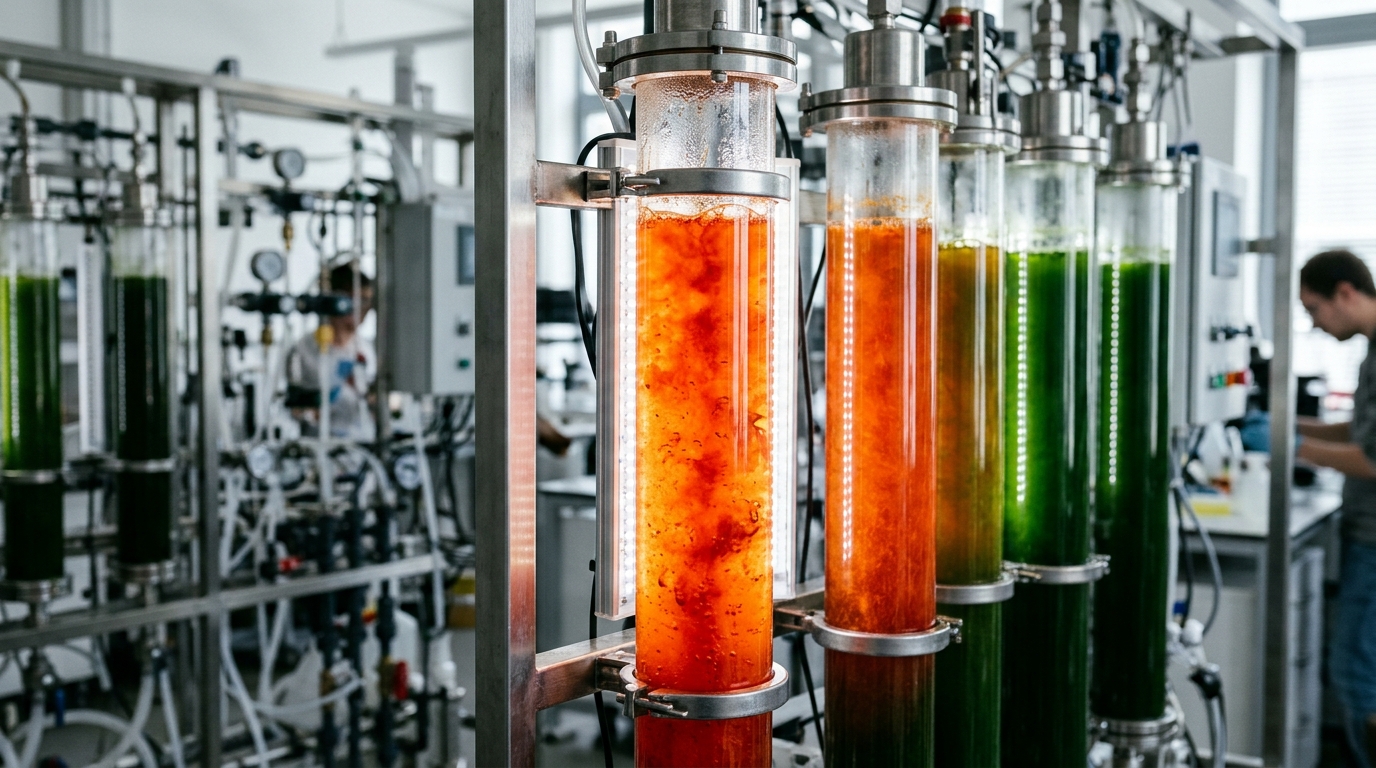
The freshwater microalga Haematococcus pluvialis, a member of the order Volvocales and family Haematococcaceae, naturally undergoes a distinctive biphasic life cycle that researchers replicated in the laboratory to decouple vegetative cell division from stress-induced secondary pigment synthesis. In this experimental framework, the initial green growth phase was maintained across ninety-six hours within batch reactors containing 500 milliliters of modified Bold Basal Medium sterilized at 121 degrees Celsius and 15 pounds per square inch for fifteen minutes. Cultures were inoculated at an initial density of 300,000 cells per milliliter and maintained at 25 degrees Celsius under a continuous sixteen-hour red light photoperiod supplied by 13.5-watt light-emitting diode lamps. Active gas exchange was sustained through manual agitation every eight hours paired with regular gaseous carbon dioxide injections at an aeration rate of 0.48 volumes of gas per volume of liquid per minute every twenty-four hours.
During this initial ninety-six-hour vegetative proliferation period, cellular growth closely tracked the assimilation of dissolved nutrients, resulting in an adaptation stage during the initial eight hours followed by sustained exponential growth through ninety-six hours. Spectrophotometric monitoring of dissolved sodium nitrate at 220 nanometers, corrected against organic background absorbance at 275 nanometers, revealed that microalgal cultures consumed 92.5 percent of the available nitrate during the exponential phase. This rapid assimilation reflected vigorous primary metabolic activity, wherein fixed carbon supplied by carbon dioxide was processed through the Calvin cycle enzyme RuBisCO in chloroplasts to generate glyceraldehyde-3-phosphate alongside structural adenosine triphosphate and reducing power. Simultaneously, cytosolic and chloroplastic reductases converted assimilated nitrate into ammonium for amino acid and structural protein synthesis, establishing a maximum kinetic growth rate of 0.032 per hour and a specific rate of 0.046 per hour before nitrogen exhaustion naturally arrested active cell division.
Upon reaching ninety-six hours of cultivation, the depletion of bioavailable nitrate signaled the initiation of the red stress-induction phase, which extended through 168 hours of total culture time to stimulate secondary carotenogenesis. To systematically untangle the complex individual and synergistic influences of multiple environmental variables without requiring an unmanageable matrix of full factorial runs, the investigators implemented a Plackett-Burman screening design generated through specialized statistical software. The experimental matrix examined three distinct abiotic growth factors across low, medium, and high setpoints: incubation temperature was tested at 16, 21.5, and 27 degrees Celsius; salinity was adjusted to 0.043, 0.107, and 0.171 molar sodium chloride; and daily illumination exposure was programmed at 8, 12, and 16 hours of blended blue-red light. The statistical architecture encompassed twelve screening treatments supplemented with three centralized replicate trials and non-saline baseline controls, enabling the research team to detect potential mathematical curvature across response profiles through analysis of variance evaluated at a significance threshold of p less than 0.1.
Analysis of variance conducted on astaxanthin yields demonstrated that photoperiod exercised the single largest influence on pigment accumulation, exhibiting a highly significant p-value of 0.0001, followed closely by temperature at p equals 0.003, whereas salinity showed no statistically significant standalone effect with a p-value of 0.075. Standardized Pareto charting confirmed that while the individual effects of lighting duration and temperature dominated the system, their two-way interaction also exerted a statistically significant positive effect on astaxanthin synthesis. Experimental treatment B1, conducted under an eight-hour blue-red photoperiod, a temperature of 27 degrees Celsius, and zero added sodium chloride, generated the peak astaxanthin concentration of 7.92 plus or minus 0.01 micrograms per milliliter at the 168-hour mark. This optimal treatment translated into a substantial biomass yield of 39.630 milligrams of astaxanthin per gram of dry biomass alongside a specific production rate of 0.117 milligrams of astaxanthin per gram of biomass per hour, outperforming comparable historical cultivation regimes requiring extended incubation intervals spanning twelve to twenty days.
The physiological mechanisms governing this pronounced astaxanthin surge relate directly to the biochemical impact of narrow-spectrum illumination and moderate thermal stress on cellular organelles. During the stress phase, blue light photons in the 430 to 480 nanometer range overload electron carriers within photosystem II, triggering the formation of reactive oxygen species within the chloroplast that function as secondary signaling messengers. These reactive oxygen cascades induce nuclear and chloroplastic transcription factors, activating the methylerythritol phosphate pathway inside the chloroplast while drawing supplemental isopentenyl diphosphate precursors from the cytosolic mevalonic acid pathway. Elevated incubation at 27 degrees Celsius accelerates metabolic turnover without denaturing essential biocatalysts, stimulating key downstream tailoring enzymes including beta-carotene hydroxylase and beta-carotene ketolase.
In sharp contrast to the multivariable dependencies governing astaxanthin, the statistical screening revealed that beta-carotene production responded almost exclusively to light duration. Analysis of variance indicated that photoperiod was the only factor achieving statistical significance with a p-value of 0.099, whereas temperature at p equals 0.460 and salinity at p equals 0.281 exerted negligible mathematical influence on total beta-carotene variation. Treatment B4, configured with an eight-hour blue-red light photoperiod, a low temperature of 16 degrees Celsius, and zero supplementary sodium chloride, achieved the global maximum beta-carotene concentration of 5.84 plus or minus 0.004 micrograms per milliliter. This condition produced an exceptional biomass yield of 140.356 milligrams of beta-carotene per gram of dry biomass and a specific production rate of 0.194 milligrams per gram per hour. A related treatment combining identical light and temperature setpoints with 0.171 molar sodium chloride yielded 2.60 plus or minus 0.007 micrograms per milliliter, demonstrating that elevated osmotic pressure offered no production advantage.
The selective accumulation of beta-carotene under low temperature reflects precise thermal modulation of the chloroplastic biosynthetic cascade. Exposure to an eight-hour blue-red photoperiod provides sufficient photochemical excitation to trigger cellular stress signaling and mobilize stored starch reserves, yielding excess glyceraldehyde-3-phosphate and pyruvate to drive chloroplastic isoprenoid synthesis through the 1-deoxy-D-xylulose-5-phosphate synthase and reductoisomerase enzymes. The resulting universal precursors, isopentenyl diphosphate and dimethylallyl diphosphate, condense to form geranylgeranyl pyrophosphate, which is subsequently converted into phytoene, lycopene, and ultimately beta-carotene by lycopene beta-cyclase. However, because the optimal catalytic window for the subsequent tailoring enzymes beta-carotene ketolase and beta-carotene hydroxylase spans 20 to 23 degrees Celsius, chilling the culture to 16 degrees Celsius drastically depresses their catalytic velocity. Consequently, the biosynthetic flow terminates at the hydrocarbon stage, causing beta-carotene to amass intracellularly as a metabolic bottleneck rather than proceeding through the final oxidative conversions required to generate astaxanthin.
Scaling these laboratory findings toward industrial manufacturing requires navigating operational trade-offs between closed and open photobioreactor architectures. While open raceway ponds offer low capital expenditure, their vulnerability to biological contamination and poor thermal regulation hinder the precise application of required environmental shifts. Conversely, closed photobioreactors equipped with narrowband light-emitting diode arrays and localized heat exchange systems provide the stringent environmental control necessary to execute abrupt shifts from vegetative red illumination to brief blue-red stress regimes. Future scale-up research must prioritize energy-efficient photobioreactor designs, potential waste heat integration, and tailored nutritional feeding strategies to maximize commercial feasibility without compromising biomass productivity or target carotenoid purity.
Subject of Research: Optimization of abiotic stress factors for astaxanthin and beta-carotene accumulation in Haematococcus pluvialis
Article Title: Evaluation of the combined effects of growth factors on the accumulation of astaxanthin and β-carotene in Haematococcus pluvialis at the laboratory level
Article References: García-Zamudio, D., Téllez-Bazán, R. A., Benítez-Hernández, E. G., Fajardo-Sánchez, F. A., Jacuinde-Ruíz, J. C., & González-Hernández, J. C. (2027). Evaluation of the combined effects of growth factors on the accumulation of astaxanthin and β-carotene in Haematococcus pluvialis at the laboratory level. 3 Biotech, 17(1), Article 4. https://doi.org/10.1007/s13205-026-05151-w
Image Credits: AI Generated
DOI: 10.1007/s13205-026-05151-w
Keywords: Haematococcus pluvialis, astaxanthin, beta-carotene, carotenogenesis, Plackett-Burman design, photoperiod, thermal stress, salinity stress, two-stage cultivation, microalgae biotechnology, reactive oxygen species, nitrate depletion, methylerythritol phosphate pathway, mevalonic acid pathway, photobioreactors, antioxidant pigments
News Source: Gregory Coleman. (November 29, 2026). Optimized Light and Temperature Regimes Maximize Carotenoid Yields in Cultivated Microalgae. Scienmag.