A detailed clinical case report published in Epilepsy and Behavior Reports documents the unexpected complete cessation of severe pathological dissociative episodes alongside the reintegration of autobiographical memory and enhanced emotional awareness following resective epilepsy surgery in a twenty-six-year-old male. The patient suffered from longstanding drug-resistant temporal lobe epilepsy accompanied by disabling, daily dissociative states characterized by distinct personality switches, profound inter-identity amnesia, and behavioral alterations. While temporal lobectomy was planned strictly as an intervention for medically refractory focal seizures, the surgical resection of the epileptogenic left anterior temporal lobe, hippocampus, and amygdala was followed by an unforeseen resolution of the co-occurring dissociative identity pathology. Over a comprehensive twenty-six-month post-operative observation period, the individual achieved sustained seizure freedom alongside an unprecedented cessation of alter-state transitions, providing rare clinical insights into the complex intersections among limbic network disruption, focal epileptic activity, functional dissociative seizures, and dissociative identity disorder.
Dissociative experiences represent disruptions and discontinuities in the normal integration of consciousness, identity, memory, emotion, perception, body representation, and motor control. Clinicians conceptualize these phenomena across a spectrum ranging from normal experiences like daydreaming to pathological dissociation. Epidemiological observations indicate that pathological dissociation is documented in approximately 0.3 to 3.4 percent of the general population, whereas its prevalence rises markedly to 5.4 percent within psychiatric inpatient cohorts. Elevated scores of thirty or greater on the Dissociative Experiences Scale occur substantially more often among individuals presenting with comorbid epilepsy and functional or dissociative seizures than among patients diagnosed with epilepsy alone. Functional dissociative seizures manifest as paroxysmal episodes mimicking epileptic convulsions without concomitant electrographic seizure activity on electroencephalography, reflecting underlying dissociative phenomena whose neurobiological and pathophysiological mechanisms remain incompletely characterized.
The patient’s clinical history revealed that dissociative episodes first surfaced during early childhood at seven years of age, presenting as an inability to recognize family members or his treasured teddy bear alongside concurrent nocturnal somnambulism and speaking in tongues. At fourteen to fifteen years of age, distinct motor events emerged, prompting a formal diagnosis of epilepsy and the initiation of the anti-seizure medication levetiracetam. His epileptic semiology characteristically featured loss of consciousness and widespread hypertonia preceded by a distinctive sensory aura described as a haze behind the eyes, followed post-ictally by acute fear and hyperemotionality. By approximately sixteen years of age, he began experiencing increasingly frequent dissociative states lasting from several minutes to many hours. He demonstrated two separate altered behavioral patterns, including a younger persona manifesting a childlike voice reflecting himself at age seven, and an aggressive, hostile identity designated by the patient and his family as Old Mate.
The alter persona Old Mate exhibited severe verbal and physical hostility toward others, occasionally requiring family intervention to prevent life-threatening behavior such as jumping from a window. On another occasion, the patient regained consciousness hundreds of kilometers from his residence with bloodied knuckles and complete amnesia for the journey. Typical precipitating triggers for these dissociative episodes included acute emotional stress, conflict, pain such as striking a finger with a hammer, loud noises, and flashing lights. Warning signs preceding a transition encompassed diaphoresis, hand twitching, an internal adrenaline rush, elevated heart rate, visual disturbances, knuckle cracking, and a sensation of heat behind the eyes accompanied by déjà vu, followed by five to six minutes of memory loss. Close family members learned they could reliably terminate the alter state by calmly directing Old Mate to step down and retrieve the patient.
Prior to surgical intervention, the patient experienced both focal impaired consciousness seizures and focal to bilateral tonic-clonic seizures despite polytherapy with carbamazepine and lamotrigine. Focal impaired consciousness events evolved to encompass intense déjà vu, nausea, vomiting, emotional lability, and occasional unilateral weakness, sometimes progressing directly into bilateral convulsions with urinary incontinence or precipitating dissociative states. The dissociative episodes occurred up to multiple times daily and showed no therapeutic response to anti-seizure medications. A comprehensive psychiatric background revealed significant developmental trauma, including severe bullying, being locked in a cupboard at school, persistent terror regarding his father’s anger, and emotional strain during his parents’ divorce. He had received a diagnosis of attention deficit hyperactivity disorder at age twenty-six, where atomoxetine provoked a dissociative episode and was replaced with low-dose methylphenidate, alongside histories of depression, anxiety, suicidal ideation, and daily cannabis consumption.
Pre-operative psychiatric intervention included a structured six-week psychological program within a specialized functional seizures clinic, where the patient acquired grounding and box-breathing techniques that occasionally allowed him to avert impending dissociative events upon early symptom recognition. While clinicians initially formulated his presentation as functional dissociative seizures with prominent identity features, extended inpatient assessment revised the primary psychiatric diagnosis to dissociative identity disorder according to criteria defined in the Diagnostic and Statistical Manual of Mental Disorders, Fifth Edition, Text Revision. This clinical diagnostic revision was substantiated by documented recurrent identity switches occurring independently of ictal electrical activity, marked inter-identity amnesia, identity-specific affect and behavioral repertoires, and an internal locus of control over episode initiation and family-mediated verbal de-escalation, without relying on structured dissociation inventories.
Diagnostic pre-surgical evaluation incorporated ambulatory and inpatient video-EEG monitoring to capture both event modalities. Ambulatory monitoring captured non-epileptic events characterized by mood changes and cranial heat alongside frequent interictal left anterior mid-temporal discharges, as well as paroxysmal motor episodes accompanied by evolving left temporal slowing without an electrographic ictal rhythm. Subsequent inpatient monitoring at The Alfred Hospital recorded four non-epileptic dissociative episodes lacking ictal electrographic correlates, during which the patient exhibited hyperventilation, low-amplitude whole-body tremors, preserved speech, and alter emergence where he detached monitoring electrodes. Monitoring also documented three stereotypical electroclinical seizures characterized by diaphoresis, hyperventilation, and drooling, with electroencephalography revealing left anterior and mid-temporal rhythmic theta activity spreading to the posterior temporal region, with one electroclinical seizure immediately following a dissociative episode.
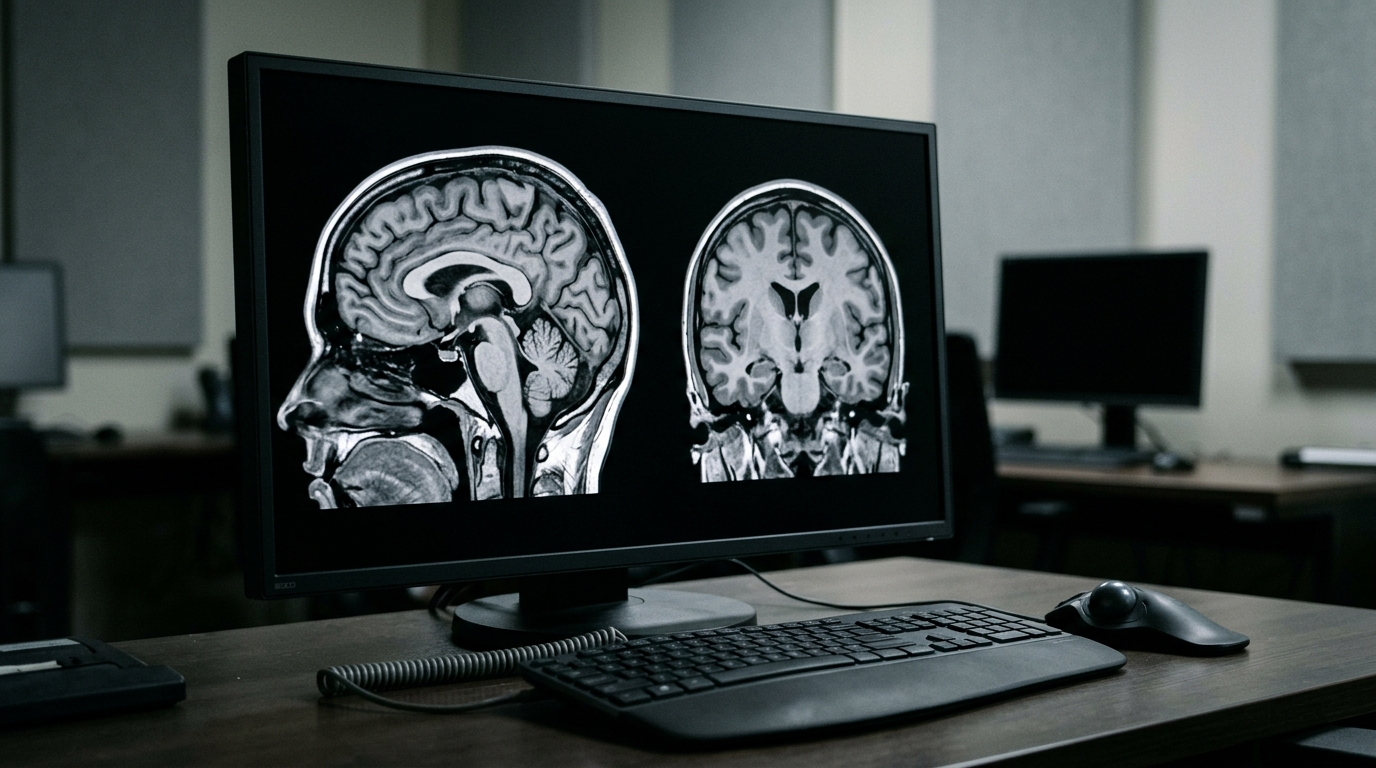
Multimodal neuroimaging demonstrated initial normal brain MRI findings, but follow-up magnetic resonance imaging two years later identified probable left mesial temporal sclerosis, corroborated by subtle increased FLAIR signal and volume loss in the left hippocampus. Fluorodeoxyglucose positron emission tomography indicated mild hypometabolism across the left temporal lobe, while ictal single-photon emission computed tomography demonstrated increased perfusion within the left mesial temporal, insular, and posterior frontal cortices. Functional magnetic resonance imaging confirmed left-hemisphere language dominance. Extensive baseline neuropsychological assessments revealed mild dysexecutive features, attentional vulnerabilities under cognitive load, and significant verbal memory deficits on the Rey Auditory Verbal Learning Test, which worsened post-ictally, alongside preserved non-verbal visual memory on the Rey Complex Figure Test and collateral reports of profound autobiographical lacunes linked to dissociative states.
During pre-operative counselling, neurosurgical clinicians advised the patient of a seventy to eighty percent probability of achieving epileptic seizure freedom, explicitly cautioning that resective surgery targeted his epilepsy rather than his dissociative identity symptoms. The patient subsequently underwent an uneventful left anterior temporal lobectomy and amygdalohippocampectomy. Post-operative histopathological examination of the excised tissue confirmed classical mesial temporal sclerosis within the resected hippocampus, normal neocortical and white matter architecture, focally thickened blood vessels without amyloid-beta deposition, and an increased density of interstitial white-matter neurons and focal neuronal clustering within the amygdala. The surgical procedure was completed without acute post-operative complications, and the patient commenced recovery with the coordinated support of his family network.
Post-surgical follow-up over twenty-six months documented dramatic therapeutic benefits. Following two isolated, ambiguous episodes occurring on a single day two months post-operatively, the patient remained entirely free from epileptic seizures and experienced no further dissociative episodes or identity switches. Post-operative neuropsychological reassessment at eight months demonstrated stable verbal encoding and delayed recall relative to baseline alongside expected mild reductions in recognition cueing, preserved confrontational naming, and measurable improvements across processing speed, executive function, and depression inventories. Conversely, the patient and his family reported substantial subjective improvements in autobiographical memory integration, characterized by spontaneous, unprompted recovery of continuous childhood memories previously segregated across dissociated personality states, corroborated by his sister’s verification of accurate recall for shared past events.
Concurrently, the patient experienced a marked reduction in chronic alexithymia, demonstrating a restored capacity to tolerate and process intense affective states such as anger, fear, and pain that had historically triggered dissociative switches. However, the psychological adjustment following profound neurocognitive changes proved complex; at fifteen months post-surgery, the patient encountered severe emotional distress, guilt regarding past behaviors executed under alter states, and emergent depressive symptoms with suicidal ideation, necessitating psychiatric triage and pharmacotherapy with escitalopram. By twenty-six months post-operatively, his mood disturbances had successfully remitted, his anti-seizure medications were undergoing scheduled weaning, and both the patient and his family reported transformative improvements in overall quality of life and psychosocial engagement, including attending live public sporting events and concerts without distress.
The study authors analyzed these findings through an integrated biopsychosocial lens, noting that while psychological interventions and familial reconciliation provided essential scaffolding, the sharp temporal cessation of dissociation following temporal lobectomy strongly implicates direct neurobiological mechanisms. Under cognitive models of functional seizures, eliminating epileptic events removes primary physiological scaffolds driven by autonomic arousal that trigger dissociative episodes. Furthermore, surgical resection of structurally abnormal limbic structures, particularly the left amygdala and hippocampus, may have eliminated pathological interference within distributed fronto-limbic networks governing affective regulation and memory retrieval. This intervention facilitated neuroplastic reorganization, dampening excessive emotional triggers while allowing previously segregated autobiographical information to reintegrate, highlighting temporal lobe networks as pivotal substrates linking focal epilepsy and severe pathological dissociation.
Subject of Research: Resolution of dissociative episodes and autobiographical memory reintegration following temporal lobectomy in drug-resistant temporal lobe epilepsy
Article Title: Meeting an old mate: unanticipated resolution of dissociative episodes and autobiographical memory reintegration following temporal lobectomy for drug-resistant epilepsy – a case report
Article References: Higson, L., McIlroy, A., Winton-Brown, T., Hunn, M., Laing, J., Nicolo, J.-P., O'Brien, T. J., Eyres, J., Alpitsis, R., Rayner, G., & Coleman, H. (2026). Meeting an old mate: unanticipated resolution of dissociative episodes and autobiographical memory reintegration following temporal lobectomy for drug-resistant epilepsy – a case report. Epilepsy & Behavior Reports, Article 100908. https://doi.org/10.1016/j.ebr.2026.100908
Image Credits: AI Generated
DOI: 10.1016/j.ebr.2026.100908
Keywords: Temporal Lobe Epilepsy, Temporal Lobectomy, Amygdalohippocampectomy, Dissociative Identity Disorder, Functional Dissociative Seizures, Autobiographical Memory, Mesial Temporal Sclerosis, Video-EEG Monitoring, Rey Auditory Verbal Learning Test, Alexithymia, Neuropsychological Assessment, Inter-Identity Amnesia, Levetiracetam, Carbamazepine, Lamotrigine, Limbic Network, Single-Photon Emission Computed Tomography, Adult ADHD
News Source: Ophelia Keating. (November 29, 2026). Dissociative Episodes Unexpectedly Cease After Temporal Lobectomy in Case Report. Scienmag.