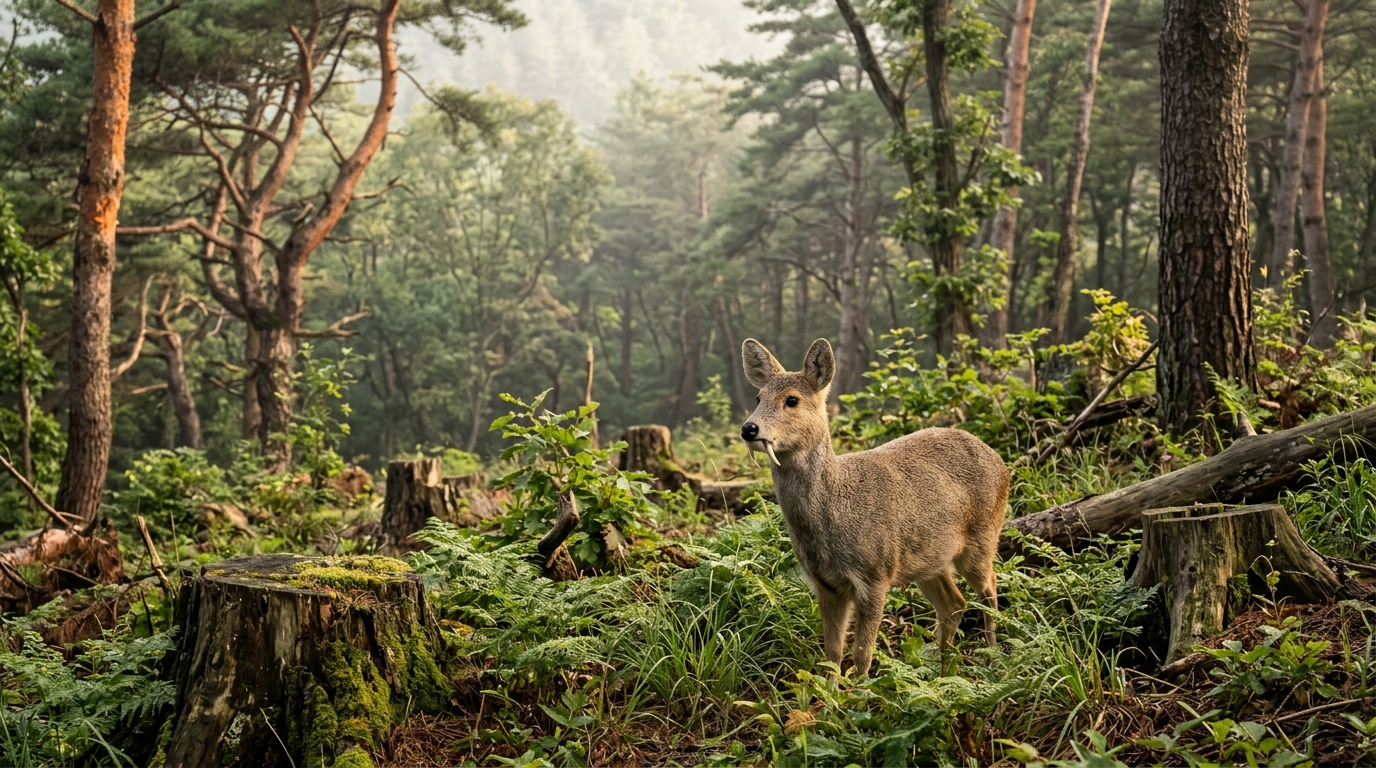
In temperate logged forests across South Korea, evaluating mammal habitat associations conditionally alongside the estimated presence of ecologically related species reveals spatial patterns that are not statistically supported by single-species models alone. An extensive camera-trap investigation published in Landscape Ecology examined how seven medium and large forest mammal species responded to the morphology of logged areas, forest vegetation structure, and anthropogenic features. Using both single-species occupancy models and pairwise multi-species occupancy models across forty-nine mountain sampling stations, the researchers showed that while nominal single-species habitat relationships vanished after false discovery rate corrections, pairwise analyses identified seven statistically supported conditional environmental slopes. These conditional relationships primarily highlighted the importance of simpler logged-area configurations at broader landscape extents and greater local structural connectivity among retained unlogged forest patches.
Commercial clear-cutting, wildfire rehabilitation, and forest stand-improvement operations radically alter landscape mosaics by fragmenting continuous forest cover into heterogeneous configurations of harvested stands and remnant unlogged patches. Ecologists refer to the spatial size, structural complexity, and arrangement of these altered forest tracts as the morphology of logged areas. While previous forestry research concentrated largely on aggregate timber harvest intensity, net forest loss, and broad individual species responses, the structural configuration of logged mosaics and its influence on community-level space use remain far less understood. Furthermore, animal habitat selection operates within an ecological community where the presence or absence of potential predators, prey, or food competitors alters risk perceptions and spatial resource distribution, meaning that environmental associations may manifest differently depending on whether an interacting species occupies the local landscape.
To investigate these dynamics, the research team conducted continuous camera-trap monitoring from June 2022 to June 2023 across seven mountains in six distinct study regions throughout South Korea, including Gumi, Andong, Chungju, and Jeongseon. The study areas occupied an average elevation of 365 meters above sea level within the temperate zone and experienced commercial or restorative timber harvesting between 2018 and 2022. While logging predominantly involved clear-cutting, some study locations retained remnant unlogged strips and clustered tree groups under local forest management guidelines. Harvested sites were subsequently replanted with Japanese larch and Sawtooth oak, establishing young, open stands with reduced tree densities relative to mature, unlogged forest stands dominated by native red pine, oriental oak, and mixed broad-leaved trees.
The monitoring network originally deployed fifty automated camera stations divided between twenty-four logged sites positioned directly inside clear-cut stands and twenty-six unlogged sites situated in adjacent mature forest stands lacking recent clear-cuts. Following data loss at one station, forty-nine stations were retained for systematic analysis, providing a median monitoring duration of 368 days with a cumulative range spanning 57 to 396 operating days. Camera stations were separated by a mean nearest-neighbor distance of 647 meters, ranging from 67 meters to 2,345 meters. Remote camera units were mounted on steel posts in open logged clearings and secured to tree trunks in unlogged stands, programmed to record three consecutive photographic frames per motion trigger at thirty-second intervals, aggregating animal records into independent thirty-minute detection events across ten-day sampling occasions.
From eleven total medium and large mammal species recorded during fieldwork, seven focal species were selected based on consistent detection frequencies and functional assignments across three trophic levels: yellow-throated marten and leopard cat as top predators; raccoon dog and Asian badger as mesopredators; and Korean hare, Siberian roe deer, and water deer as primary herbivores. Highly specialized, rarely detected, or trophically ambiguous taxa—specifically the Eurasian otter, red fox, Siberian weasel, and wild boar—were excluded from community modeling. To assess interspecific contexts without presuming biological interactions beforehand, the researchers defined twelve specific species pairs across three published ecological categories: predator-prey trophic linkages, shared spatial interactions, and potential food competition.
Environmental variation was initially captured through fifty-one candidate variables encompassing logged-area morphology, microhabitat vegetation, human disturbance, and physical topography. Morphology, human infrastructure, and topography were calculated across three predefined concentric extents—local (50 meters), intermediate (500 meters), and broad landscape (1 kilometer)—using satellite imagery and geographic information systems. Vegetation structure, by contrast, was surveyed directly in the field within 11.28-meter-radius circular plots surrounding each camera location, measuring standing and downed wood volume alongside visual foliage density across six vertical strata. Following the removal of zero-variance attributes, forty numerical landscape variables were condensed using principal component analysis, while seven mixed microhabitat vegetation variables were reduced through factor analysis of mixed data. Multicollinearity filtering with variance inflation factors produced thirteen final, orthogonal predictor axes representing five logging morphology dimensions, four vegetation structures, three anthropogenic gradients, and one topographic aspect.
Species-specific annual site-use probabilities were initially estimated through single-species occupancy models evaluating candidate combinations of detection and environmental covariates. Out of more than eighty-four thousand evaluated model formulations, single-species models identified six nominally supported environmental associations for raccoon dog, leopard cat, and Korean hare before multiple-testing adjustments. For instance, raccoon dog site use appeared positively associated with logged-area proportions and negatively associated with distance to hiking trails, while Korean hare site use correlated positively with greater separation between logged patches. Leopard cat site use exhibited a negative relationship with broad-scale logged-area complexity, indicating greater site use in landscapes with simpler geometric configurations at 500-meter and 1-kilometer extents. However, following Benjamini–Hochberg false discovery rate correction across all unique model-averaged tests, none of these six species-level associations retained statistical support, with the lowest adjusted p-value reaching 0.277.
In marked contrast to the single-species results, pairwise multi-species occupancy models implementing a multivariate Bernoulli framework yielded seven conditional environmental associations that retained statistical significance following rigorous false discovery rate corrections. These supported conditional relationships centered recurrently on two morphology gradients: ML1, representing simpler logged-area configuration and higher connectivity of retained unlogged patches at the 50-meter local extent, and ML4, reflecting simpler logged-area configurations across intermediate and broad extents of 500 meters and 1 kilometer. Microhabitat vegetation axis VE1, which characterized greater standing tree volume and canopy overstory cover between 8 and 20 meters, represented the only supported non-morphological variable, positively tracking yellow-throated marten site use specifically when Asian badgers were estimated to be absent.
Examining these relationships within specific ecological pairings revealed distinct directional patterns across predator-prey, competitive, and spatial interaction categories. Under predator-prey contexts, Korean hare site use exhibited a significant negative association with broad-scale logged-area complexity (ML4) when either leopard cat or yellow-throated marten was absent, indicating that hares utilized simpler logged landscapes when free from top predator presence. Similarly, yellow-throated marten site use was strongly and negatively associated with local logging complexity and unlogged patch isolation (ML1) when Korean hares were present. Within spatial interaction and food-competition categories, marten site use remained negatively linked with ML1 when leopard cats were absent and when Asian badgers were absent, while Asian badger site use similarly correlated with simpler local logging mosaics when raccoon dogs were present.
To evaluate whether spatial proximity between adjacent camera stations influenced these mathematical outcomes, the researchers performed sensitivity analyses by systematically excluding one station from each of two closely spaced station pairs separated by less than 100 meters, yielding four distinct 47-site subsets. All seven conditional environmental slopes originally supported under the full 49-site dataset maintained their estimated mathematical directions across all four sensitivity scenarios, and their unadjusted 95% confidence intervals consistently excluded zero. Nevertheless, the number of conditional associations retaining statistical support after subset-specific false discovery rate adjustments varied between zero and five across scenarios, demonstrating that sample composition and spatial point distribution introduce measurable statistical sensitivity into multi-species model estimates.
Crucially, the researchers emphasize that statistical support for an environmental slope under one species state does not demonstrate that animal responses genuinely change because of another species. In the original 49-site analysis, none of the 156 evaluated environmental interaction coefficients governing occupancy dependence (f12) achieved false discovery rate significance, providing no statistical evidence that interspecific residual associations varied across environmental gradients. Instead, the supported conditional patterns reflect condition-specific statistical power, shared habitat affinities, or unmeasured environmental heterogeneity rather than verified interspecific repulsion or attraction.
Subject of Research: Pairwise conditional site-use associations of forest mammals across logged landscapes
Article Title: Species-specific and pairwise conditional site-use associations of forest mammals in logged landscapes
Article References: Kim, M., Park, J. Y., Kim, H. G., & Hong, S. (2026). Species-specific and pairwise conditional site-use associations of forest mammals in logged landscapes. Landscape Ecology, 41(12), Article 239. https://doi.org/10.1007/s10980-026-02497-7
Image Credits: AI Generated
DOI: 10.1007/s10980-026-02497-7
Keywords: Landscape Ecology, Forest Mammals, Logging Morphology, Camera Trapping, Occupancy Modeling, Multi-Species Occupancy Models, Single-Species Occupancy Models, South Korea, Clear-Cutting, Yellow-Throated Marten, Leopard Cat, Korean Hare, Asian Badger, Raccoon Dog, Habitat Fragmentation, False Discovery Rate, Landscape Configuration, Forest Connectivity
News Source: William Thompson. (November 29, 2026). Mammal Site Use in Logged Korean Forests Shows Conditional Spatial Patterns. Scienmag.