In a comprehensive measurement-science review published in Measurement: Energy, researchers Rukmani Singh, Claudia Borri, Francesco Baldini, and Francesco Chiavaioli evaluated optical fiber sensors for operando monitoring of next-generation batteries. Modern rechargeable cells, especially lithium-ion batteries powering electric vehicles and renewable grid storage, remain constrained by nonlinear degradation, limited lifespans, and severe hazards including dendrite formation and thermal runaway. Addressing these operational challenges requires diagnostic tools capable of probing internal physicochemical states with high spatial and temporal resolution. Conventional monitoring methods, including surface thermocouples, strain gauges, pressure transducers, and electrochemical impedance spectroscopy, provide macroscopic data but suffer from limited spatial resolution, electromagnetic susceptibility, and sealed cell incompatibility. Advanced analytical tools like synchrotron X-ray diffraction, electron microscopy, and nuclear magnetic resonance provide fundamental insights, but their cost, complexity, and footprint prevent real-time deployment in operating cells. Embedded optical fiber sensors have therefore emerged as a powerful technology to overcome the traditional black box limitations of working electrochemical energy storage.
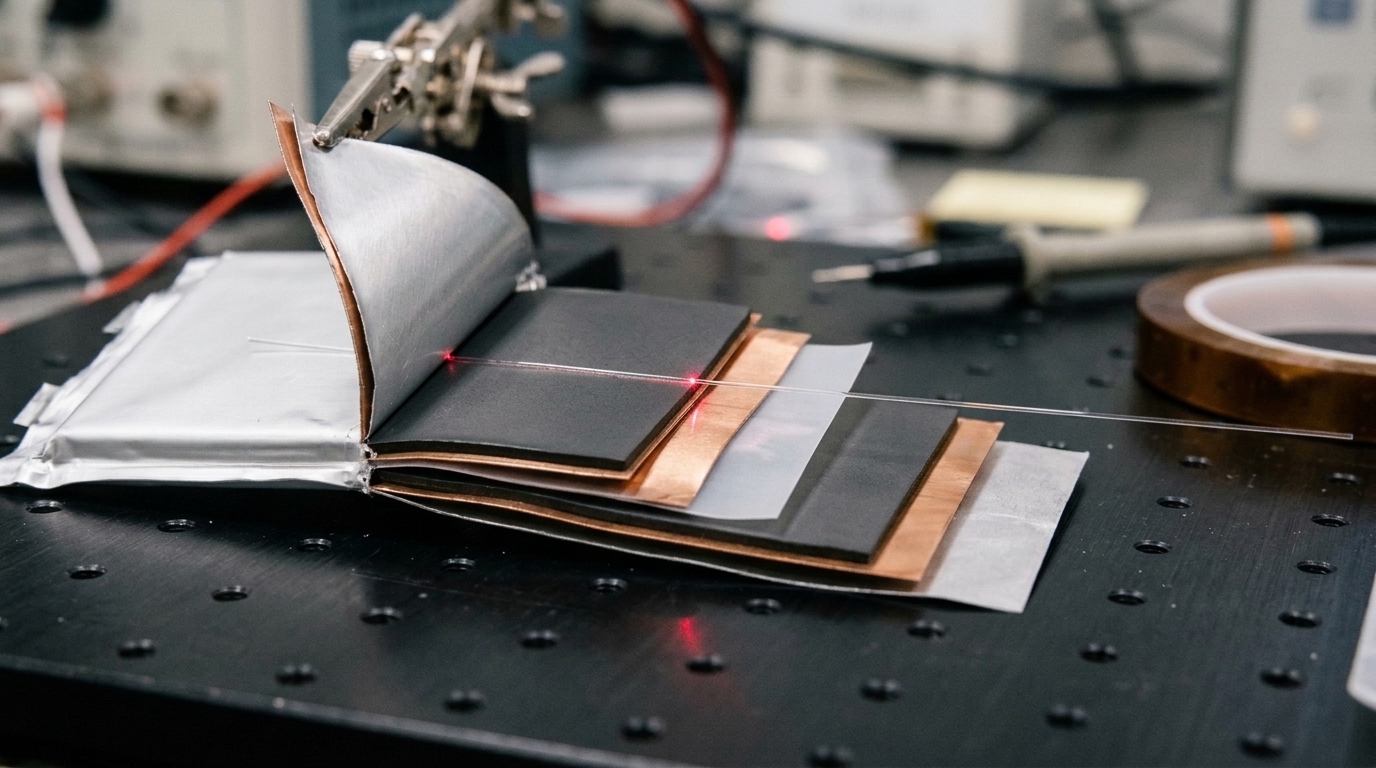
Optical fiber sensors possess a unique combination of physical properties that make them exceptionally well suited for the harsh electrochemical environments inside operational batteries. With miniaturized form factors typically below 250 micrometers in diameter, optical fibers offer intrinsic electromagnetic immunity, chemical inertness, mechanical flexibility, and the capability for long-distance data transmission without signal degradation. These waveguides can be integrated directly between electrode layers, within liquid electrolytes, or along cell casings to monitor internal conditions continuously during charge and discharge cycling. The underlying transduction mechanism relies on light-matter interactions, where local variations in temperature, mechanical strain, surrounding refractive index, or chemical composition alter transmitted or reflected light in terms of wavelength, intensity, phase, or polarization. Importantly, the review clarifies that optical sensors directly measure primary physical quantities rather than electrochemical states. Fundamental operational parameters such as state of charge and state of health cannot be accessed through optical signals alone; instead, they must be inferred through calibrated electrochemical models or data-driven machine-learning algorithms.
Among primary optical sensing architectures, fiber Bragg gratings and tilted fiber Bragg gratings represent the most established devices for battery diagnostics. A standard fiber Bragg grating comprises periodic refractive index modulations etched in the fiber core that reflect a specific Bragg wavelength while transmitting all other spectral components. Shifts in this reflected wavelength respond to surrounding temperature through thermo-optic and thermal expansion effects, and to mechanical strain via the photo-elastic effect. In battery electrodes, cyclic volume fluctuations generate significant mechanical stresses that shift the grating resonance. During lithiation of graphite anodes, lattice expansion of approximately ten percent creates compressive stresses between 10 and 100 megapascals, producing Bragg wavelength shifts of 1 to 5 nanometers over a full charge-discharge cycle, while silicon anodes experience volume changes up to roughly 300 percent. Tilting the grating plane couples guided light into cladding modes, generating a dense comb-like transmission spectrum sensitive to surrounding refractive index variations for chemical monitoring.
The physical strain and thermal signatures captured by fiber Bragg gratings provide direct empirical proxies for battery state estimation and degradation tracking. During continuous cycling, the progressive accumulation of the solid electrolyte interphase on anode surfaces causes long-term volume expansion, registering as a persistent baseline strain drift that tracks cell aging over hundreds of cycles. Cited experimental studies demonstrated that monitoring strain amplitude evolution allows battery state of health tracking over 500 cycles, providing an early warning of impending failure approximately 60 cycles ahead of conventional electrochemical indicators. Furthermore, distributed grating arrays can resolve localized compressive stress hot spots, distinguishing hazardous lithium plating from normal intercalation strain through spatial heterogeneity. When optical proxies for strain, temperature, and refractive index are coupled with machine-learning algorithms, state of charge estimation accuracy exceeds 99 percent under dynamic loading. However, the authors emphasize that predictive accuracy remains model-dependent and sensitive to cell chemistry, posing ongoing challenges for universal battery management deployment.
Combining tilted fiber Bragg gratings with surface plasmon resonance creates hybrid sensors capable of probing nanoscale electrochemical kinetics at electrode-electrolyte interfaces. By coating the tilted grating region with a thin gold film, the evanescent field excites surface plasmon polaritons at the metallic interface. These plasmonic waves exhibit extreme sensitivity to dielectric changes within an evanescent penetration depth of 100 to 500 nanometers, achieving refractive index sensitivities of 100 to 500 nanometers per refractive index unit and resolving ion concentration changes near 0.1 to 1 millimolar. Because the core-guided Bragg resonance remains unaffected by external chemical variations, it provides an inherent reference feature that eliminates temperature cross-sensitivity to less than 0.1 refractive index units per degree Celsius. Researchers have utilized plasmonic tilted gratings to observe localized state of charge variations, track real-time ion transport kinetics, identify lithium depletion preceding metal plating, and evaluate proton intercalation dynamics in aqueous zinc-ion batteries via the temporal derivative of optical transmission.
Interferometric optical fiber configurations provide another high-sensitivity platform, particularly optimized for tracking internal gas evolution, mechanical swelling, and pressure dynamics. Architectures including Fabry-Pérot, Mach-Zehnder, and Michelson interferometers operate by splitting and recombining light waves to produce interference patterns whose phase and spectral dips shift with cavity variations. In battery monitoring, extrinsic Fabry-Pérot sensors enclosing a compressible gas or polymer medium achieve sub-kilopascal pressure resolution across the 0.1 to 5 megapascal range with millisecond response times. In commercial 18650 cells undergoing thermal runaway abuse, hybrid probes integrating a fiber Bragg grating and a Fabry-Pérot cavity sequentially mapped critical failure stages, from initial electrolyte evaporation and solid electrolyte interphase breakdown to separator melting, internal short circuits, and safety vent activation. Additionally, dual-cavity cascaded Fabry-Pérot sensors successfully decoupled electrode swelling from gas-induced pressure. In pouch cells, gas generation preceding visible thermal runaway symptoms by several minutes creates internal pressure rises of 10 to 50 kilopascals, establishing an indispensable early warning window.
Distributed spectroscopic techniques expand optical diagnostics from discrete point measurements to continuous, spatially resolved profiling along standard optical fibers. Systems based on optical frequency domain reflectometry and phase-sensitive optical time-domain reflectometry exploit intrinsic Rayleigh backscattering, while Brillouin and Raman scattering methods provide strain-temperature discrimination and thermal-only mapping. Optical frequency domain reflectometry utilizes swept-frequency lasers and Fourier transformation to achieve sub-centimeter spatial resolution across fiber lengths up to 100 meters, making it ideal for cell and module profiling. In pouch and cylindrical lithium-ion cells, distributed reflectometry resolved internal thermal hotspots and non-uniform current distributions, revealing peak in-plane temperature gradients up to 307 percent larger than readings obtained from co-located surface thermocouples under identical cycling currents. Concurrently, phase-sensitive time-domain reflectometry achieves dynamic acoustic and strain sensing with sub-millisecond temporal resolution, detecting acoustic emission signatures generated during localized gas bubble nucleation. These distributed spectroscopic platforms provide continuous, electromagnetically immune mapping of internal thermal and mechanical fields unattainable through conventional point sensors.
Despite these impressive analytical capabilities, the physical integration of optical fibers introduces serious concerns regarding sensor intrusiveness and electrochemical compatibility within working cells. A standard telecommunication fiber, possessing a 125-micrometer cladding and a 250-micrometer polymer coating, occupies significant volume relative to internal cell components. Commercial battery separators are typically 15 to 25 micrometers thick, while electrode coatings measure 50 to 100 micrometers per side. Consequently, an embedded fiber is five to ten times larger than the separator, creating mechanical stress concentrations, causing separator deformation, and increasing internal short-circuit risks. Synchrotron operando X-ray diffraction on commercial prismatic cells revealed that embedded fibers cause significant local delays in graphite lithiation kinetics, altering LiC6 and LiC12 phase distributions near the fiber at charging rates of 2C and above, despite overall cell capacity remaining unaffected. This confirms that invasive sensors risk reporting localized artifacts rather than true bulk behavior. Mitigating intrusiveness requires positioning fibers parallel to current collectors, adopting reduced-diameter microfibers down to 40 micrometers, or utilizing surface-mounted configurations.
Chemical resilience and feedthrough packaging present additional critical barriers preventing the translation of optical fiber sensors from laboratories to production environments. Standard acrylate coatings swell and delaminate when exposed to organic carbonate solvents like ethylene carbonate, dimethyl carbonate, and ethyl methyl carbonate, producing artificial baseline drift that mimics mechanical strain. Polyimide coatings exhibit superior chemical stability in aggressive electrolytes, while hermetic carbon coatings withstand electrolyte infiltration and thermal extremes up to 400 degrees Celsius. Gold coatings in plasmonic sensors must also remain electrically insulated from current collectors to prevent parasitic electrochemical reactions. Furthermore, cell packaging requires feedthroughs that maintain gas tightness under cycling pressures between 0 and 500 kilopascals and operational temperatures from minus 20 to plus 60 degrees Celsius, while withstanding thermal runaway conditions exceeding 1 megapascal and 200 degrees Celsius. Although epoxy seals function in laboratory prototypes, their hermetic integrity beyond 500 cycles remains unverified. The authors recommend field-wide transparency standards, requiring researchers to report fiber-to-electrode volume ratios and validate electrochemical performance with and without embedded sensors.
Transitioning optical fiber sensing into commercial battery management systems ultimately depends on overcoming severe hardware cost barriers and standardizing industrial packaging. Laboratory-grade optical frequency domain reflectometry interrogators cost between 30,000 and 80,000 dollars, and phase-sensitive systems cost 15,000 to 50,000 dollars, compared to 500 to 10,000 dollars for commercial electrochemical impedance spectroscopy hardware. Viable commercial deployment requires reducing multi-channel interrogator costs below 1,000 dollars per channel through chip-scale photonic integrated circuits, silicon-photonic demodulators, and microcomb lasers, which currently remain early-stage prototypes. Most evaluated sensor configurations currently occupy Technology Readiness Levels between 4 and 5, with only select module-level hybrid networks achieving level 6. Future development must establish automated multi-parameter calibration protocols, cross-sensitivity decoupling techniques, and real-time integration with artificial intelligence-driven digital twins. By fusing optical, electrochemical, and acoustic data streams, next-generation battery management architectures can progress from reactive control to predictive diagnostics, substantially enhancing the safety, cycle life, and operational efficiency of energy storage across electric mobility and grid infrastructure.
Subject of Research: Optical fiber sensors for operando monitoring of advanced rechargeable batteries
Article Title: Optical fiber sensors for operando monitoring of next-generation batteries: a review
Article References: Singh, R., Borri, C., Baldini, F., & Chiavaioli, F. (2026). Optical fiber sensors for operando monitoring of next-generation batteries: a review. Measurement: Energy, 12, Article 100116. https://doi.org/10.1016/j.meaene.2026.100116
Image Credits: AI Generated
DOI: 10.1016/j.meaene.2026.100116
Keywords: optical fiber sensors, operando battery monitoring, fiber Bragg gratings, tilted fiber Bragg gratings, surface plasmon resonance, Fabry-Pérot interferometer, optical frequency domain reflectometry, phase-sensitive OTDR, lithium-ion batteries, thermal runaway diagnostics, internal battery strain, internal gas pressure, sensor intrusiveness, battery management systems, solid electrolyte interphase, state of charge estimation, state of health tracking, photonic integrated circuits
News Source: Denise Maddox. (November 29, 2026). Optical Fiber Sensors Enable Operando Internal Diagnostics Inside Next-Generation Batteries. Scienmag.