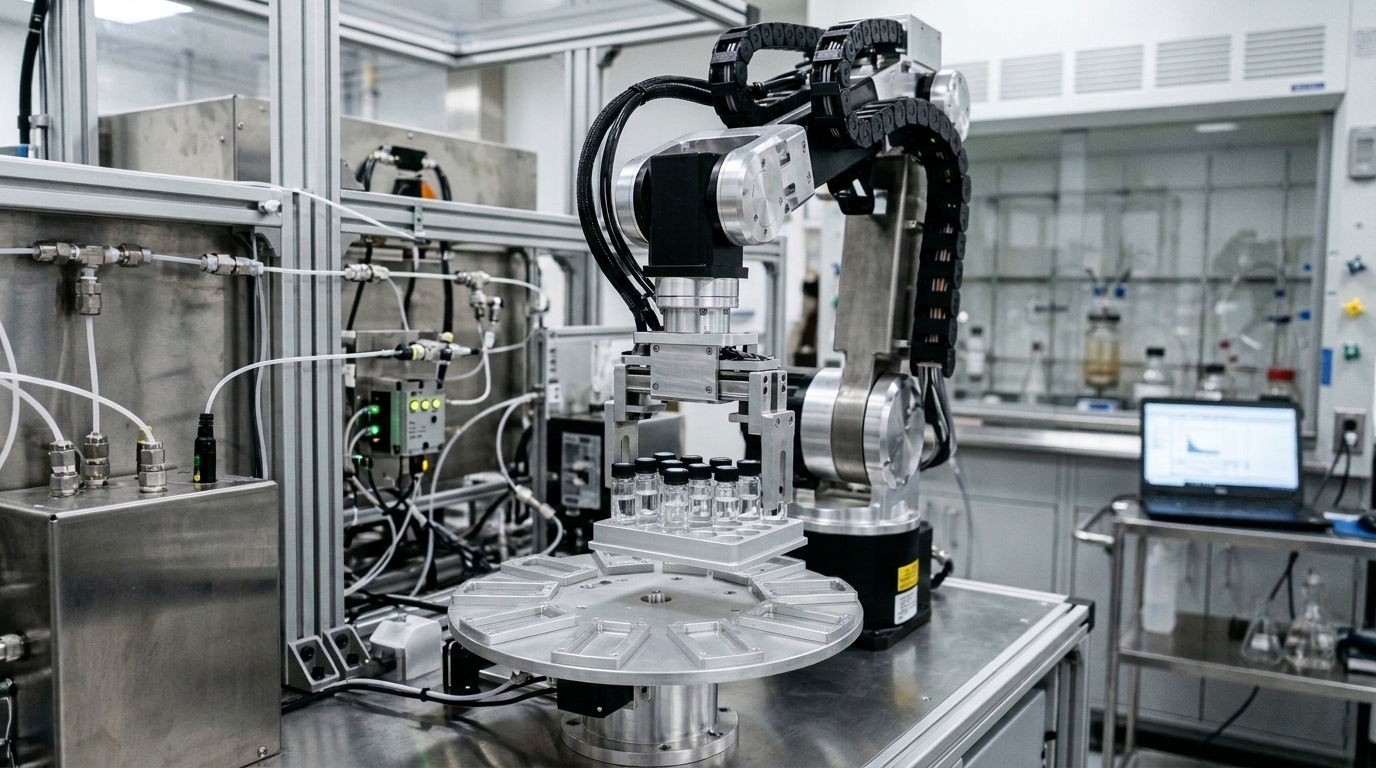
In a perspective published in Nature Machine Intelligence, researchers argue that realizing genuine laboratory autonomy requires moving beyond language-first planning to construct bottom-up operational frameworks grounded in physical execution. Although large language models and agentic reasoning systems have captured attention as tools for accelerating scientific cognition and writing, the authors emphasize that experimental laboratories cannot treat autonomous science primarily as a text problem. Physical investigations must inevitably operate within a reality of instrument-addressable actions, physical constraints, operational latencies, and financial costs. To bridge the gap between high-level conceptual hypotheses and automated physical benchwork, self-driving laboratories require computational structures that directly compile abstract scientific goals into concrete, executable decisions across laboratory hardware.
To establish this operational foundation, the authors propose three core operational principles for guiding autonomous discovery systems. First, self-driving facilities should implement an information-efficiency objective designed to maximize decision-relevant information gained per unit of experimental expenditure. Satisfying this benchmark requires researchers to unite comprehensive data acquisition strategies with minimal, decisive experimental designs that avoid wasted instrument time. Second, scientific hypotheses must be formally compiled into well-defined experimental footprints. These footprints encompass accessible physical actions, operational constraints, measurable observables, and deterministic or probabilistic decision rules. Third, reward design must be recognized as a pivotal bottleneck within closed-loop experimentation, particularly when researchers must compress complex, high-dimensional diagnostic measurements into scalar utilities or sequence decisions across multi-step research campaigns.
The authors frame self-driving laboratories not as simple automated optimizers, but as long-horizon, out-of-distribution discovery engines. Within this perspective, translating localized laboratory-scale optimization into durable technological and manufacturing achievements demands accelerating the entire experiment, model, and decision loop. Critically, the authors stress that automated workflows must prioritize uncovering durable physical and chemical mechanisms rather than merely exploiting short-term statistical correlations. The immediate operational milestone for the scientific community should therefore focus on operational intelligence rather than immediate full autonomy. This operational intelligence centers on the systemic capacity to iterate faster across coupled experimental stages, design parsimonious experiments, preserve rich provenance records, and continuously accumulate mechanistic knowledge capable of generalizing far beyond local experimental conditions.
To advance self-driving laboratories from isolated laboratory demonstrations into enduring scientific infrastructure, the authors outline several concrete engineering targets. First, research workflows and scientific hypotheses must be expressed as standardized experimental footprints linked with auditable decision traces. Making operational constraints, costs, and decision logic completely explicit ensures that experimental protocols become portable across institutions rather than remaining trapped as implicit, laboratory-specific domain folklore. Furthermore, progress in laboratory automation must be rigorously evaluated across two interdependent dimensions. Rather than evaluating isolated instruments solely through localized throughput increases, performance assessments must balance step-level key performance indicators against downstream propagation metrics that track how localized improvements genuinely alter discovery efficiency in subsequent analytical stages.
A third major objective focuses on treating reward functions as formal scientific artefacts. The authors advocate establishing standardized reward reports and open, reusable reward libraries that make explicit precisely what objective is being optimized, which physical invariances and failure modes are accounted for, and how multi-dimensional sensor data are compressed into actionable utility metrics. In parallel, autonomous planning systems must integrate techno-economic footprint estimators as primary modules. By calculating the physical feasibility, operational latency, and monetary cost of potential experiments directly at the planning stage, these modules tether abstract idea generation to real-world feasibility. Additionally, autonomous operations cannot scale across multiple institutions without modular, composable workflow objects managed by constraint-aware orchestration frameworks that replace brittle, ad hoc laboratory scripts.
Alongside workflow orchestration and automated execution, the authors emphasize that autonomous laboratories must actively invest in the complementary discipline of learning fundamental physics from experimental data. Consequently, self-driving platforms must extract causal physical mechanisms, symmetry invariants, and uncertainty-calibrated surrogate models to guide physical decisions into entirely new parameter regimes.
Although many concrete examples cited in the perspective emerge from advanced microscopy and materials characterization, the underlying operational principles apply across diverse scientific domains. In flow chemistry and robotic chemical synthesis, these operational semantics manifest as executable actions governing reagent dosing, mixing, temperature regulation, residence times, purification protocols, and sample collection, directed by reward functions evaluating yield, chemical selectivity, or safety thresholds. In high-throughput biological workflows, identical foundations translate into automated liquid handling, incubation schedules, and multi-well assay execution, guided by rewards measuring cell growth, gene expression, or phenotypic profiles under strict viability constraints. Across catalysis testing, chromatography, and optical spectroscopy, the operational imperative remains consistent: hypotheses must reliably compile into executable instrument actions governed by explicit constraints, auditable decision traces, and transparent reward architectures.
Subject of Research: Operational frameworks and reward functions for self-driving laboratories
Article Title: Enabling lab autonomy with reward functions and executable workflows
Article References: Kalinin, S. V., Slautin, B. N., Liu, Y., Foadian, E., Duscher, G., Ahmadi, M., & Bazhirov, T. (2026). Enabling lab autonomy with reward functions and executable workflows. Nature Machine Intelligence. https://doi.org/10.1038/s42256-026-01339-0
Image Credits: AI Generated
DOI: 10.1038/s42256-026-01339-0
Keywords: self-driving laboratories, laboratory autonomy, executable workflows, reward functions, closed-loop experimentation, operational intelligence, experimental footprints, decision traces, techno-economic footprint estimators, constraint-aware orchestration, information efficiency, mechanistic knowledge, flow chemistry, synthesis robotics, high-throughput biology, materials characterization, surrogate models
News Source: Denise Maddox. (November 28, 2026). Self-Driving Laboratories Require Executable Workflows and Explicit Rewards to Reach Autonomy. Scienmag.