• HOME
  • NEWS
  • EXPLORE
    • CAREER
      • Companies
      • Jobs
    • EVENTS
    • iGEM
      • News
      • Team
    • PHOTOS
    • VIDEO
    • WIKI
  • BLOG
  • COMMUNITY
    • FACEBOOK
    • INSTAGRAM
    • TWITTER
Saturday, November 28, 2026
BIOENGINEER.ORG
No Result
View All Result
  • Login
  • HOME
  • NEWS
  • EXPLORE
    • CAREER
      • Companies
      • Jobs
        • Lecturer
        • PhD Studentship
        • Postdoc
        • Research Assistant
    • EVENTS
    • iGEM
      • News
      • Team
    • PHOTOS
    • VIDEO
    • WIKI
  • BLOG
  • COMMUNITY
    • FACEBOOK
    • INSTAGRAM
    • TWITTER
No Result
View All Result
Bioengineer.org
No Result
View All Result
Home NEWS Science News Technology

Computational Screening Identifies Anion-Pillared Frameworks for Helium Separation from Gas Mixtures

by
November 28, 2026
in Technology
Reading Time: 2 mins read
0
Computational Screening Identifies Anion-Pillared Frameworks for Helium Separation from Gas Mixtures

Computational Screening Identifies Anion-Pillared Frameworks for Helium Separation from Gas Mixtures

Share on FacebookShare on TwitterShare on LinkedinShare on RedditShare on Telegram

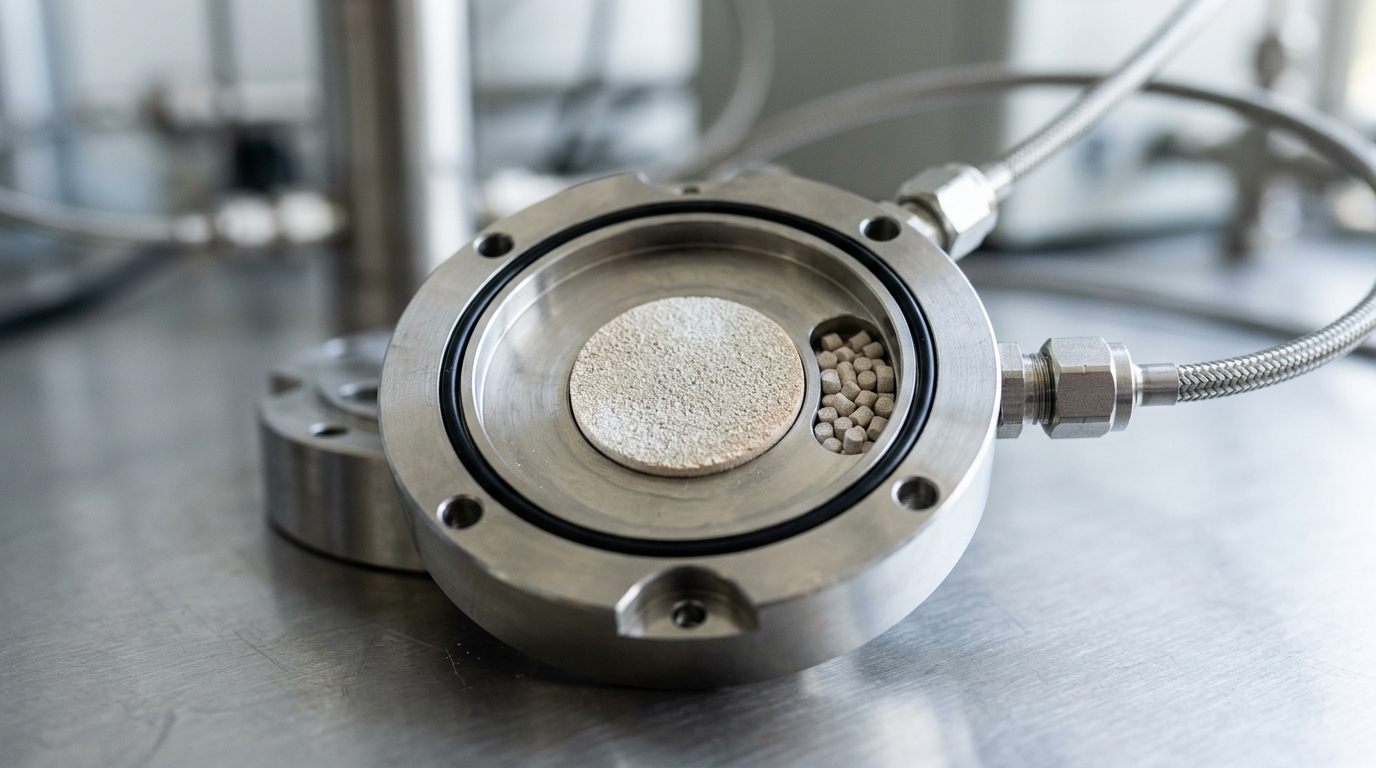
A computational investigation has evaluated the structural characteristics and separation potential of 936 anion-pillared metal–organic frameworks for isolating helium from ternary gas mixtures. Researchers focused on the separation of helium from methane and nitrogen, targeting an ongoing technical demand for efficient, economical, and safe helium purification technologies using porous adsorbent media.

Structural characterization across the 936 candidate frameworks mapped key geometric metrics governing molecular adsorption. Across the set, the materials exhibited largest cavity diameters ranging between 3.17 and 12.51 Å, alongside pore limiting diameters spanning 2.15 to 11.22 Å. The accessible surface areas ranged from 0 to 4659 m²/g, while the accessible pore volumes varied from 0 to 1.41 cm³/g.

To evaluate gas separation performance within the ternary methane, nitrogen, and helium mixtures, the study employed high-throughput grand canonical Monte Carlo simulations. These molecular simulations measured the selective uptake and adsorption behaviors across the structural library, allowing the identification of the top-performing framework candidates within the investigated collection.

Using the simulation results, the investigators constructed machine learning models to map the relationships connecting the geometric features of the frameworks to their separation characteristics. The trained models demonstrated the ability to predict separation performance parameters directly from the underlying structural metrics of the porous materials.

Following the broader computational screening, the authors selected three representative high-performing framework structures to examine gas–adsorbent interactions at the molecular scale. Detailed analysis of these three systems provided specific insight into the microscopic interaction mechanisms occurring between the gas molecules and the framework surfaces.

The authors reported that the systematic modeling and machine learning framework provide theoretical context and structural design guidelines for identifying porous adsorbent materials for helium purification.

Subject of Research: High-throughput computational screening of anion-pillared metal–organic frameworks for helium purification

Article Title: Machine-learning-assisted high-throughput computational investigation of helium purification from CH4/N2/He mixture in APMOFs

Article References: Li, X.-D., Liu, C.-X., Li, J.-X., Liu, X.-Y., Wei, Y.-K., Tian, W.-F., Wang, J.-F., & Li, P. (2026). Machine-learning-assisted high-throughput computational investigation of helium purification from CH4/N2/He mixture in APMOFs. Journal of Materials Science. https://doi.org/10.1007/s10853-026-14154-0

Image Credits: AI Generated

DOI: 10.1007/s10853-026-14154-0

Keywords: helium purification, metal-organic frameworks, APMOFs, computational screening, grand canonical Monte Carlo, machine learning, gas separation, porous materials, methane separation, nitrogen separation, pore limiting diameter, largest cavity diameter, accessible surface area, pore volume, molecular simulation

News Source: Denise Maddox. (November 28, 2026). Computational Screening Identifies Anion-Pillared Frameworks for Helium Separation from Gas Mixtures. Scienmag.


Tags: accessible surface areaAPMOFscomputational screeninggas separationGrand Canonical Monte Carlohelium purificationlargest cavity diameterMachine LearningMetal-Organic Frameworksmethane separationmolecular simulationnitrogen separationpore limiting diameterpore volumeporous materials
Share12Tweet7Share2ShareShareShare1

Related Posts

Refinement Pipeline Enhances Skeleton Detection in Clinical Gait Analysis Videos

Refinement Pipeline Enhances Skeleton Detection in Clinical Gait Analysis Videos

November 28, 2026
Regulatory Uncertainty in Brazilian Offshore Wind Shapes Stakeholder Power Dynamics

Regulatory Uncertainty in Brazilian Offshore Wind Shapes Stakeholder Power Dynamics

November 28, 2026

Knowledge-Guided Multi-Agent Reinforcement Learning Improves Dormitory Risk Management in Simulation

November 28, 2026

Scoping Review Finds Language Models Aid Biomedical Knowledge Graphs Under Controlled Workflows

November 28, 2026

POPULAR NEWS

  • Review Links Thyroid Peroxidase Gene Variants to Elevated Autoantibodies in Hashimoto Thyroiditis

    Review Links Thyroid Peroxidase Gene Variants to Elevated Autoantibodies in Hashimoto Thyroiditis

    29 shares
    Share 12 Tweet 7
  • Male Preterm Infants Face Higher Bronchopulmonary Dysplasia Risk in Cohort Study

    29 shares
    Share 12 Tweet 7
  • Moderate Altitude Triggers Early Physiological Shifts and Challenges Aerobic Exercise Performance

    29 shares
    Share 12 Tweet 7
  • Structured Keywords Outperform Deep Language Models in Journal Editor Assignment System

    29 shares
    Share 12 Tweet 7

About

We bring you the latest biotechnology news from best research centers and universities around the world. Check our website.

Follow us

Recent News

Inter-Dose Hormone Change Predicts Failure After Two-Dose Methotrexate for Ectopic Pregnancy

Refinement Pipeline Enhances Skeleton Detection in Clinical Gait Analysis Videos

SgSPX1 Regulates Phosphate Homeostasis and Starvation Response in Tropical Legume Stylosanthes guianensis

Subscribe to Blog via Email

Enter your email address to subscribe to this blog and receive notifications of new posts by email.

Join 89 other subscribers
  • Contact Us

Bioengineer.org © Copyright 2023 All Rights Reserved.

Welcome Back!

Login to your account below

Forgotten Password?

Retrieve your password

Please enter your username or email address to reset your password.

Log In
No Result
View All Result
  • Homepages
    • Home Page 1
    • Home Page 2
  • News
  • National
  • Business
  • Health
  • Lifestyle
  • Science

Bioengineer.org © Copyright 2023 All Rights Reserved.