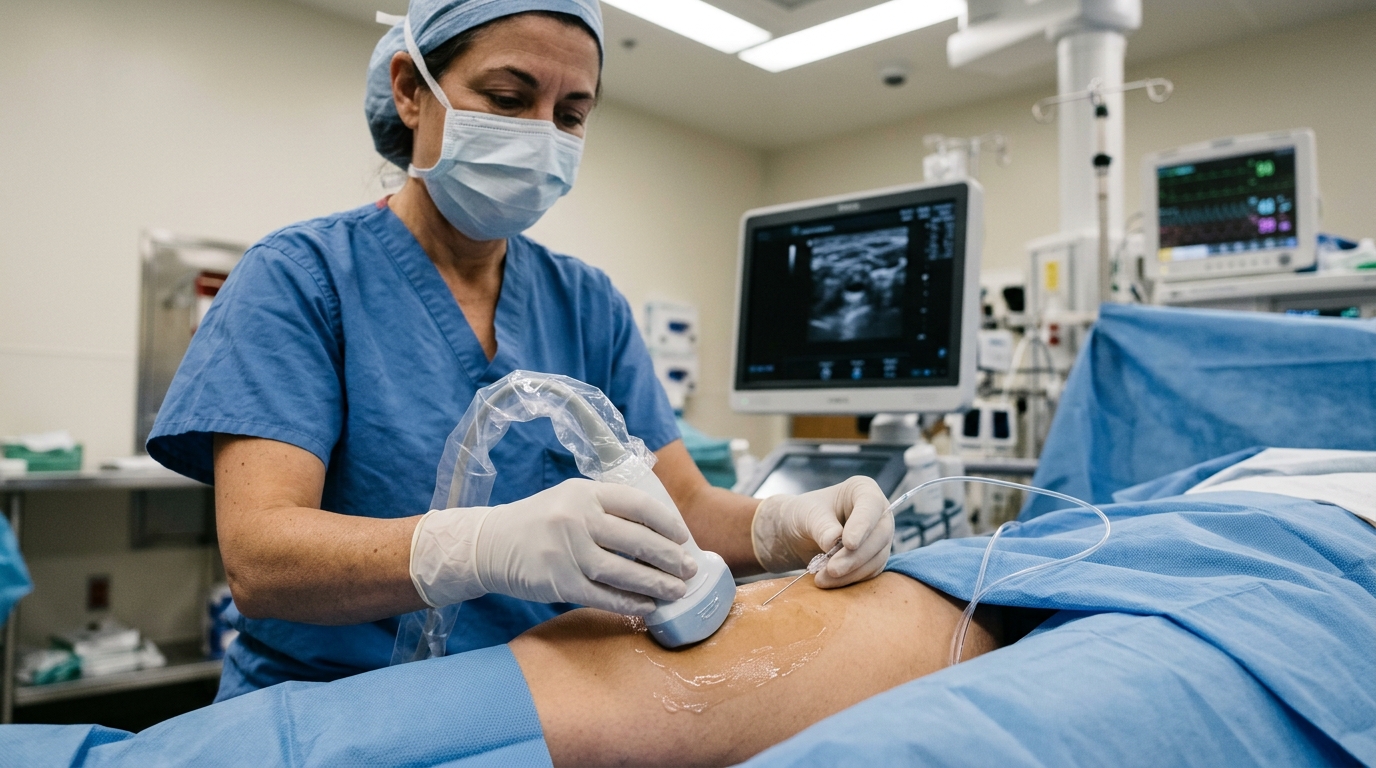
In a retrospective cohort study evaluating primary surgical anesthesia techniques for total knee arthroplasty, clinical researchers at Peking University Third Hospital found that a triple peripheral nerve block regimen was associated with no intraoperative vasopressor use compared with traditional spinal anesthesia combined with a femoral block. The study, published in Frontiers in Medicine, directly addressed an ongoing gap in clinical evidence regarding whether targeted peripheral nerve blockade can serve effectively as a primary surgical anesthetic rather than merely an adjunct for postoperative pain management. In standard orthopedic practice, spinal anesthesia frequently induces sympathetic nerve blockade that precipitates systemic hypotension, requiring vasoactive medication to maintain mean arterial pressure. By contrast, the peripheral nerve block regimen investigated in the study achieved complete surgical anesthesia while preserving sympathetic tone and improving early postoperative resting pain scores.
The retrospective single-center investigation examined records from 101 consecutive patients screened for unilateral total knee arthroplasty at the Northern Branch of Peking University Third Hospital between January 1 and December 31, 2023. This specific calendar window was selected because 2023 marked the year when primary peripheral nerve block anesthesia became routinely accessible at the facility. Eligibility criteria encompassed adult patients aged 18 years or older classified with American Society of Anesthesiologists physical status I through III who underwent primary unilateral knee replacement under either combined peripheral nerve blockade or spinal anesthesia with femoral nerve block, supported by complete medical records. The investigators excluded patients undergoing bilateral or revision knee procedures, individuals with histories of psychiatric disorders, regular narcotic users, patients with incomplete documentation for either primary outcome, those who failed to complete their planned anesthesia protocol, and those undergoing multiple surgical procedures during a single hospitalization.
Following protocol-defined exclusions, which removed thirteen patients during initial screening for psychiatric conditions, regular narcotic consumption, or incomplete documentation, eighty-eight patients remained eligible. Two additional patients in the spinal anesthesia cohort were excluded following failed neuraxial puncture that necessitated intraoperative conversion to general anesthesia, leaving a final analytical cohort of 86 patients. Within this final group, 30 patients received primary combined peripheral nerve blocks and 56 patients received spinal anesthesia with an adjunct femoral nerve block. Conversion to general anesthesia had been prespecified as an exclusion criterion for comparative analysis because general anesthesia could confound intraoperative hemodynamic and postoperative pain outcomes, ensuring that all analyzed patients were managed entirely under their allocated regional protocols.
The primary peripheral nerve block regimen comprised ultrasound-guided blocks of the proximal sciatic, femoral, and obturator nerves administered while patients remained in the supine position. Anesthesiologists used a total volume of 40 mL of 0.4% ropivacaine, formulated by diluting 16 mL of 1% ropivacaine with 24 mL of sterile normal saline, delivered through a 100-mm echogenic needle under continuous visualization. For the sciatic nerve block, a low-frequency curvilinear transducer was placed transversely over the anteromedial thigh approximately 8 to 9 centimeters distal to the inguinal crease, delivering 15 mL of local anesthetic around the nerve via the adductor magnus approach. The femoral nerve block utilized 15 mL of local anesthetic injected under linear transducer guidance from lateral to medial, while the obturator block delivered 5 mL between the adductor longus and adductor brevis muscles for the anterior branch and another 5 mL between the adductor brevis and adductor magnus muscles for the posterior branch.
Patients assigned to the comparator group received an identical ultrasound-guided femoral nerve block using 15 mL of local anesthetic followed by spinal puncture in the lateral decubitus position. Following confirmation of free cerebrospinal fluid return at the lumbar L3 to L4 interspace through a midline approach, clinicians injected between 2 and 3 mL of 0.5% hyperbaric bupivacaine, with the precise intrathecal volume determined by patient characteristics and clinical judgment before repositioning the patient supine. In both cohorts, sensory blockade was verified by pinprick testing 20 minutes after injection; successful blockade in the peripheral nerve group required complete loss of pinprick sensation across the anterior thigh, medial mid-thigh, plantar foot, dorsal foot, and posterolateral leg, whereas successful spinal anesthesia required a bilateral dermatomal sensory block reaching the T8 to T10 level prior to surgical incision.
Intraoperative monitoring followed standard protocols including electrocardiography, noninvasive blood pressure tracking, pulse oximetry, and supplemental oxygen delivered at 3 to 5 liters per minute via facemask, alongside thigh tourniquet inflation maintained at 280 mmHg. Continuous intravenous dexmedetomidine hydrochloride sedation was infused at 0.4 to 0.7 micrograms per kilogram per hour without a loading dose in both groups. Intraoperative hypotension, defined as a mean arterial pressure below 65 mmHg, was treated using bolus doses of intravenous phenylephrine at 40 micrograms or ephedrine at 5 to 10 milligrams to maintain a target pressure between 65 and 100 mmHg. When patients exhibited procedural intolerance or signs of inadequate sensory coverage, supplemental analgesia was administered as intravenous sufentanil boluses of 5 micrograms, while incision-site infiltration with 10 mL of 1% lidocaine was permitted as a local rescue measure.
The study designated two co-primary endpoints: the intraoperative vasopressor administration rate and the rescue analgesic utilization rate during the initial 12 postoperative hours. Among patients undergoing spinal anesthesia with femoral block, 11 of 56 individuals, representing 19.6 percent of the cohort, required intraoperative vasopressor boluses, whereas none of the 30 patients in the combined peripheral nerve block group required vasopressor support. This absolute risk difference of 19.6 percentage points, with a 95% confidence interval spanning from 5.6 to 31.8 percentage points, achieved statistical significance with an unadjusted p-value of 0.007 and a Holm-Bonferroni-adjusted p-value of 0.014. Meanwhile, the second co-primary endpoint demonstrated no statistically significant difference between cohorts, as rescue analgesia within 12 hours was administered to 10.7 percent of the spinal group and 6.7 percent of the nerve block group, yielding a risk difference of 4.0 percentage points and an adjusted p-value of 0.708.
Evaluation of secondary postoperative pain metrics revealed a distinct early advantage for the combined peripheral nerve block strategy. Resting pain scores measured on an 11-point numerical rating scale at 12 hours postoperatively were significantly lower in the peripheral nerve block group, which recorded a median score of 0 with an interquartile range of 0 to 2, compared with a median score of 2 and an interquartile range of 2 to 2 in the spinal group, reflecting a statistically significant difference (p < 0.001). However, this analgesic divergence resolved over subsequent observation windows; resting pain scores at 24, 48, and 72 hours postoperatively remained uniformly low across both groups with identical medians of 2.0. Similarly, rescue analgesic consumption showed no meaningful differences during the 12 to 24, 24 to 48, or 48 to 72-hour intervals, aligning with the expected clinical duration of single-injection local anesthetic blockade alongside the scheduled multimodal oral and intravenous analgesia administered to all patients.
Functional recovery milestones and longitudinal joint mobility assessments showed largely comparable trajectories across the two anesthetic techniques. Every patient in both treatment cohorts achieved initial ambulation on postoperative day 1. The documented initiation of formal physician-supervised rehabilitation occurred earlier in the peripheral nerve block group with a statistically significant distributional difference (p = 0.002), although both cohorts exhibited an identical median start day of postoperative day 3. Postoperative hospital discharge trended earlier in the peripheral nerve block group, with a median of 4.0 days compared to 5.0 days in the spinal group, though this difference did not attain statistical significance (p = 0.068). Longitudinal linear mixed-effects modeling of knee range of motion across 81 patients at 4 weeks and 76 patients at 12 weeks demonstrated substantial time-dependent improvements in active flexion and extension deficit across both groups, without significant main effects of anesthetic technique or group-by-time interactions.
The investigators emphasized several important clinical and methodological limitations inherent to their retrospective single-center design. Anesthetic selection reflected non-random clinical decisions made by attending physicians, introducing potential selection bias, as evidenced by a significantly higher baseline prevalence of lumbar spine disease in the peripheral nerve block group (16.7 percent versus 3.6 percent, p = 0.047). A sensitivity analysis excluding the seven patients with lumbar spine disease confirmed the persistence of the primary findings, demonstrating a 20.4 percentage point vasopressor risk difference (p = 0.014) and maintained 12-hour pain score reductions. Nonetheless, the modest sample size, low absolute event rates, and absence of continuous hemodynamic duration tracking limit definitive equivalence conclusions, prompting the authors to recommend prospective, randomized multicenter trials with active adverse event surveillance to confirm these findings.
Subject of Research: Comparative perioperative and analgesic outcomes of combined peripheral nerve blocks versus spinal anesthesia in total knee arthroplasty
Article Title: Combined peripheral nerve block as primary anesthesia versus spinal anesthesia with femoral nerve block for total knee arthroplasty: a retrospective cohort study
Article References: Dun, Y., Wang, L., Wu, C., Liu, Y., Yao, Y., & Qu, Y. (2026). Combined peripheral nerve block as primary anesthesia versus spinal anesthesia with femoral nerve block for total knee arthroplasty: a retrospective cohort study. Frontiers in Medicine, 13, Article 1996708. https://doi.org/10.3389/fmed.2026.1996708
Image Credits: AI Generated
DOI: 10.3389/fmed.2026.1996708
Keywords: total knee arthroplasty, peripheral nerve block, spinal anesthesia, femoral nerve block, sciatic nerve block, obturator nerve block, intraoperative vasopressors, hemodynamic stability, ropivacaine, bupivacaine, postoperative analgesia, numerical rating scale, knee range of motion, functional rehabilitation, enhanced recovery after surgery, orthopedic surgery, Peking University Third Hospital, hypotension
News Source: Ophelia Keating. (November 27, 2026). Combined Peripheral Nerve Blocks Associated With Lower Vasopressor Use in Knee Replacement. Scienmag.