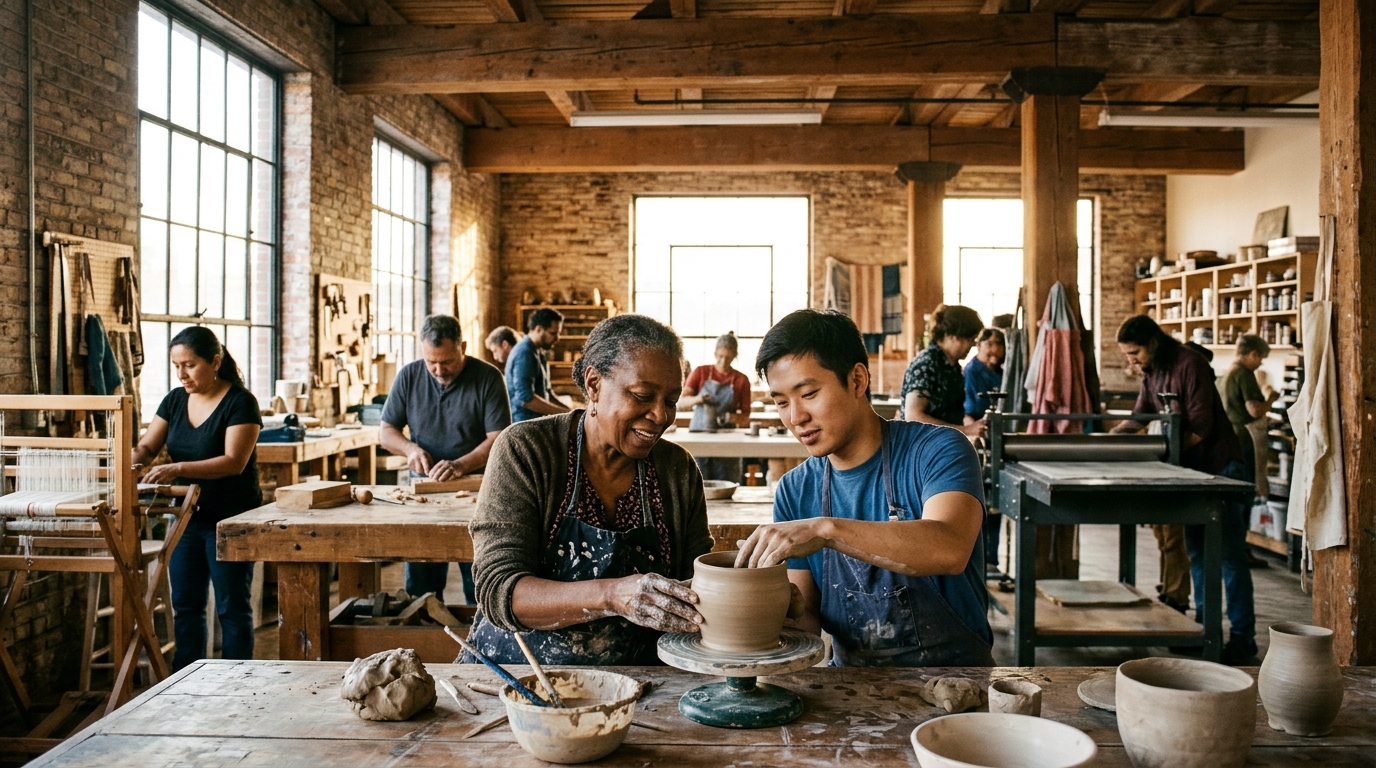
Urban regeneration driven by creative initiatives does not inevitably trigger gentrification or the displacement of long-standing neighborhood residents, according to an extensive empirical study published in Frontiers of Urban and Rural Planning by researchers Yue Gao, Jiaxin Qi, Wenli Xie, and Huang Huang. Evaluating the micro-scale dynamics of contemporary cities, the research team established that cultural and creative regeneration unfolds across three interrelated yet analytically distinct mechanisms: industrial introduction, dedicated space-making, and event-led activity activation. By examining fine-grained point of interest mapping data and comparative neighborhood case interventions across Shanghai and Berlin, the authors demonstrated that social outcomes rely heavily on whether incoming creative functions establish substantive ties with existing resident networks, local third-sector organizations, and inclusive municipal governance structures rather than acting solely as speculative capital investments or isolated economic enclaves.
The theoretical framework developed in the study departs from traditional urban economic perspectives that conceptualize creative industries as a single, uniform production sector. Instead, the authors conceptualized creative industries as a heterogeneous industrial system focused on symbolic value production, intellectual property generation, and knowledge-intensive services. Creative spaces were defined as relational settings where production, cultural consumption, and public social encounters intersect, while creative activities were identified as processual media that link physical sites with everyday neighborhood routines through both visible gatherings and cooperative knowledge exchanges. The study underscored that while historical urban models relied heavily on land expansion and wholesale structural demolition, modern cities face stock-based spatial constraints that require endogenous optimization and functional reuse of existing built environments to restore localized economic vitality and civic engagement.
For Shanghai, the team obtained 39,734 records under the science, education, and cultural services classification from the AutoNavi Map application programming interface, ultimately retaining 36,245 functional points after excluding non-creative facilities such as driving schools, kindergartens, and internal campus installations. For Berlin, the dataset encompassed 5,534 verified points of interest spanning higher education facilities, exhibition halls, art galleries, libraries, media enterprises, museums, specialty retailers, cinemas, and performing arts theaters. The researchers cautioned that while differing classification granularities and administrative scales prevented direct comparisons of absolute numbers, structural distributions and functional mixing could be robustly evaluated across both urban environments.
Spatial concentration was modeled across both cities using kernel density estimation configured with an output cell resolution of 100 meters, an exploratory search bandwidth of 1,000 meters, and density values calibrated per square kilometer. Functional diversity was subsequently calculated using standardized Shannon entropy formulas applied across regular geographic grids, measuring the balance and variety of functional categories across each cell. In Shanghai, the functional mix was calculated across a regular one-square-kilometer grid evaluating sixteen distinct categorical types. In Berlin, the assessment utilized a half-square-kilometer grid evaluating nine functional categories. The analytical team treated these point of interest coordinates specifically as spatial proxies identifying the locations of potential infrastructural carriers rather than as direct measurements of cultural event frequency or total economic productivity.
The spatial modeling revealed marked contrasts between the foundational creative anchors supporting Shanghai and Berlin. In Shanghai, kernel density distributions revealed a pronounced core-periphery gradient, forming a continuous high-density belt spanning the central districts of Xuhui, Changning, Jing’an, Huangpu, Hongkou, and Yangpu. Dense clusters emerged around key institutional and commercial nodes, including the Metro City district in Xuhui, the Wujiaochang university zone in Yangpu, and major cultural destinations near the Oriental Pearl Tower and Shanghai Science and Technology Museum in Pudong New District. In Berlin, kernel density analysis demonstrated a continuous multi-nodal concentration extending from Mitte through Charlottenburg-Wilmersdorf westward and Friedrichshain-Kreuzberg eastward, alongside secondary neighborhood clusters in Prenzlauer Berg, Neukölln, and Steglitz-Zehlendorf. While Shanghai’s creative core relied heavily on academic institutions and research organizations, Berlin exhibited high concentrations of public-facing exhibition halls, art galleries, and media producers embedded directly into residential quarters.
Shannon entropy calculations confirmed that high functional mixing coincided with central urban cores while displaying distinct structural relationships with gross density. Across central Shanghai and Berlin’s inner neighborhoods, grid cells displayed continuous high diversity, indicating the co-location of research, cultural display, media production, and public services within walking distances. However, the researchers noted that density and functional mix do not always align uniformly; certain high-density zones reflected specialized single-sector agglomerations, whereas several lower-density peripheral neighborhoods maintained balanced functional mixtures.
To evaluate how these structural patterns materialize in operational practice, the authors evaluated detailed micro-scale regeneration initiatives in both cities, starting with space-led transformation at the Super Tube project in Shanghai. Initiated in 2022 along the Suzhou River at the intersection of Jiangsu North Road and Wanhangdu Road, this project reclaimed 1,880 square meters of previously neglected sheltered space beneath an expressway viaduct. Confronted with low clearance and utilitarian infrastructure, designers avoided concealing on-site municipal pipelines and sanitation equipment, instead converting them into bold geometric motifs highlighted with saturated color palettes. Incorporating historic industrial iconography drawn from nearby historic flour mills, mints, and breweries, the site was transformed into an age-inclusive public park hosting weekend music gatherings and a self-operated pocket cafe that successfully restored neighborhood attachment for an aging local population.
A complementary community-led activation pathway was documented at the Chuangzhi Community Garden, established in 2016 within an interstitial residual parcel in Shanghai’s compact Wujiaochang subdistrict. Operational management was structured around multi-stakeholder governance integrating professional landscape designers, resident volunteers, and third-sector civil society organizations. By organizing continuous public programming, including seasonal farmers’ markets, botanical dyeing workshops, and plant-swapping days, the initiative transformed dormant highway-adjacent ground into an active social common that bridges surrounding residential communities and neighboring corporate technology parks.
In Berlin, the researchers analyzed industrial heritage reuse at Marienpark in the Mariendorf district of Tempelhof-Schöneberg. The project balanced sensitive architectural conservation with the strategic attraction of innovative enterprises focused on artificial intelligence, renewable energy, and modern urban manufacturing. Infrastructure improvements restored connectivity along the adjacent Teltow Canal, while public amenities, including a craft brewery and beer garden, host large-scale exhibitions, cultural markets, and live concerts. The ongoing project serves as a testing ground for circular construction techniques, illustrating how enterprise attraction and heritage preservation can mutually reinforce community vitality.
Alternative temporary and informal activation mechanisms were examined at Berlin’s Floating University, established in 2018 within a 1938 rainwater detention basin originally constructed for the former Tempelhof Airport in Kreuzberg. Following the airport’s closure, the site fell into disuse until the non-profit association Floating e.V., comprising architects, artists, and environmental scientists, initiated low-impact public operations. Utilizing reversible, lightweight platforms, scaffolding frameworks, and non-permanent recyclable structures, the group avoided permanent physical interventions while establishing lecture rooms, maker workshops, and collective gathering spaces. The venue accommodates public seminars, experimental academic courses, ecological remediation studies, and theatrical performances, demonstrating how temporary stewardship can reactivate specialized hydrological infrastructure into an incubator for neighborhood cultural production without triggering commercial displacement.
Synthesizing spatial datasets and field observations, the study established that community regeneration does not follow an invariant linear sequence where industrial investment must precede public activity. Instead, projects can successfully commence through physical space-making, participatory event programming, or commercial enterprise introduction, with each element possessing the capacity to catalyze the other two over time. The authors emphasized that the emergence of gentrification is not an unavoidable byproduct of cultural enhancement; rather, displacement and social exclusion arise when creative facilities operate as insular, profit-driven islands disconnected from surrounding civic networks. When municipal authorities coordinate creative initiatives with neighborhood associations and grant residents active roles in operational governance, creative revitalization fosters durable social equity alongside environmental and economic renewal.
Subject of Research: Urban community regeneration through creative industries, creative spaces, and creative activities in Shanghai and Berlin
Article Title: Creative industries, creative spaces, and creative activities in community regeneration: lessons from Shanghai and Berlin
Article References: Gao, Y., Qi, J., Xie, W., & Huang, H. (2026). Creative industries, creative spaces, and creative activities in community regeneration: lessons from Shanghai and Berlin. Frontiers of Urban and Rural Planning, 4(1), Article 31. https://doi.org/10.1007/s44243-026-00103-7
Image Credits: AI Generated
DOI: 10.1007/s44243-026-00103-7
Keywords: urban regeneration, community placemaking, creative industries, creative spaces, creative activities, Shanghai urban planning, Berlin urban planning, point of interest analysis, kernel density estimation, Shannon entropy, gentrification mitigation, adaptive reuse, industrial heritage, Chuangzhi Community Garden, Marienpark Berlin, Floating University, Super Tube project
News Source: Denise Maddox. (November 27, 2026). Creative Spaces and Activities Revitalize Communities Without Inevitable Gentrification. Scienmag.