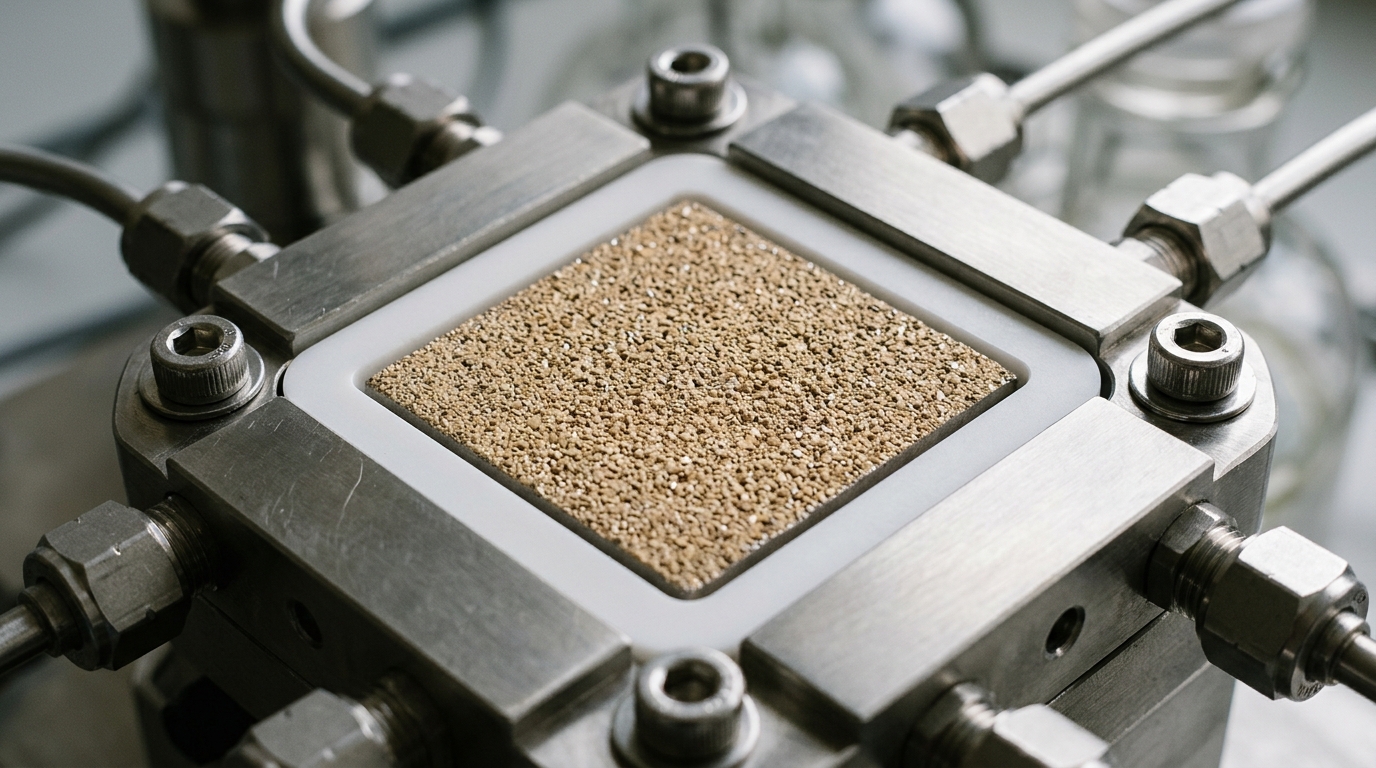
Incorporating methane oxidation into the anode of solid oxide electrolysis cells using non-noble metal-loaded, zirconia-doped cerium oxide catalysts substantially reduces cell voltage and electricity consumption during high-temperature water electrolysis. Researchers synthesized and evaluated catalysts based on cerium oxide doped with zirconia and loaded with five weight percent non-noble metals, specifically nickel, cobalt, and iron, to promote methane catalytic oxidation at the solid oxide electrolysis cell anode. Water electrolysis in solid oxide electrolysis cells typically consumes sixty to seventy percent of total electrical energy during the anodic oxygen evolution reaction, but introducing hydrocarbon fuels such as methane supplies chemical energy that directly lowers electrical demand. The study revealed that catalyst preparation methods and the selection of active metals govern both oxygen ion conduction through the catalyst bulk and methane oxidation activity on the anode surface. Among tested configurations, nickel emerged as the most suitable active metal, balancing essential electrochemical performance with surface methane oxidation.
High-temperature solid oxide electrolysis cells offer distinct thermodynamic advantages for hydrogen production compared with low-temperature water electrolysis systems, achieving theoretical electrolysis efficiencies exceeding ninety percent alongside reduced overpotentials. However, overcoming the high anodic overpotential of the oxygen evolution reaction remains a primary operational hurdle. Prior investigations established that introducing methane into an electrolytic cell utilizing yttria-stabilized zirconia electrolytes could lower the cell voltage needed to achieve a current density of zero point two amperes per square centimeter at eight hundred degrees Celsius down to zero point four volts, far below values required for direct oxygen evolution. Nevertheless, methane possesses a remarkably stable tetrahedral hydrocarbon structure characterized by a carbon-hydrogen bond energy of four hundred thirty-five kilojoules per mole, rendering catalytic activation difficult at elevated operating temperatures. Although noble metals such as palladium, platinum, and rhodium exhibit high catalytic activity, their prohibitive costs impede large-scale industrial deployment, prompting intensive investigation into economical non-noble transition metals including iron, cobalt, and nickel supported on oxygen-conducting ceria-based carriers.
Cerium oxide materials demonstrate superior oxygen storage capacity and rapid oxygen ion transport, yet pure ceria tends to undergo crystal cell collapse at high temperatures, which destroys oxygen vacancies and ion transport pathways. Doping cerium oxide with zirconium atoms stabilizes the crystal framework against high-temperature degradation while systematically increasing oxygen vacancy concentrations. Furthermore, under oxygen-poor or reducing operating environments, surface tetravalent cerium cations reduce to trivalent cerium cations, creating oxygen-deficient surface defect structures that enhance methane oxidation. To assess structural and catalytic trade-offs, investigators fabricated ceria-zirconia supports and catalysts containing five weight percent metal loadings through four distinct synthesis pathways: sol-gel, hydrolysis, sol-gel-impregnation, and hydrolysis-impregnation. Reagents included cerium nitrate hexahydrate, zirconium nitrate pentahydrate, nickel nitrate hexahydrate, ammonium carbonate, and citric acid. In the hydrolysis route, precursor nitrates dissolved in deionized water at eighty degrees Celsius received ammonium carbonate before evaporation, drying at one hundred degrees Celsius for twelve hours, and calcination at five hundred degrees Celsius for five hours at three degrees per minute.
In the sol-gel formulation, precursor nitrates were dissolved in deionized water, followed by the addition of citric acid at ninety degrees Celsius with a citric acid molar ratio double that of total metal cations, generating a colloidal sol that was evaporated, dried at one hundred degrees Celsius for twelve hours, and calcined under identical thermal conditions. For post-impregnation variants, pure ceria-zirconia carriers were synthesized first via hydrolysis or sol-gel without active metals, followed by wet impregnation with metal nitrate solutions, solvent evaporation at eighty degrees Celsius, and identical calcination. X-ray diffraction analyses using copper K-alpha radiation across scanning angles from five to ninety degrees confirmed characteristic cerium oxide fluorite diffraction patterns corresponding to standard powder diffraction files, with no distinct zirconia reflections, confirming complete incorporation of zirconia into the ceria crystal lattice to form a solid solution. Notably, the sol-gel nickel catalyst displayed no observable nickel oxide diffraction peaks, indicating that nickel ions predominantly incorporated directly into the cerium oxide bulk crystal structure, whereas hydrolysis and impregnation routes produced distinct surface-located nickel oxide crystallites.
Scanning electron microscopy demonstrated clear morphological distinctions between carrier preparation methods. The ceria-zirconia support synthesized by the sol-gel route exhibited highly dispersed, isolated particles possessing abundant interconnected porous networks, which facilitate rapid mass transfer of gaseous reactants between the catalyst surface and the bulk gas flow. In contrast, hydrolysis generated heavily agglomerated larger particulate clusters characterized by irregular packing pores, with few discernible pores within constituent particles. Energy-dispersive X-ray spectroscopy confirmed the presence and dispersion of nickel across catalyst surfaces. Complete solid oxide electrolysis single cells were assembled on nickel oxide-yttria-stabilized zirconia cathode substrates supporting an eight-mole-percent yttria-stabilized zirconia electrolyte layer. Screen printing was utilized to apply an anode slurry comprising the synthesized catalyst, samarium-doped ceria, and silver powder in an equal mass ratio of one to one to one, blended with five weight percent starch and binder. Cross-sectional electron microscopy verified layer thicknesses: a thirty-micrometer anode, a seventeen-micrometer electrolyte, a thirteen-micrometer translation layer, and a three-hundred-forty-three-micrometer cathode support, yielding an effective anode active area of one point five square centimeters.
Prior to evaluating methane thermal catalytic oxidation, all catalyst powders underwent pre-treatment in a tube furnace at eight hundred fifty degrees Celsius for two hours at a heating rate of two degrees per minute to match operational cell conditions. Approximately zero point zero five grams of catalyst was loaded into a six-millimeter-diameter stainless-steel tubular reactor, forming a fixed bed of approximately two millimeters packing height, and subsequently reduced under hydrogen at eight hundred degrees Celsius for one hour. Following reactor cooling under argon to four hundred degrees Celsius, a reaction gas blend containing two point five milliliters per minute of methane, ten milliliters per minute of oxygen, and ninety milliliters per minute of argon was introduced. Gas chromatography of dried effluent streams demonstrated complete oxidation selectivity exceeding ninety-nine point five percent across all tests between five hundred and six hundred fifty degrees Celsius. Among preparation methods, the hydrolysis-impregnation nickel catalyst exhibited the highest catalytic activity, closely followed by sol-gel-impregnation, while the sol-gel catalyst exhibited significantly lower methane conversion due to nickel confinement within the bulk lattice rather than active surface exposure.
Electrochemical water electrolysis evaluations were conducted inside a tubular furnace at eight hundred fifty degrees Celsius following initial argon purging and reduction under fifty milliliters per minute of hydrogen for one hour. The anode chamber received eighty-five milliliters per minute of argon for thirty minutes while cathode hydrogen flow was adjusted to eighty-five milliliters per minute, after which fifty milliliters per minute of water vapor was supplied to the cathode side. Once stabilized, the anode atmosphere was switched to fifty milliliters per minute of methane to record current-voltage curves, constant voltage electrolysis across zero point two to one point six volts, and electrochemical impedance spectroscopy between ten to the sixth and ten to the negative second hertz. The sol-gel nickel anode achieved the highest overall electrochemical performance and lowest cell voltage under both argon and methane atmospheres, recording the lowest ohmic resistance and polarization resistance. However, current-voltage curves and impedance spectra for the sol-gel anode remained nearly identical under argon and methane, demonstrating that despite superior bulk oxygen ion conduction, its low methane oxidation activity prevented further voltage reduction from methane consumption.
In marked contrast to the sol-gel catalyst, anodes prepared by impregnation routes displayed pronounced performance shifts when switching from inert argon to methane. Under argon, the sol-gel-impregnation anode showed a steep voltage increase around two hundred sixty milliamperes per square centimeter, attributable to the rapid accumulation of evolved oxygen gas within porous anode structures, which elevates local surface oxygen partial pressures. Introducing methane into the anode chamber promoted surface methane oxidation, which actively consumed transported lattice oxygen ions and liberated molecular oxygen, thereby suppressing oxygen partial pressures and lowering cell voltages across the polarization curve. Electrochemical impedance spectroscopy confirmed lower polarization resistance under methane than under argon for this impregnated anode. The hydrolysis-impregnation nickel catalyst, having the highest surface methane oxidation activity among tested samples, generated the largest electrochemical enhancement when exposed to methane. Constant voltage electrolysis at cell voltages exceeding zero point six volts demonstrated that while current densities slowed under argon due to oxygen gas accumulation, methane oxidation sustained linear current increases by continuously depleting local oxygen.
Evaluating active metals prepared by hydrolysis-impregnation revealed stark differences between nickel, cobalt, and iron. During standalone thermal oxidation in oxygen-rich environments, cobalt-loaded catalysts exhibited the highest methane conversion, followed by nickel and iron. In the solid oxide electrolysis cell anode, however, current-voltage and constant voltage measurements revealed that cobalt and iron catalysts exhibited inferior performance under methane compared to argon at cell voltages below zero point eight volts, showing increased polarization resistance. Mechanistically, water electrolysis in this system proceeds through a Mars-van Krevelen pathway wherein anodic oxygen evolution occurs prior to methane oxidation. Methane adsorbs directly onto active transition metal surface sites; when the oxygen evolution reaction dominates, competitive methane adsorption blocks available active sites, elevating polarization impedance. While cobalt provides excellent thermal oxidation under excess oxygen, its poor intrinsic electrochemical conductivity and oxygen evolution activity impede electrolysis. Conversely, iron provides lower ohmic and polarization resistances than cobalt but lower catalytic activity. Nickel uniquely fulfills the dual requirement of superior oxygen evolution capability and high methane catalytic oxidation activity.
In conclusion, the investigation confirms that promoting solid oxide electrolysis cell water electrolysis via anodic natural gas oxidation requires precise simultaneous optimization of catalyst preparation techniques and active metal selection. Achieving maximum cell voltage reduction under a methane anode atmosphere relies upon two coupled phenomena: rapid oxygen ion transport from the solid electrolyte across the anode bulk to sustain oxygen evolution, and highly active catalytic methane oxidation on the anode surface to rapidly consume oxygen species and lower the local oxygen partial pressure. The sol-gel method effectively incorporates nickel into the ceria-zirconia crystal framework to yield outstanding bulk ionic transport and minimal polarization resistance, yet surface-located nickel crystallites produced via impregnation are indispensable for triggering rapid methane oxidation. Nickel outperforms cobalt and iron by resisting competitive adsorption penalties and providing balanced catalytic and electrocatalytic properties. These findings delineate clear design principles for non-noble metal ceria-based composite anodes capable of drastically curbing electric power consumption in high-temperature hydrogen generation.
Subject of Research: Methane-assisted water electrolysis in solid oxide electrolysis cells
Article Title: Non-noble metal-loaded and zirconia-doped cerium oxide for water electrolysis in SOEC promoted by natural gas
Article References: Huang, Q., Li, Z., Wang, T., Huang, H., & Song, H. (2026). Non-noble metal-loaded and zirconia-doped cerium oxide for water electrolysis in SOEC promoted by natural gas. Sustainable Energy Research, 13(1), Article 28. https://doi.org/10.1186/s40807-025-00233-4
Image Credits: AI Generated
DOI: 10.1186/s40807-025-00233-4
Keywords: solid oxide electrolysis cell, water electrolysis, methane oxidation, hydrogen production, anode catalyst, cerium oxide, zirconia doping, non-noble metal catalysts, nickel catalyst, sol-gel method, hydrolysis impregnation, oxygen evolution reaction, oxygen partial pressure, electrochemical impedance spectroscopy, polarization resistance, Mars-van Krevelen mechanism, cell voltage reduction
News Source: Denise Maddox. (November 27, 2026). Nickel Ceria Anodes Cut Solid Oxide Electrolysis Voltage Using Methane Oxidation. Scienmag.