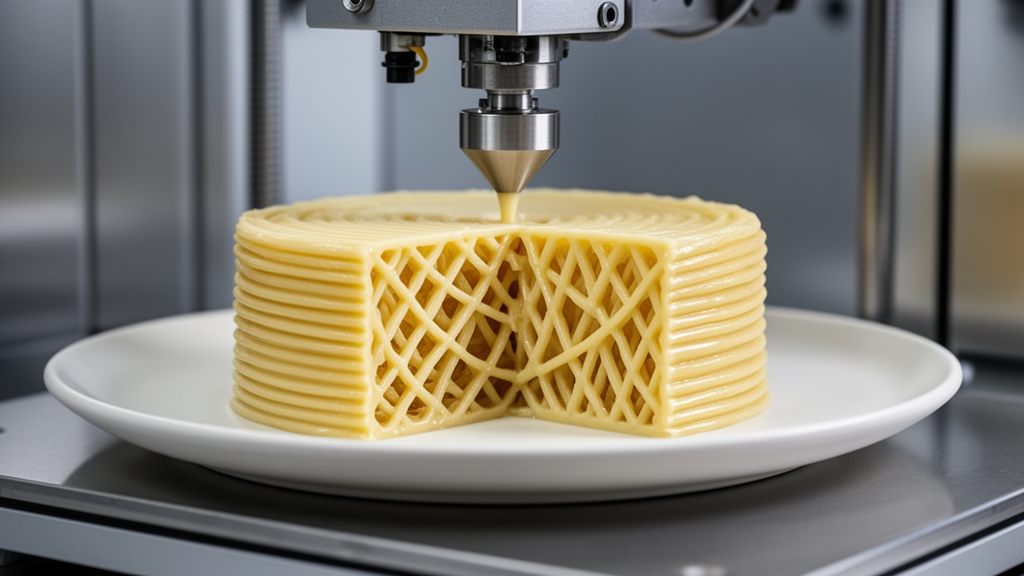
A research team led by Yorito Igeta, Koki Fujiwara, Jun Ogawa, and Hidemitsu Furukawa has demonstrated a novel method for controlling anisotropic texture in three-dimensional food printing using only a single formulation of food ink. Reporting in the journal Artificial Life and Robotics, the researchers established that adjusting the printing layer pitch and the internal structural geometry allows localized variations in mechanical hardness and directional mouthfeel without altering the external appearance of the printed food item. Additive manufacturing in food processing typically relies on blending multiple distinct ingredients with contrasting physical properties to achieve varied textural profiles across an edible object. In contrast, this new approach relies on structural mechanics and physical toolpath parameters to manipulate mechanical bite resistance, establishing that careful calibration of layer deposition and interior infill geometry can directly govern the bite characteristics experienced during mastication.
Three-dimensional food printing operates as an additive manufacturing discipline capable of fabricating edible products with tailored dimensions, shapes, and interior architectures from paste, liquid, powder, or melted materials known as food inks. Although multi-material printing systems have expanded color and firmness gradients through multi-screw extruders and in-nozzle mixing heads, creating items that share identical external visuals while differing entirely in mouthfeel remains an engineering hurdle. In healthcare and care facilities, elderly individuals or patients requiring texture-modified diets frequently experience psychological discomfort and diminished appetite when presented with meals that look visibly different from standard food. Developing fabrication methods that retain identical exterior geometries while modulating chewiness and resistance addresses these physiological and emotional dining challenges.
To establish a reproducible material baseline for extrusion testing, the investigators prepared a standardized cookie-style food ink formulated from seventy grams of freeze-milled rice flour, thirty grams of granulated sugar, thirty grams of rice bran oil, and one whole egg. Thorough homogenization was carried out using a manual mixer to maintain batch consistency, ensuring that the food paste would extrude reliably through fine dispensing nozzles without clogging or phase separation. Rice flour derived from freeze-milled processing provides a stable matrix that supports extended shelf life and preserves flavor attributes while serving as an adaptable base for additive extrusion. Such powdered formulations also highlight how agricultural fractions and upcycled ingredients can be incorporated into structured food manufacturing systems, provided the resulting paste exhibits the requisite viscoelastic and thixotropic properties necessary to maintain spatial fidelity after deposition on the build platform.
The material dynamics of the rice flour ink were rigorously analyzed using an Anton Paar MCR 302 rheometer fitted with twenty-five-millimeter-diameter parallel plates set to a one-millimeter measurement gap. After loading, trimming, and allowing the prepared paste to equilibrate for five minutes, dynamic strain sweep tests were conducted across a strain range spanning 0.01 percent to 150 percent at an oscillation frequency of one hertz and a regulated temperature of twenty-five degrees Celsius. These oscillatory measurements identified the linear viscoelastic region, revealing that the formulation retained its structural integrity under applied strains below one percent. When strain exceeded one percent, both moduli dropped steeply as the material shifted into a viscous-dominated flow regime, allowing the ink to pass smoothly through the printer nozzle.
Complementary apparent viscosity assessments performed across a frequency range from 0.1 to 100 hertz confirmed that the rice flour ink exhibited pronounced thixotropic behavior, characterized by an exponential decline in the flow curve under increasing shear rates. The printing operations were executed on a multifunctional additive manufacturing platform featuring a coordinated mechanical architecture. Horizontal translation was driven by independent x-axes and u-axes managing two dispensing syringes, while vertical positioning was directed along z-axes and w-axes, with the build platform traveling along the y-axis. The platform was controlled via a G-code framework utilizing Duet firmware, where the M563 command implemented a software-based virtual extruder abstraction that mapped motor drivers to designated tool numbers.
Mechanical characterization was conducted using a Yamaden RE2-33005C creepmeter configured to measure compressive rupture forces across printed specimens. The testing protocol utilized a wedge-shaped plunger measuring one by thirty millimeters driven at a constant downward velocity of ten millimeters per second to achieve a target strain of ninety percent. A V-shaped wedge was chosen specifically over conventional cylindrical probes because cylindrical geometries fail to capture localized stress concentrations and nuanced mechanical failures within discrete printed lines. Three orthogonal axes were evaluated: the build direction along the vertical stacking path was defined as the Z-direction, the X-direction represented the horizontal orientation where the wedge plunger contacted the specimen perpendicular to the printed deposition lines, and the Y-direction represented the horizontal orientation where the wedge blade pressed parallel to the deposition lines. All rupture assessments were performed in triplicate to provide statistically representative mean values.
To evaluate the direct influence of layer pitch on mechanical texture, the team printed Sample 1 specimens as twenty-four-millimeter cubes featuring a one-hundred-percent linear infill pattern. Printing was conducted at a constant traverse speed of five thousand millimeters per minute, evaluating nozzle diameters of 0.8, 1.2, and 2.0 millimeters alongside vertical pitch values of 0.3, 0.6, and 0.9 millimeters. Rupture testing along the Z-axis demonstrated that compressive hardness increased substantially as the deposition pitch decreased, recording maximum rupture forces of 3.34 plus or minus 0.29 newtons at a pitch of 0.3 millimeters, 3.00 plus or minus 0.33 newtons at 0.6 millimeters, and 1.89 plus or minus 0.37 newtons at 0.9 millimeters.
Directional rupture profiling revealed pronounced anisotropic behavior across the three tested orientations of the printed cubes. When compressed in the X-direction perpendicular to the printed filaments, specimens fabricated with a 0.3-millimeter pitch displayed a sharp, steep climb in mechanical stress followed by a prolonged plateau, indicating exceptional internal cohesion and sustained structural resistance under deformation. In contrast, the 0.6-millimeter pitch specimens exhibited a sudden post-peak drop in stress, reflecting localized discontinuities where crack propagation accelerated through looser infill gaps. At a 0.9-millimeter pitch, the maximum stress dropped sharply due to diminished inter-strand bonding. Along the Y-direction, where compression ran parallel to the deposition tracks, narrower pitches preserved cohesive plastic deformation, whereas wider pitches caused brittle shearing along filament interfaces. Compression along the Z-axis exhibited intermittent, stepped stress drops following peak loading, capturing layer-by-layer delamination where individual strata fractured sequentially rather than failing as a uniform monolith.
The experimental investigation subsequently evaluated internal geometric architecture through Sample 2, which utilized a cylindrical tire wheel model with an outer diameter of fifty-six millimeters and an axial thickness of ten millimeters. Four distinct interior configurations radiating from a central hub were fabricated: spoke-type, mesh-type, fin-type, and dish-type geometries. These wheel specimens were deposited using a 1.0-millimeter nozzle, a 0.5-millimeter pitch, and a travel speed of five thousand millimeters per minute. Following additive fabrication, all wheel specimens underwent thermal curing in a Toshiba ER-WD7000 superheated steam oven, where they were baked at one hundred eighty degrees Celsius for nine minutes to establish a firm, cookie-like matrix suitable for structural deformation analysis. Compressive fracture tests applied along the horizontal X-axis revealed that all four structural configurations reached their initial mechanical yield points at strain levels below ten percent before load resistance diminished.
The mechanical performance of the baked wheel geometries diverged markedly depending on internal reinforcement arrangements. The spoke-type structure demonstrated rapid strength degradation and early mechanical failure because its sparse, open geometry provided limited load-bearing paths, causing stresses to concentrate heavily at individual strut junctions. In comparison, the mesh-type and fin-type geometries exhibited significantly greater toughness and sustained deformation ranges before final fracture. Their interconnected, lattice-like networks distributed compressive forces across multiple adjacent members, preventing sudden catastrophic failure and providing a more progressive mechanical breakdown during compressive loading.
The researchers noted that these observed fracture patterns correspond closely with classical structural mechanics principles, including Maxwell’s stability criterion, which differentiates between stretch-dominated structures that maintain high stiffness-to-weight ratios and bending-dominated lattice geometries where stress concentrates at connecting nodes. However, the authors emphasized that classical structural engineering equations, initially developed for uniform industrial materials, face limitations when applied directly to complex food systems. Food materials experience significant physical changes during thermal processing, including material shrinkage, moisture evaporation, and matrix hardening during high-temperature baking. Because purely theoretical calculations cannot fully predict these post-baking mechanical transformations, experimental validation remains essential for mapping structural design to actual perceived texture. By controlling layer pitch and internal infill geometry using a single food ink, food engineers can systematically tune directional bite hardness and progressive structural disintegration, laying a foundation for personalized nutrition products designed for specific masticatory capabilities.
Subject of Research: Anisotropic texture control and mechanical tuning in single-ink 3D food printing
Article Title: Anisotropic texture control in 3D food printing through pitch adjustment and internal structural design
Article References: Igeta, Y., Fujiwara, K., Ogawa, J., & Furukawa, H. (2025). Anisotropic texture control in 3D food printing through pitch adjustment and internal structural design. Artificial Life and Robotics, 30(4), 786-793. https://doi.org/10.1007/s10015-025-01065-7
Image Credits: AI Generated
DOI: 10.1007/s10015-025-01065-7
Keywords: 3D food printing, anisotropic texture, variable pitch technique, rheological characterization, extrusion-based additive manufacturing, rice flour ink, linear viscoelastic region, mechanical rupture testing, internal structural design, interlayer adhesion, food fracture mechanics, personalized nutrition, thixotropic behavior, Duet firmware, virtual extruder, creepmeter analysis
News Source: Denise Maddox. (November 26, 2026). Variable Pitch and Internal Design Enable Directional Texture Control in 3D-Printed Foods. Scienmag.