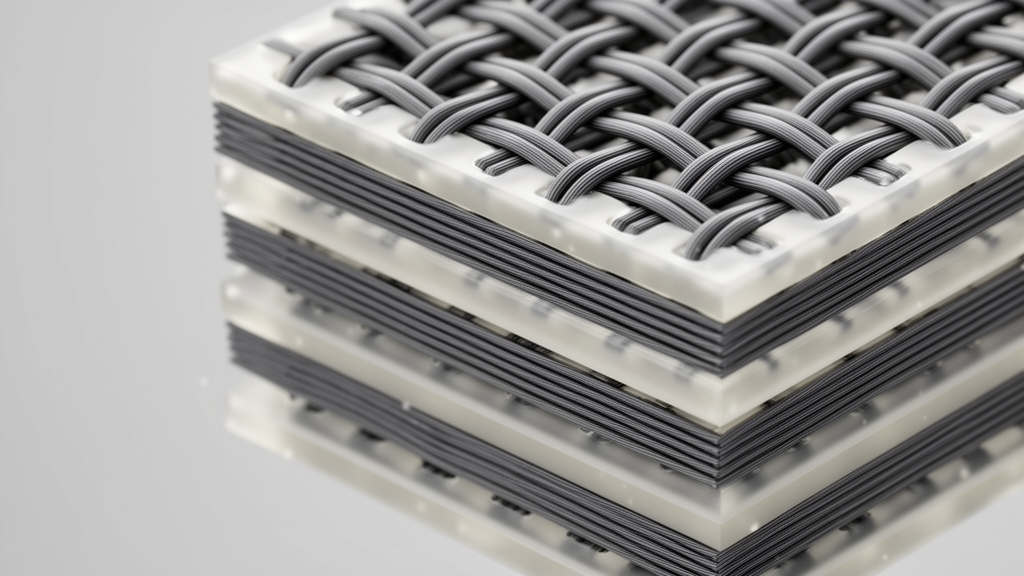
A newly developed sequential finite element modeling framework shows that compressive mechanical deformation alters localized electrostatic charge accumulation while largely preserving overall bulk capacitance in continuous carbon fiber structural supercapacitors. Published in Applied Composite Materials by engineering researchers Davood Peyrow Hedayati, Rafael Schelkow, Michael Kucher, and Robert Böhm, the study isolates microscale electro-mechanical interactions within carbon fiber-reinforced gel polymer electrolytes. By coupling linear elastic mechanics directly to electrostatic field equations, the team established that compressive deformation induces a non-uniform redistribution of electric field intensity that concentrates near fiber-separator interfaces. Crucially, the simulations demonstrate that interior reinforcement fibers experience substantial parasitic shielding—termed geometric electrostatic screening—which diminishes their contribution to energy storage. The findings provide quantitative geometric benchmarks for designing dual-function composite materials capable of carrying structural loads without sacrificing electrical energy retention.
Structural supercapacitors represent an emerging class of multifunctional composites designed to satisfy the demand for lightweight, high-power energy storage across electrified transportation platforms. By merging load-bearing capacity with electrochemical energy storage, these composite architectures eliminate parasitic mass and volume associated with conventional external enclosures and protective housings. In standard fibrous configurations, continuous carbon fibers fulfill two simultaneous functions, serving as mechanical reinforcement and as the primary current-collecting electrode material. Meanwhile, a surrounding non-liquid electrolyte matrix provides mechanical load transfer and ionic transport. According to established structural classification schemes, multifunctional systems can be categorized into four degrees of integration, ranging from discrete devices placed inside structural shells to fully integrated single-phase materials. While high-integration concepts typically rely on rigid solid polymer electrolytes whose low ionic conductivity restricts power density, intermediate architectures incorporate gel polymer electrolytes encapsulated within stiffer structural composite laminates to balance ion mobility with load transfer.
Prior experimental investigations have firmly established that mechanical stress directly alters the electrochemical performance of structural supercapacitors, yet the underlying mechanisms have remained difficult to decouple. Physical experiments have demonstrated that applied flexural stresses can diminish the measured capacitance of composite laminates containing functionalized woven carbon fiber electrodes by approximately 15 percent. Conversely, testing on structural supercapacitors utilizing graphene oxide-based carbon fiber electrodes has revealed capacitance retention of roughly 95 percent after 15,000 continuous cycles under sustained static compressive loads of 30 kilopascals. In addition, in situ electrochemical impedance spectroscopy conducted during four-point bending tests has confirmed an intimate relationship between mechanical deformation and specific capacitance. Despite these clear experimental observations, prevailing computational efforts have historically relied on isolated single-physics simulations, modeling either macroscopic mechanical stiffness and unit-cell elasticity through finite element analysis or electrochemical impedance through equivalent circuits, thereby overlooking the coupled geometric feedback between the two domains.
To bridge this modeling divide, the researchers formulated an electrostatic-mechanical sequential interaction framework that explicitly captures how compressive deformation alters local electrode geometry and subsequent bulk electrostatic field distributions. The investigators designated the methodology as a sequential interaction model to emphasize one-way physical coupling, wherein mechanical deformation dictates microstructural displacement, which in turn recalculates the electrostatic field. Crucially, the authors established a geometric benchmark by intentionally excluding the nanometer-scale physics of the electric double layer, faradaic charge transfer, pseudocapacitance, and dynamic ion transport governed by Poisson-Nernst-Planck equations. This deliberate simplification separates macroscopic, permittivity-governed electrostatic behavior from complex electrochemical kinetics and surface adsorption phenomena. By focusing on steady-state charge accumulation on pure, unmodified carbon fiber surfaces, the framework provides a clean physical baseline to isolate first-order geometric effects, particularly the parasitic fiber-to-fiber shielding that arises purely from changes in physical proximity under mechanical compression.
The numerical framework models an additively manufactured structural supercapacitor benchmark composed of unidirectional continuous carbon fibers embedded within a poly(vinyl alcohol) and sodium chloride gel polymer electrolyte. Sodium chloride was chosen over complex ionic liquids to maintain a non-toxic and environmentally sustainable formulation. Within the composite architecture, a dedicated inter-electrode gel polymer electrolyte layer acts as the physical separator between opposing half-cells, dispensing with conventional porous polymer separator membranes. To simulate the material, the researchers created a two-dimensional representative volume element measuring 20 micrometers by 20 micrometers in the in-plane coordinate system, with an assigned effective depth of 20 micrometers along the longitudinal fiber axis. This representative volume element contains a symmetrical half-cell domain featuring three circular carbon fibers, each 8 micrometers in diameter with an initial center-to-center spacing of 10 micrometers. The modeled domain corresponds to a 38 percent fiber volume fraction, closely mirroring the nominal 41 percent volume fraction of manufactured continuous-fiber printing tapes.
The governing mechanical equations treat the gel polymer electrolyte as a homogeneous, isotropic, linear elastic solid operating under infinitesimal strain assumptions. Equilibrium across the electrolyte matrix is governed by the divergence of the Cauchy stress tensor in the absence of external body forces, while internal mechanical stress is defined through Hooke’s law utilizing the first Lamé parameter and the elastic shear modulus. Carbon fibers are modeled as non-deformable, rigid bodies due to their exceptionally high stiffness relative to the compliant surrounding polymer matrix. At the fiber-matrix interfaces, the boundary formulation accommodates normal compliance for gap closure and tangential sliding friction without permitting material interpenetration. On the electrical side, quasi-static field behavior is solved through charge relaxation theory and continuity of electric current density. The total accumulated charge on each individual fiber surface is computed via Gauss’s law of electrostatics by integrating the normal component of the electric field, which directly yields individual and total electrostatic capacitance values.
Boundary conditions and numerical discretization were implemented within the COMSOL Multiphysics software suite, combining the structural solid mechanics and AC/DC electrostatic modules. Mechanically, the left boundary of the representative volume element was subjected to uniform prescribed compressive displacements, while the right separator boundary was constrained in the normal direction while permitting transverse movement. Periodic boundary conditions were enforced along top and bottom boundaries to replicate the repeating microstructural array. Electrostatically, carbon fiber surfaces were assigned a constant applied electric potential, the separator interface was grounded at zero potential representing symmetric half-cell conditions, and outer lateral edges were treated as insulating Neumann boundaries to eliminate charge leakage. The computational domain was discretized into 8,086 triangular finite elements using quadratic polynomial shape functions for both displacement and electric potential fields. Utilizing a nonlinear solver with an auxiliary displacement sweep to capture geometric contact phenomena, each complete simulation converged within a total solution time of approximately 70 seconds.
Mechanical simulation results demonstrated that applying prescribed boundary displacements of 0.2 micrometers and 0.4 micrometers required average boundary reaction forces of 7.9 x 10^-8 Newtons and 14.25 x 10^-8 Newtons, respectively. Under these compressive loads, the rigid carbon fibers translated laterally within the compliant gel electrolyte matrix. Because the polymer exhibits relatively low stiffness, this translation occurred non-uniformly across the representative volume element, leading to localized variations in inter-fiber spacing. As the applied displacement increased from 0.2 to 0.4 micrometers, the asymmetry in structural displacement became noticeably more pronounced. The resulting longitudinal normal stress distribution revealed intense stress concentrations along the fiber-matrix interface of the leading fiber, designated CF1, which sits immediately adjacent to the separator splitting line. In contrast, the secondary and tertiary fibers positioned further back experienced comparatively lower interfacial stress levels, highlighting how mechanical load is preferentially absorbed by microstructural features directly facing the central boundary.
The corresponding electrostatic simulations demonstrated a pronounced spatial inhomogeneity in electric field intensity across both undeformed and deformed states. In the undeformed baseline, the electric field reached a magnitude of 1.0 x 10^6 volts per meter between half-cells, with local peak field strengths surging to 2.0 x 10^6 volts per meter on the surface of fiber CF1 facing the separator. Under compressive displacement, this field localization intensified, with fiber CF1 absorbing the overwhelming majority of overall electric field density. In stark contrast, trailing fibers CF2 and CF3 exhibited markedly lower surface field intensities despite their identical geometry and symmetrical placement. The research team identified this parasitic disparity as geometric electrostatic screening. In this mechanism, the leading fiber effectively shields interior fibers from the primary electric potential gradient. The authors noted that this mesoscale electrostatic screening operates independently of nanoscale ionic Debye screening, functioning analogously to classical transmission-line models of porous electrodes where exterior regions dominate charge accumulation while interior pores remain suppressed.
An evaluation of cumulative electrical capacitance across varying compressive strain levels revealed a linear trend characterized by an exceptionally shallow slope, confirming that overall capacitance remains largely invariant under pure mechanical compression. This high degree of capacitance retention under compressive deformation closely aligns with previous experimental observations documented in hydrogel-based supercapacitors. To contextualize the numerical findings, the authors compared the simulation outputs against two theoretical analytical benchmarks derived from charged particle capacitance formulations. A single-fiber analytical model, representing the lower physical bound by assuming only leading fiber pairs contribute to charge storage, slightly underestimated numerical capacitance because it omitted adjacent field interactions. Conversely, a three-fiber analytical model that assumed all fibers contribute equally while ignoring electrostatic shielding drastically overestimated capacitance. This direct comparison underscored that treating multi-fiber carbon electrodes as ideal parallel-plate systems introduces substantial predictive errors, demonstrating that resolving localized geometric screening is essential for accurately forecasting the charge capacity of structural composites.
Parametric analyses examining electrode dimensions, fiber volume fractions, and fiber spacing yielded crucial architectural principles for designing high-performance structural supercapacitors. Extending the representative volume element along the thickness direction in an x-extended configuration produced only negligible capacitance increases, as added interior fibers were heavily screened by preceding rows. Conversely, expanding the model vertically along the separator boundary in a y-extended configuration produced a linear three-fold increase in electrostatic capacitance by exposing more fibers directly to the active counter-electrode line. Similarly, increasing fiber volume fraction elevated overall capacitance primarily through additional charge accumulated on front-row fibers, indicating that thick electrodes suffer from diminishing material efficiency. Furthermore, evaluating different fiber distributions at an identical volume fraction demonstrated that optimizing spatial arrangement can boost charge storage by up to 20 percent. The authors cautioned that their model assumes isotropic carbon fibers and steady-state quasi-static conditions, noting that future work must incorporate transverse fiber anisotropy, dynamic electric double layer kinetics, and multi-axial mechanical loading.
Subject of Research: Sequential mechanical-electrostatic finite element modeling of structural supercapacitors under compressive deformation
Article Title: Mechanical- Electrostatic Sequential Interaction Modeling in Structural Supercapacitors
Article References: Peyrow Hedayati, D., Schelkow, R., Kucher, M., & Böhm, R. (2026). Mechanical- Electrostatic Sequential Interaction Modeling in Structural Supercapacitors. Applied Composite Materials, 33(2), Article 79. https://doi.org/10.1007/s10443-026-10452-7
Image Credits: AI Generated
DOI: 10.1007/s10443-026-10452-7
Keywords: structural supercapacitors, carbon fiber composites, gel polymer electrolyte, finite element analysis, electrostatic screening, compressive deformation, capacitance retention, representative volume element, sequential interaction modeling, energy storage, multifunctional materials, electric field distribution, Hooke's law, Gauss's law, COMSOL Multiphysics, fiber volume fraction, surface charge density, additive manufacturing
News Source: Denise Maddox. (November 26, 2026). Sequential Model Shows Compressive Deformation Preserves Capacitance in Structural Supercapacitors. Scienmag.