Potato cultivation serves as an indispensable cornerstone of global food security, where the physiological quality of seed tubers directly governs crop emergence, overall yield, and final harvest uniformity. In contemporary potato production, cut-seed planting has emerged as a widely adopted industrial practice because dividing larger tubers into smaller seed pieces markedly optimizes seed utilization efficiency while curtailing planting expenditure. As field mechanization accelerates across agricultural supply chains, mechanical seed cutters increasingly slice large tubers into irregular pieces while screening out smaller, whole tubers for direct sowing. However, the resulting mixture of intact potatoes and sharp, fragmented seed pieces exhibits substantial structural variation in volume, surface geometry, and dimensional eccentricity. These irregular physical traits pose severe obstacles for downstream sorting machinery, forcing industrial facilities to depend on manual sorting lines that remain inherently labour-intensive, slow, and prone to operational inconsistency. To address this bottleneck, researchers have engineered an automated robotic manipulation system capable of fast, physics-informed pick-and-place execution.
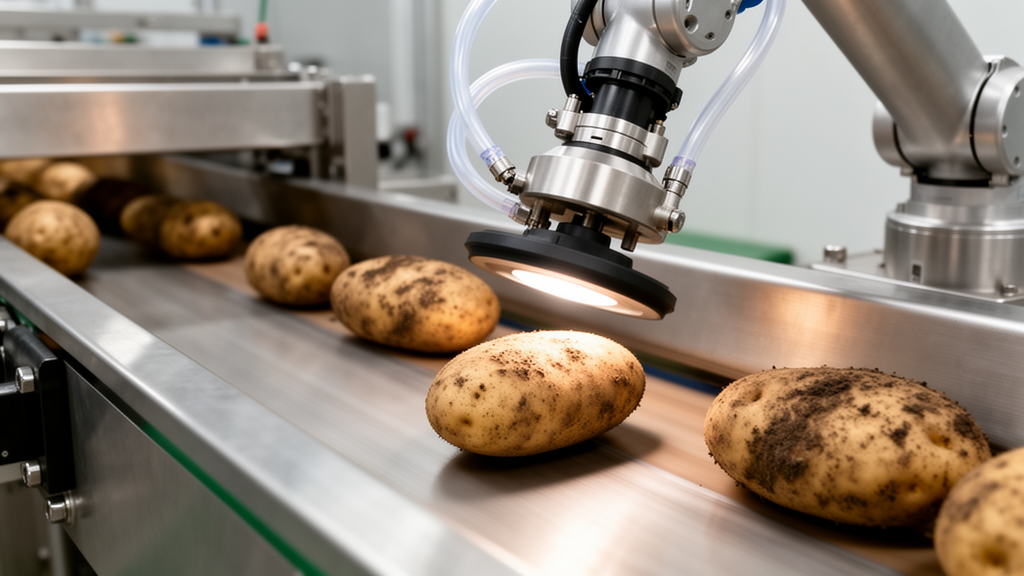
The experimental hardware platform was constructed around a high-speed three-degree-of-freedom parallel manipulator manufactured by Nachuan Technology, paired with an integrated industrial sorting framework. Visual perception is handled by an Orbbec Femto Bolt RGB-D camera rigidly stationed above a moving conveyor belt at an inclined perspective of roughly forty-five degrees to observe incoming tubers. Pneumatic actuation is driven by an Airtac solenoid valve coupled with a vacuum pump that powers a dual-layer flexible suction cup mounted as the robotic end-effector. All software components run within an Ubuntu 22.04 environment coordinated through Robot Operating System Noetic to manage synchronization across perception modules, neural inference scripts, and low-level manipulator controllers. The spatial tracking framework formalizes five interconnected coordinate systems: the camera frame, the robot base frame, the end-effector frame, the object frame, and the moving conveyor frame whose primary axis tracks the belt direction. This integrated setup provides the structural foundation for executing sub-second pick-and-place trajectories over continuously moving agricultural items.
Online grasping execution follows a structured perception-decision-execution architecture designed to handle unpredictable raw produce. The vision pipeline begins as the RGB-D sensor streams paired colour and depth frames into a YOLO-based detection and instance segmentation network that isolates individual seed potatoes from the background conveyor. Segmented pixel masks are directly applied to the aligned depth images, projecting localized surface coordinates into three-dimensional space using the calibrated camera intrinsics. After spatial depth thresholding and point cloud outlier filtering isolate clean instance-level point clouds, the system faces the complex challenge of identifying an optimal grasp location. Conventional industrial automation typically directs suction cups toward the geometric centroid or bounding box centre of a segmented item. However, potato fragments possess steep planar facets, slicing ridges, and curved perimeters where centroid-targeted suction cups encounter severe air leakage or lateral sliding. Reliable robotic manipulation instead requires picking locations that explicitly ensure continuous contact seals and mechanical stability.
To establish rigorous physical grounding without demanding tedious manual annotations, the researchers developed an analytical physics-based scoring method that quantifies local suction suitability. This teacher formulation evaluates candidates through a two-stage procedure comprising candidate pre-screening and refined contact evaluation. In the pre-screening step, point clouds are downsampled, and candidate surface normals are evaluated against the robot’s fixed vertical approach direction using cosine similarity, immediately discarding surfaces whose steep inclination would impede perpendicular cup placement. The remaining candidate points then undergo refined evaluation across two complementary criteria: local sealing quality and boundary margin. To evaluate sealing quality, an annular contact region corresponding to the inner and outer radii of the suction cup lip is extracted within a bounded vertical height band scaled by voxel dimensions. This annular zone is partitioned into twenty-four angular bins to assess circumferential continuity, while local height variance across the ring is penalized using an exponential flatness function to reject uneven or ridged surfaces.
The second core component of the physics-based scoring formulation assesses boundary safety to prevent the suction cup from overhanging tuber edges. The algorithm computes the global geometric centre of the visible point cloud and calculates the Euclidean distance to every constituent point, defining the effective object scale via the robust ninety-eighth percentile of these radial distances to neutralize isolated measurement noise. For each candidate suction point, normalized distance to the centroid is scaled through an exponential boundary coefficient to penalize selections located near peripheral boundaries or narrow cut corners. The final physics score represents an equal average of the annular sealing score and the boundary margin score. During initial robotic validations across one hundred stationary potato samples comprising fifty whole tubers and fifty cut pieces, this physics-based scoring method achieved an overall grasping success rate of ninety-seven percent, dramatically surpassing the sixty-three percent success rate recorded by standard centroid-based targeting.
Although the analytical physics-based scoring formulation reliably identifies viable grasping targets, calculating dense annular geometry and neighbourhood variances across hundreds of candidate points incurs substantial computational overhead that impedes real-time sorting. To resolve this latency, the investigators designed SupoNet, a specialized deep neural network that directly learns suction-aware geometric representations from point cloud inputs. The architecture combines a PointNet++ backbone with a pointwise Transformer module placed between intermediate set abstraction layers to capture long-range geometric dependencies across the irregular potato surfaces. The network processes eight thousand one hundred ninety-two input points per instance, hierarchically downsampling the coordinates through farthest-point sampling layers before propagating high-dimensional geometric features back to the original point resolution. This structure enables SupoNet to synthesize local surface curvature alongside overall tuber topography, mapping raw spatial coordinates directly into dense feature embeddings without requiring manual feature engineering.
SupoNet refines these geometric embeddings through a suction-aware feature learning module that introduces response-based discrete hard feature selection. The local features are projected into a hidden latent space, where an internal response scoring function ranks points into complementary high-response and low-response subsets. Features gathered from these distinct subsets are pooled through mean, maximum, and log-sum-exp operations to construct a rich global descriptor that is replicated across all points and fused with local pointwise vectors. A dual-branch prediction head then processes these fused representations through pointwise multi-layer perceptrons, dedicating one branch to predicting sealing quality and the other to estimating boundary margins under sigmoid activations. A physics-guided score composition layer averages the two predicted components to output the final pointwise suction score map. The model is supervised using Smooth L1 loss applied exclusively to the intermediate physical attributes against offline labels generated by the analytical scoring framework.
The training dataset was constructed from two thousand ninety-eight single-view point clouds evenly divided between whole tubers and cut pieces, split by physical sample identifier into training, validation, and testing subsets according to a seven-to-two-to-one ratio. SupoNet was optimized using the AdamW algorithm on an NVIDIA GeForce RTX 3060 workstation for one hundred fifty epochs with cosine learning rate scheduling and an initial five-epoch warm-up. Convergence analysis revealed rapid error reduction within thirty epochs, maintaining tight alignment between training and validation loss curves without overfitting. When evaluated against ground-truth labels on the held-out test split, SupoNet achieved a mean absolute error of 0.044 and a Spearman rank correlation coefficient of 0.965. Empirical cumulative distribution functions across low, middle, and high ground-truth score groups demonstrated distinct, ordered separation, confirming that the network regressed continuous physical suitability across the entire tuber surface rather than merely segmenting binary grasp regions.
Comprehensive ablation experiments demonstrated that the physics-guided dual-branch decomposition provides vital structural guidance for point cloud learning. Removing the physics-guided score composition to regress overall suction scores directly caused severe performance degradation, escalating mean absolute error from 0.044 to 0.172 and collapsing rank correlation from 0.965 down to 0.235, while a baseline PointNet++ model yielded an error of 0.097. Eliminating the boundary margin branch severely impaired candidate ranking consistency, whereas omitting the sealing quality branch elevated regression errors and weakened local flatness discrimination. Interestingly, introducing an auxiliary surface normal estimation head offered no statistically significant gain, indicating that the network inherently captures directional surface alignment from raw coordinates under physics-guided supervision. Furthermore, when retrained across alternative suction cup radii of 2.5 millimetres and 7.5 millimetres, SupoNet preserved high ranking correlations between 0.945 and 0.965, demonstrating practical geometric adaptability across different pneumatic tooling sizes.
In comparative robotic trials evaluating sixty stationary seed potatoes, SupoNet matched the grasping reliability of its computational teacher while drastically slashing operational latency. SupoNet achieved a 98.3 percent pick-and-place success rate for its top-ranked candidate and maintained success rates exceeding 93 percent across lower-ranked candidates, outperforming the adapted SuctionNet-1Billion baseline which attained only 76.7 percent top-rank success due to limitations in fixed-axis handling and single-view occlusion. Crucially, whereas the analytical scoring formulation required an average of 1452.5 milliseconds per tuber, SupoNet executed feature inference and candidate extraction in only 153.8 milliseconds, delivering a 9.4-fold computational speedup. When deployed downstream on a continuous conveyor operating at 0.1 metres per second alongside the parallel manipulator moving at speeds up to six metres per second, the unified robotic system processed one hundred fifty randomly ordered potatoes with an overall grasping success rate of 94.7 percent at an average handling pace of 0.8 seconds per tuber, proving the operational viability of physics-guided point cloud networks for high-throughput agricultural sorting.
Subject of Research: Physics-guided point cloud deep learning for automated robotic suction sorting of processed seed potatoes
Article Title: SupoNet: Physics-guided point cloud learning for robotic grasping of processed seed potatoes
Article References: Lyu, Y., Wo, J., Xu, W., Wang, F., Jiang, H., Knoll, A., Yang, D., Ying, Y., & Zhou, M. (2026). SupoNet: Physics-guided point cloud learning for robotic grasping of processed seed potatoes. Artificial Intelligence in Agriculture. https://doi.org/10.1016/j.aiia.2026.10.009
Image Credits: AI Generated
DOI: 10.1016/j.aiia.2026.10.009
Keywords: agricultural automation, robotic grasping, seed potatoes, SupoNet, point clouds, suction grippers, parallel manipulators, PointNet++, sealing quality, boundary margin, computer vision, RGB-D perception, spatial suppression, conveyor sorting, deep learning, instance segmentation, agricultural robotics
News Source: Alan Morgan. (November 26, 2026). Physics-Guided Deep Learning Enables Robotic Suction Sorting of Seed Potatoes. Scienmag.