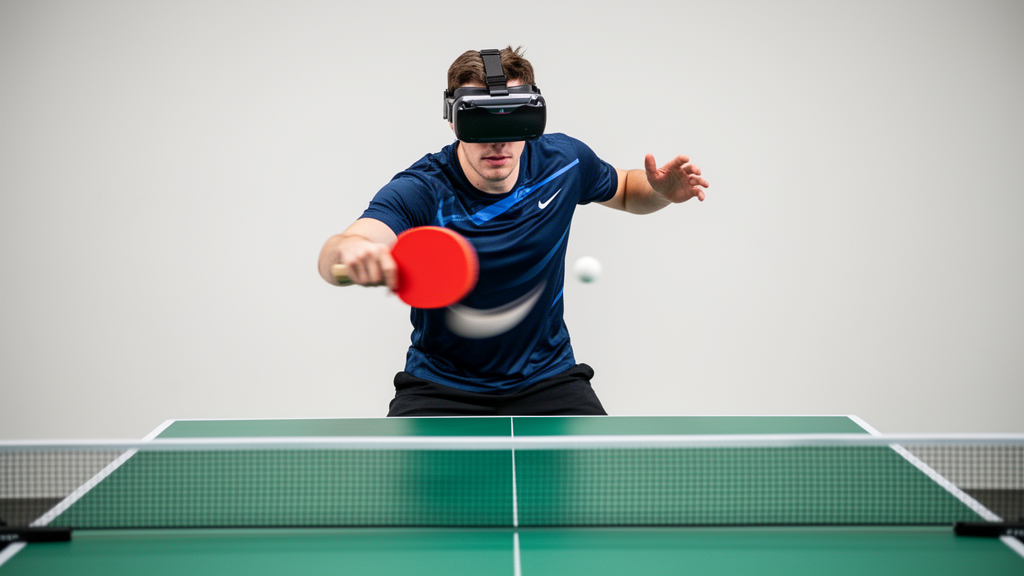
A preliminary feasibility study investigating virtual reality sports instruction found that an immersive, game-based training application produced statistically significant increases in novice and amateur players’ self-reported confidence and self-rated spin generation during table tennis forehand topspin practice. Developing the forehand topspin stroke represents an intricate technical hurdle in racket sports because execution demands precise synchrony across racket angle calibration, wrist rotation, and spatial contact timing. Conventional sports pedagogy relies heavily on repetitive physical drills to cultivate neuromuscular adaptations, yet beginners frequently encounter motivational decline and lack immediate, informative visual feedback necessary for motor memory consolidation. To evaluate how digital immersion addresses these foundational training barriers, researchers engineered a structured virtual reality system that combines explicit mechanical guidance with dynamic feedback cues. The resulting investigation assessed immediate psychological and perceptual adaptations across twenty-three participants, establishing that structured immersive simulation meaningfully elevates perceived competence and kinesthetic awareness before players transition to unguided athletic environments.
The conceptual framework underpinning the digital training program synthesizes established motor learning theory and contemporary motivational psychology, specifically Fitts and Posner’s three-stage model of skill acquisition alongside Self-Determination Theory. According to motor learning principles, novices situated in the initial cognitive stage depend heavily on explicit external guidance to decipher complex biomechanical mechanics and establish coherent mental representations of requisite movement patterns. To scaffold this progression, the system provides visual trajectory overlays and spatial reference visuals designed to systematically minimize cognitive load during early swing execution. In parallel, Self-Determination Theory posits that fulfilling an athlete’s psychological need for perceived competence remains vital to maintaining intrinsic engagement during repetitive drills. Because the current investigation functioned as an initial feasibility trial of the prototype’s pedagogical structure, researchers concentrated primarily on subjective psychological benchmarks—specifically self-assessed confidence and self-rated spin magnitude—recognizing that self-efficacy and kinesthetic awareness operate as essential psychological precursors before measurable biomechanical improvements emerge in physical testing.
To support motor skill acquisition, the virtual environment integrates three distinct visual instructional mechanisms: trajectory paths, reference visuals, and quiet eye cues. The trajectory path feature renders a visual overlay of the ideal swing path directly in the user’s field of view, providing an explicit target that reduces the exploratory search space for novice athletes. Reference visuals supply static spatial representations of correctly positioned rackets at decisive intervals, enabling learners to compare real-time controller orientation against calibrated models to facilitate error correction and proprioceptive refinement. Concurrently, quiet eye cues direct visual attention toward explicit spatial targets immediately prior to ball contact. Rooted in attentional control theory, guiding gaze behavior stabilizes visual-motor coordination, minimizing cognitive interference and performance anxiety during critical swing phases. Together, these complementary visual aids create a tightly coupled sensory feedback loop, supplying immediate knowledge of performance to accelerate internal movement model development during early motor skill practice.
Pedagogical scaffolding within the system is operationalized through a progressive three-tier training framework that systematically withdraws visual assistance as player competency advances. This fading technique directly reflects the guidance hypothesis within motor learning research, which cautions that continuous, unvarying instructional feedback can induce learner dependency and hinder long-term retention. In Level 1, designated Guided Training, players practice with comprehensive visual scaffolding, including the full racket trajectory path, model racket images positioned at the backswing and contact phases, a highlighted contact zone on an interactive spin wheel, and a numerical scoring display. Level 2, titled Technique Refinement, eliminates the trajectory path overlay, compelling players to rely more heavily on emerging motor schemas. Finally, Level 3, named Stroke Mastery, removes the highlighted contact target on the spin wheel, requiring athletes to execute topspin swings guided solely by static reference images and the point counter to foster intrinsic motor control.
The system guides athletes through an eight-step operational workflow spanning four overarching phases: preparation, familiarization, execution, and challenge and evaluation. Training initiates with an instructional video outlining correct anatomical posture and stance. Participants then engage in active stroke practice, aligning their right-hand controller with virtual model rackets positioned at key backswing and contact junctures while receiving color-coded visual verification of their positional accuracy. A visual swing trajectory displays during the movement and vanishes immediately upon correct execution. To generate topspin mechanics, users interact with a simulated spin wheel target featuring a highlighted contact arc spanning the twelve o’clock to four o’clock positions. Swings striking within this highlighted segment initiate wheel rotation corresponding to applied speed and angle, followed by follow-through toward a designated finishing position. Participants must achieve specified point thresholds in timed evaluation challenges to unlock subsequent training tiers.
The engineering architecture behind the application combines commercial virtual reality hardware with dedicated three-dimensional physics and modeling engines. The simulation was developed within the Unity engine using Nvidia PhysX to handle physical interactions, while visual models were authored in Blender. Controller velocity is continuously tracked using proprietary interface APIs to determine swing initiation beyond a calibrated velocity threshold, with resulting kinetic values assigned to the virtual paddle’s rigid-body component to calculate rotational forces transferred to the spin wheel upon collider contact. The virtual trajectory path was generated through cubic Bézier and B-spline interpolation algorithms fitted to three-dimensional coordinate milestones identified from published biomechanical literature adhering to International Society of Biomechanics joint coordinate standards. Furthermore, the two static model racket representations at backswing and contact positions incorporate precise angular specifications, aligning spatial coordinates across red, yellow, and blue reference planes to model authentic forehand topspin mechanics.
Empirical evaluation of the training system involved twenty-three male undergraduate students recruited from the Faculty of Computer Science at the Vietnam Korea University of Information and Communication Technology, with a mean age of 21.7 years and heights ranging between 170 and 180 centimeters. To evaluate whether prior athletic background influenced training responsiveness, researchers categorized participants into three distinct cohorts based on self-reported background: novices with under six months of prior play, intermediate players possessing between six months and one year of experience, and experienced participants reporting between one and more than three years of active engagement. The training session was administered using the Meta Quest 3 head-mounted display, with participants utilizing the standard right-hand hardware controller to represent the table tennis paddle. Each individual completed structured self-assessment questionnaires immediately prior to and immediately following the immersive virtual training intervention.
The experimental protocol utilized standardized five-point questionnaire scales to capture changes across the primary outcome variables of self-reported confidence and self-rated spin amount. Confidence was operationalized through specific questionnaire items asking participants to rate their confidence level when executing forehand topspin shots on an ordinal scale ranging from one, denoting very unconfident, to five, denoting very confident. Similarly, self-rated spin amount was captured using a single five-point item prompting users to estimate the perceived magnitude of ball spin generated, spanning from one for no spin at all to five representing extremely high spin. Researchers explicitly emphasized that this self-rated metric reflected participants’ personal perceptual estimation rather than an objective physical measurement of ball revolutions per minute, paddle velocity, contact precision, or biomechanical efficiency. Post-training assessments additionally recorded descriptive engagement metrics, including cumulative training duration, total points accrued, operational ease of use, and reported satisfaction.
Quantitative analysis revealed statistically significant improvements across both primary subjective measures following the virtual training intervention. Participants’ mean confidence rating rose from a baseline of 2.87 with a standard deviation of 0.97 prior to training to 3.52 with a standard deviation of 0.79 following system completion, reflecting a 0.65-point gain and a twenty-three percent relative increase. Concurrently, mean self-rated spin amount advanced from 2.04 with a standard deviation of 0.93 to 2.69 with a standard deviation of 0.76, representing a 0.66-point increase and a thirty-three percent relative enhancement. Paired-sample t-tests demonstrated significant gains for both confidence and self-rated spin, yielding identical aggregate test statistics of t(22) = 4.832, p < 0.001, with large effect sizes of Cohen’s d = 1.008 and ninety-five percent confidence intervals extending from 0.372 to 0.932. Although aggregate metrics converged numerically, individual response profiles varied substantially across participants, confirming that confidence and perceived spin operated as separate psychometric constructs.
To examine whether prior table tennis experience moderated training efficacy, the researchers analyzed individual improvement delta scores across the novice, intermediate, and experienced cohorts. For confidence level gains, a one-way analysis of variance indicated that differences between experience tiers were not statistically significant, F(2, 20) = 1.082, p = 0.358, despite novices recording the largest mean gain of 0.89 compared to 0.43 for intermediate players and 0.57 for experienced athletes. For self-rated spin amount improvements, preliminary Shapiro-Wilk testing detected non-normal score distributions within the novice and intermediate groups, necessitating non-parametric Kruskal-Wallis evaluation. This analysis identified a marginally significant effect of prior experience on spin ratings, chi-square(2) = 5.12, p = 0.078, with novices achieving a mean gain of 1.00 compared to 0.57 for intermediate players and 0.29 for experienced participants, suggesting that absolute beginners derived the greatest relative perceptual benefit from targeted visual scaffolding.
Notwithstanding these positive preliminary indications, several substantive methodological constraints limit the broader generalizability of the findings. The investigation examined a modest cohort of twenty-three male students from a single university, precluding direct extrapolation to diverse athletic demographics, female competitors, or broader age groups. Methodologically, the study employed a one-group pretest-posttest design lacking a non-virtual control group or active conventional coaching comparison cohort, meaning observed improvements could potentially stem from confounding influences such as testing familiarity, participant expectation bias, or transient novelty effects associated with immersive head-mounted hardware. Furthermore, because all outcome measures were questionnaire-based self-reports rather than objective kinematic motion tracking or high-speed ball trajectory analytics, the data do not verify physical stroke accuracy or real-world skill transfer. The researchers concluded that while virtual reality visual scaffolding effectively nurtures subjective self-efficacy and perceived motor awareness, future empirical research must incorporate randomized controlled designs, longitudinal retention follow-ups, and objective biomechanical instrumentation.
Subject of Research: Virtual reality game-based motor training and subjective skill perception in table tennis
Article Title: A VR game-based system for forehand topspin training in table tennis: A feasibility study on user confidence and perceptions
Article References: Kim, S.-H., Cuong, V. H., Thao, L. H. N., Phu, D. C., Phu, N. L. T., Linh, N. T., Hieu, H. V., & Bao, L. D. (2026). A VR game-based system for forehand topspin training in table tennis: A feasibility study on user confidence and perceptions. Computers & Education: X Reality, 9, Article 100175. https://doi.org/10.1016/j.cexr.2026.100175
Image Credits: AI Generated
DOI: 10.1016/j.cexr.2026.100175
Keywords: Virtual reality, Table tennis, Forehand topspin, Motor learning, Meta Quest 3, Self-Determination Theory, Visual cueing, Quiet Eye, Scaffolding, Fitts and Posner model, Kinesthetic awareness, Sports technology, Perceived competence, Visual feedback, Feasibility study, Unity game engine, B-spline trajectory
News Source: Denise Maddox. (November 26, 2026). Virtual Reality Table Tennis Training Increases Player Confidence and Perceived Spin. Scienmag.