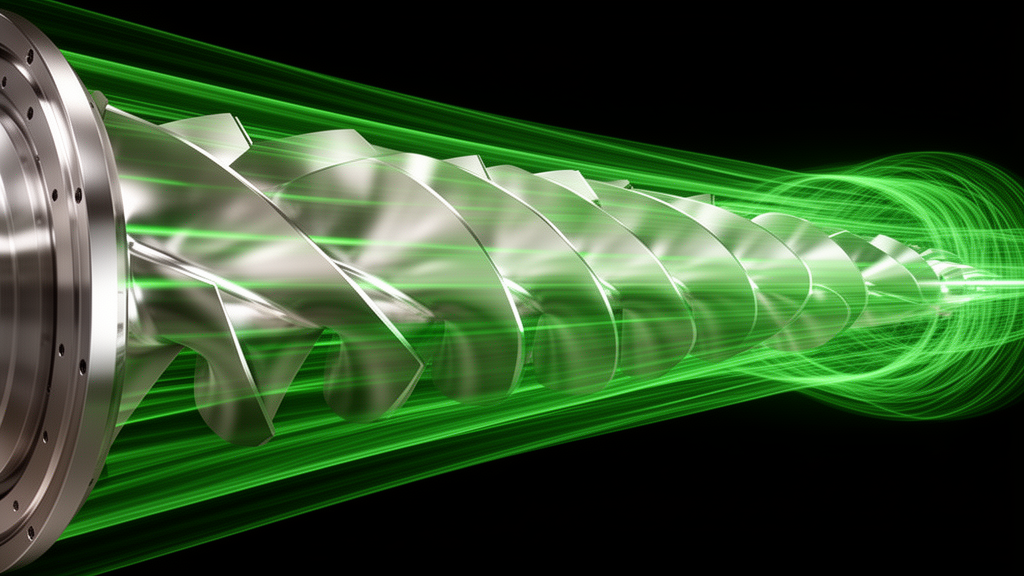
Aerospace engineers have developed an advanced mathematical correction framework that substantially refines aerodynamic loss and flow deviation predictions within axial compressor cascades, slashing model calculation errors by up to seventy-nine percent. Published in Propulsion and Energy by Ziqi Zhang, Bin Jiang, Chunmei Zhang, Zhidong Chi, and Huiqing Tao, the numerical study targets discrepancies in quasi-three-dimensional aerodynamic design tools. In modern turbomachinery development, engineers rely extensively on empirical correlations to estimate cascade performance during preliminary design phases, but traditional formulations frequently falter when evaluating modern blade geometries. By integrating multivariate nonlinear regression with an adaptive simulated annealing optimization algorithm, the investigative team established new empirical corrections that systematically account for the chordwise position of maximum blade thickness and incoming flow Reynolds numbers. Their corrected formulations reduced root-mean-square errors in total pressure loss by 78.92 percent at design incidence and 60.22 percent at off-design conditions, while cutting deviation angle errors by over 78 percent across simulated operating envelopes.
The performance prediction accuracy of quasi-three-dimensional compressor design workflows has historically remained tethered to empirical correlation models derived from classical experimental cascade testing. While classical correlations guided early generations of gas turbine engines, escalating aerodynamic stage loading in modern commercial and industrial compressors generates intricate flow fields dominated by complex boundary layer transitions, flow separation, and laminar-turbulent turning. Furthermore, contemporary compressor blades utilize controlled diffusion airfoils, offering enhanced geometric flexibility compared to conventional airfoils. Controlled diffusion airfoils are tailored to accelerate gas flow over the suction surface through customized curvature, maintaining adequate pressure gradients that suppress laminar boundary layer separation and postpone transition toward the trailing edge. However, because foundational empirical loss and deviation models were calibrated using older NACA-65 or double-circular-arc test databases, they fail to provide reliable aerodynamic predictions for flexible controlled diffusion designs that feature non-traditional thickness distributions and varied leading or trailing edge geometries.
Under varying aerodynamic operating regimes, the physical flow field within axial compressor cascades exhibits pronounced sensitivity to both the incoming Reynolds number and the chordwise thickness distribution of the blade. At low Reynolds numbers, viscous effects become more prominent as fluid velocity decreases near the solid wall, causing the boundary layer on the blade surface to thicken considerably. When the separated boundary layers along the pressure and suction surfaces converge at the blade trailing edge, they generate enlarged wake vortex regions that sharply elevate cascade total pressure losses. Conversely, shifting the maximum thickness position toward the forward section of the blade redistributes aerodynamic loading, promoting early boundary layer transition along the suction surface while relieving mechanical loading along the rear section. This reduction in trailing-edge loading prevents turbulent boundary layer separation until the flow reaches the immediate vicinity of the trailing edge, thereby suppressing both aerodynamic loss and flow deviation angles under favorable pressure gradients.
To establish baseline comparisons, the research team conducted a mathematical tolerance analysis of standard empirical equations implemented in industrial turbomachinery design codes. Specifically, baseline loss predictions under design incidence were formulated using Dawes’ fits to the historical Koch and Smith loss correlations alongside Swan’s equivalent diffusion factor formulation, which determines exit momentum thickness and boundary layer form factors. Off-design loss calculations were evaluated against Aungier’s asymmetric model, which determines positive and negative stall incidence angles alongside Mach number correction factors. For flow turning, baseline deviation angles were computed through the classic NASA SP-36 correlations fitted by Davis, complemented by Carmody and Creveling’s off-design deviation model. The tolerance analysis revealed that these classical empirical structures completely omit direct terms for the maximum thickness position coefficient and apply oversimplified Reynolds number corrections, causing classical models to predict identical deviation angles across diverse blade profiles and severely underpredict aerodynamic losses at elevated incidence angles.
To overcome the physical shortcomings of historical formulations, the investigators focused their numerical investigation on the fifth-stage rotor blade profile of an eight-stage power-generation axial compressor. The research team constructed customized controlled diffusion airfoil geometries by deploying an automated two-dimensional planar cascade parameterization program optimized via genetic algorithms. Within this workflow, camber lines and chordwise thickness distributions were defined using third-order seven-point Non-Uniform Rational B-Splines, or NURBS curves. This parameterization provided precise geometric control over the maximum thickness position coefficient, defined as the ratio of the distance from the leading edge to the center of the maximum inscribed tangent circle relative to the total axial chord length. Five distinct cascade geometries featuring maximum thickness position coefficients spanning from 0.2 to 0.6 were generated to establish an extensive sample database across varied aerodynamic flow conditions.
High-fidelity computational fluid dynamics simulations were executed to build the calibration database and capture detailed aerodynamic flow phenomena across the cascade configurations. Computational domain grids were generated with the commercial NUMECA AutoGrid5 module using an O4H structured mesh topology, setting computational inlet and outlet boundaries at one full chord length upstream and downstream of the blade. A mesh independence study on the blade with a thickness coefficient of 0.3 showed that total pressure loss coefficients shifted by only 0.11 percent when expanding the grid from 55,000 to 80,000 cells, confirming that 55,000 cells achieved grid independence. Numerical calculations were performed using the ANSYS CFX solver combining the Shear Stress Transport turbulence model with the Gamma Theta transition model, which reliably resolves natural and laminar separation bubble transitions. The numerical methodology was validated against experimental blade surface pressure distributions across incidence angles of negative four, zero, and positive four degrees, showing tight agreement.
The resulting aerodynamic sample database incorporated uniform sampling across five blade thickness profiles, seven distinct incidence angles, and inlet Reynolds numbers ranging between 1.5 times ten to the fifth and 1.5 times ten to the sixth at a constant inlet Mach number of 0.7. To calibrate revised empirical coefficients from this dataset, the researchers utilized an adaptive simulated annealing algorithm paired with multivariate nonlinear regression. Unlike traditional simulated annealing techniques with rigid cooling schedules, the adaptive simulated annealing method dynamically modifies its temperature reduction rate based on previous search results. When consecutive iterations yield favorable improvements, the algorithm accelerates temperature reduction to expedite convergence, whereas unfavorable steps trigger slower cooling to avoid abandoning promising global basins. With convergence defined as an absolute difference below one times ten to the negative seventh between model predictions and numerical results, the algorithm reliably optimized multi-parameter regression functions.
Applying this optimization framework to aerodynamic loss modeling yielded substantial accuracy gains across both design and off-design operating conditions. At the design incidence angle, the classical Reynolds correction term governing exit momentum thickness was reformulated into a power function where both coefficient and exponent were modeled as quadratic polynomials of the maximum thickness position coefficient. This modification reduced the root-mean-square error of the design total pressure loss coefficient from 0.005 to 0.001, representing a net precision improvement of 78.92 percent across all investigated Reynolds numbers. For off-design operation, the researchers modified Aungier’s parabolic loss formulation into a comprehensive quadratic equation where the second-order coefficient incorporates coupled terms of the maximum thickness position and Reynolds number. Validated at Reynolds numbers of 227,000 and 1,500,000, the revised off-design loss model reduced root-mean-square error from 0.028 to 0.011, achieving an overall error decrease of 60.22 percent and expanding reliable modeling boundaries.
The investigation achieved parallel enhancements in predicting flow deviation angles, addressing the critical flaw where classical models failed to recognize geometric shifts in maximum thickness. For design incidence angles, the researchers supplemented the classical NASA SP-36 formulation with a multivariate polynomial correction factor containing linear and quadratic terms for both the maximum thickness coefficient and normalized Reynolds number. This modification dropped the design deviation angle root-mean-square error from 1.003 degrees down to 0.216 degrees, reflecting a 78.44 percent error reduction. For off-design deviation angles, the study unified Carmody and Creveling’s piecewise formulation into a single continuous quadratic equation incorporating the thickness position coefficient, normalized incidence parameter, and logarithmic Reynolds number terms. In comparative evaluations, the percentage of sample points exhibiting prediction errors exceeding ten percent plunged from approximately seventy percent under the classical model to merely 8.40 percent under the corrected model, cutting root-mean-square error by 78.56 percent from 1.750 degrees to 0.375 degrees.
By resolving the historical limitations of empirical cascade formulations, the revised regression models offer a mathematically robust framework for modern high-load compressor design. The authors demonstrated that while classical correlations severely degrade at low Reynolds numbers and extreme positive or negative incidence angles, incorporating the blade maximum thickness position and logarithmic viscous scaling restores predictive integrity without necessitating computationally expensive three-dimensional Navier-Stokes calculations during preliminary design loops. However, the researchers noted that blade profiles with large maximum thickness position coefficients still experience abrupt flow changes at low Reynolds numbers. Furthermore, because incoming flow was maintained at a subsonic Mach number of 0.7 without exceeding critical cascade limits, secondary flow losses, shock waves, and tip clearance vortex interactions were excluded. Consequently, the derived empirical equations provide highly calibrated profile loss and deviation predictions specifically tailored for subsonic controlled diffusion rotor cascades.
Subject of Research: Empirical model corrections for compressor cascade loss and deviation angles
Article Title: Model correction for loss and deviation angle of compressor cascade based on multiple nonlinear regression
Article References: Zhang, Z., Jiang, B., Zhang, C., Chi, Z., & Tao, H. (2025). Model correction for loss and deviation angle of compressor cascade based on multiple nonlinear regression. Propulsion and Energy, 1(1), Article 9. https://doi.org/10.1007/s44270-025-00008-8
Image Credits: AI Generated
DOI: 10.1007/s44270-025-00008-8
Keywords: compressor cascade, total pressure loss, deviation angle, quasi-3D design, controlled diffusion airfoil, multiple nonlinear regression, adaptive simulated annealing, Reynolds number correction, maximum thickness position, computational fluid dynamics, axial compressor, ANSYS CFX, SST turbulence model, Gamma Theta transition model, incidence angle, aerodynamic performance, turbomachinery
News Source: Scienmag.