Researchers at the University of California, Los Angeles have demonstrated a compact optical processor that performs nonlinear computations using only linear optical components arranged on a single diffractive layer. Led by UCLA Professor Aydogan Ozcan with researchers Yuntian Wang, Alexander Chen, and Md Sadman Sakib Rahman, the team developed this design to eliminate requirements for specialized nonlinear optical materials or multiple optical layers.
Nonlinear mathematical operations provide the critical computational foundation for modern artificial intelligence architectures and extensive digital signal-processing tasks. However, realizing these nonlinear transformations efficiently using light waves has represented a persistent technical bottleneck in physical computing. Prior systems typically required specialized materials with nonlinear responses or multiple aligned optical layers to carry out these operations.
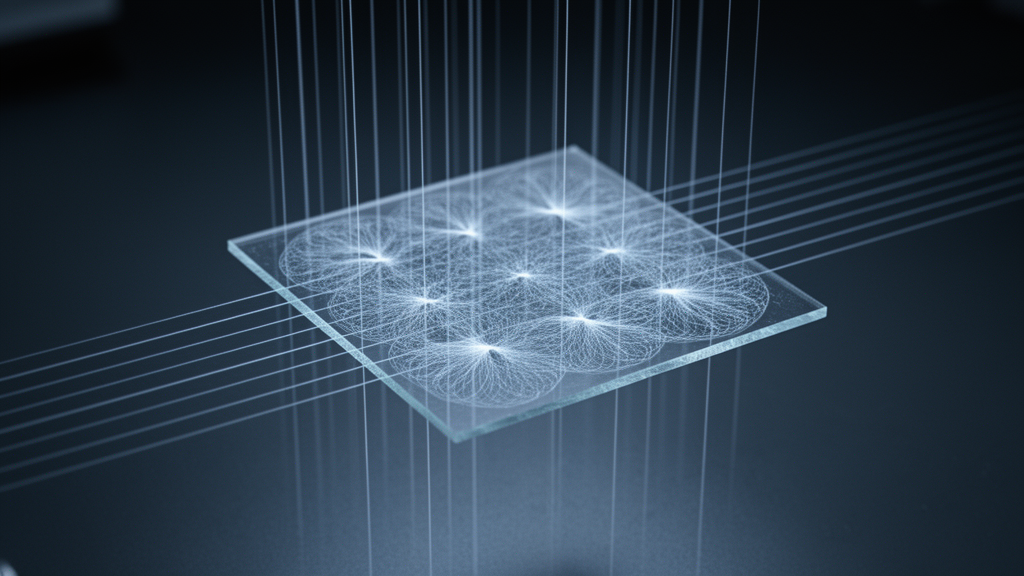
To address these physical constraints, the investigators created an architecture called single-layer encoder-decoder co-localization, abbreviated as E+D. In this physical design, a dynamic encoder that represents the computational input data is co-located directly on the same phase-only surface as a trained, fixed decoder pattern. This layout consolidates both optical components onto a unified phase-only surface.
When illuminated by coherent light, the optical fields generated by the input encoder and the fixed decoder propagate and interfere with each other in free space. Measuring the resulting light intensity at the output plane yields the desired nonlinear computational output. Because intensity detection captures wave interference, the system produces nonlinear responses without relying on physical nonlinear optical materials.
The team mathematically demonstrated that this single-layer co-localization framework can approximate arbitrary real-valued, band-limited nonlinear functions under coherent light and intensity-based detection. Subsequent numerical simulations confirmed this capability, reproducing diverse nonlinear activation functions commonly deployed in artificial neural networks. Furthermore, the researchers established that the computational framework can be systematically extended to process functions requiring multiple input variables.
In a proof-of-concept experimental implementation conducted with visible light, the researchers patterned 100 individual encoder-decoder processing units across a single programmable spatial modulator and recorded their optical projections using a camera sensor. An in situ learning technique was used to fine-tune the physical hardware, allowing the processor to approximate 100 distinct nonlinear functions simultaneously during a single forward optical pass with negligible operational error.
The experimental platform maintained stable measurements for at least 12 hours without requiring realignment or recalibration. By integrating a learned phase pattern that remains permanently fixed following the training phase, the design decreased nonlinear function-approximation errors by multiple orders of magnitude, even when restricted by the limited phase precision of commercial hardware.
The UCLA investigators also demonstrated that the single-layer architecture can approximate complex-valued nonlinear functions by deploying multiple detector channels at the output stage. Reported in the journal Light: Science & Applications, this development establishes an avenue for compact and scalable optical processing platforms that carry out sophisticated calculations with fewer components, simplified alignment, and heightened hardware flexibility.
Subject of Research: Nonlinear optical computing using a single diffractive layer
Article Title: A single optical layer computes nonlinear functions in parallel
Article References: A single optical layer computes nonlinear functions in parallel. Original publication (Bibliographic details unavailable.)
Image Credits: AI Generated
DOI: Not provided
Keywords: optical computing, nonlinear computation, diffractive optical processor, encoder-decoder co-localization, phase-only surface, wave interference, intensity detection, in situ learning, spatial light modulator, visible light experiments, neural network activation functions, parallel computing, band-limited functions, complex-valued functions, Aydogan Ozcan, UCLA research
News Source: Scienmag.