Conducted by food engineering researchers evaluating cereal brewing alternatives, the study assessed locally grown maize as a partial replacement for malted barley at a fixed fifteen-percent adjunct ratio. By systematically altering precooking temperatures across 65°C, 80°C, and 95°C alongside heating durations of 35, 55, and 75 minutes in a three-by-three factorial experimental framework, the researchers quantified how thermal processing influences starch gelatinization, enzymatic hydrolysis during mashing, yeast metabolism during primary fermentation, and subsequent physical and organoleptic beer characteristics.
Ethiopia’s commercial brewing industry has expanded substantially over the past two decades, driven by population growth, urbanization, rising consumer demand, and domestic capital investments in brewing capacity. National beer production surged from approximately one million hectoliters in 2003/04 to more than ten million hectoliters annually in recent years, cementing brewing as a vital component of the country’s agro-industrial sector. This rapid expansion has stimulated demand for foundational brewing raw materials, which traditionally rely on malted barley. While malted barley remains the principal raw material because it provides hydrolytic enzymes—including alpha-amylase, beta-amylase, beta-glucanase, and proteases that facilitate starch conversion, cell-wall degradation, and wort nitrogen nutrition—heavy reliance on malt inflates production expenditures. Utilizing locally cultivated cereal adjuncts such as dent maize presents an effective strategy to lower raw material costs, as maize provides abundant starch, widespread availability, and low relative procurement costs.
Despite the economic benefits of incorporating maize as an adjunct, native maize starch presents a major technological challenge during brewing mashing because of its high gelatinization temperature. Consequently, dedicated hydrothermal precooking is necessary to gelatinize maize starch, rendering it susceptible to enzymatic hydrolysis when combined with barley malt in the mash vessel. Insufficient thermal treatment results in incomplete gelatinization and poor extract recovery, whereas excessive thermal processing increases industrial energy requirements, impairs starch functionality, and risks denaturing malt enzymes upon blending, highlighting the need to identify balanced temperature and holding time combinations.
To evaluate these precooking variables under controlled conditions, the researchers sourced locally cultivated white dent maize grains (Zea mays L.) and dried Cascade hop pellets (Humulus lupulus L.) from supermarkets in Bahir Dar City, Ethiopia. Industrial malted barley was procured from Dashen Malt Factory in Gondar, a major commercial malt supplier for regional breweries, and stored in cool, dry conditions to preserve its enzymatic activity. The maize kernels underwent manual cleaning and degermination to remove the oil-rich germ tissue prior to size reduction. Both malted barley and degerminated maize were milled using a laboratory hammer mill fitted with a one-millimeter screen to achieve a uniform coarse grist suitable for extraction. The brewing formulation maintained a constant substitution ratio of 15 percent maize grist (90 grams) to 85 percent barley malt grist (510 grams), with a standardized liquor-to-grist ratio of 1:3 weight-to-volume across twenty-seven experimental mashes representing three independent replicates per treatment.
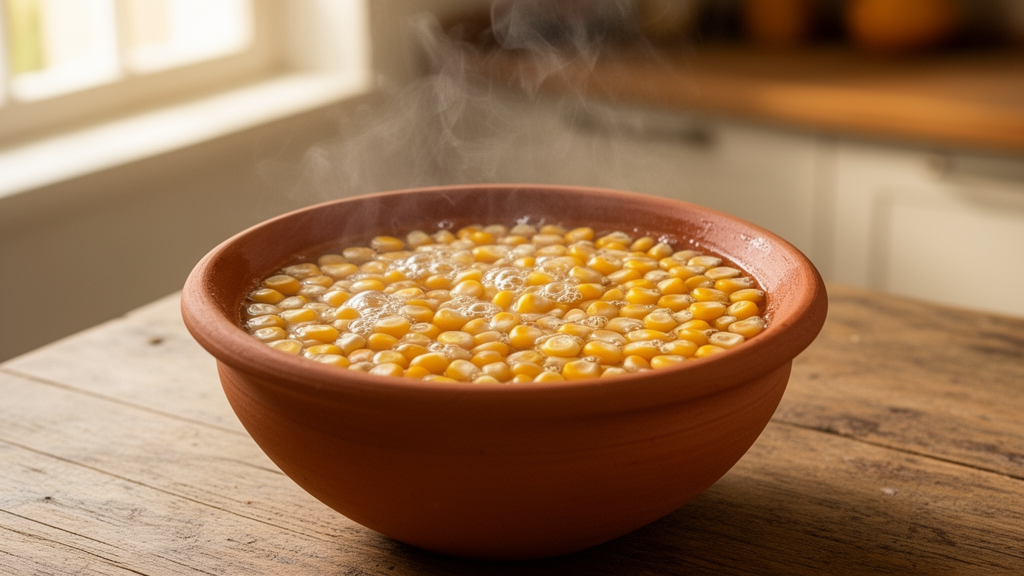
The hydrothermal precooking protocol involved mixing 90 grams of maize grist with 270 milliliters of water in a boiling pan and maintaining the slurry at 65°C, 80°C, or 95°C for holding periods of 35, 55, or 75 minutes. Once precooked, the maize slurry was blended directly with 510 grams of barley malt grist and 1530 milliliters of water in the mash vessel. Mashing followed a multi-rest profile with successive holding stages at 45°C for 20 minutes, 52°C for 15 minutes, 63°C for 50 minutes, and 72°C for 20 minutes, with mash pH monitored and adjusted to 5.3 using food-grade reagents. Following saccharification, sweet wort was separated through a 40-mesh sieve and muslin cloth, then boiled at 102°C for one hour and forty minutes. After boiling, the hopped wort was clarified via sedimentation and micro-mesh filtration, transferred into sterile vessels, and gradually cooled in refrigeration over three hours until reaching a target pitching temperature of 14°C.
Primary fermentation was initiated by inoculating cooled wort with commercial brewing yeast, Saccharomyces cerevisiae strain SafAle S-04, which had been rehydrated in sterile water at a 1:10 ratio between 25°C and 29°C for 15 to 30 minutes. Yeast slurry was pitched into 1.5-liter sterile plastic fermenters at an inoculation rate of approximately 0.75 million viable cells per milliliter per degree Plato, establishing an initial yeast concentration of roughly 4.5 billion viable cells. The closed fermentation vessels were incubated at 14°C for fourteen days until specific gravity achieved a stable plateau, confirming that primary fermentable sugar consumption had concluded. Following fermentation, the green beer was decanted from the yeast sediment without mechanical agitation and passed through two successive stages of gravity filtration using a one-micrometer micro-sieve and sterile muslin cloth. Filtered beer samples were then stored in sterile containers under refrigeration for comprehensive analytical and sensory evaluations.
Physicochemical analysis revealed that precooking conditions exerted statistically significant effects on wort gravities, sugar extraction, and fermentability. Original gravity values varied from 10.33°P under the 95°C for 35-minute condition to a peak of 13.40°P under the 95°C for 75-minute treatment, demonstrating that extended hydrothermal processing disrupted maize starch granules and released higher concentrations of soluble extract. As precooking temperature and duration increased, final gravity dropped from 6.13°P in the 65°C for 55-minute trial to 2.04°P in the 95°C for 75-minute trial, matching commercial all-malt final gravities that typically range from 2°P to 4°P. Real extract declined from 7.24°P to 4.25°P, while the apparent degree of fermentation expanded from 46.06 percent to 84.78 percent. These shifts confirmed that higher precooking temperatures and longer holding times augmented starch gelatinization and subsequent malt enzymatic hydrolysis, providing abundant fermentable sugars that yeast efficiently converted into alcohol while leaving fewer residual unfermented carbohydrates.
Ethanol production and fermentation kinetics closely reflected the enhanced availability of fermentable substrates across treatments. Final alcohol content increased consistently with precooking severity, rising from 2.62 percent by weight under the 65°C for 35-minute treatment to a maximum of 5.80 percent under the 95°C for 75-minute treatment, falling within the conventional four-to-six percent alcohol range expected of commercial maize-adjunct brews. Daily gravity monitoring over the initial five days revealed that yeast metabolic activity was most vigorous during the first two to three days before moderating as simple sugars were depleted. Fermentation rates increased from 0.74 specific gravity units per day in the 65°C for 35-minute run to 1.53 specific gravity units per day in the 95°C for 75-minute run. Elevated precooking conditions facilitated rapid enzymatic degradation of complex maize polysaccharides into readily assimilable simple sugars, sustaining yeast vitality, accelerating substrate consumption, and enhancing the overall rate of ethanol synthesis.
In contrast to the major shifts observed in carbohydrate breakdown and alcohol yield, physical colloidal attributes of the finished beers exhibited remarkable stability across all precooking treatments. Turbidity readings ranged from 0.67 to 1.46 nephelometric turbidity units, displaying no statistically significant differences among the nine experimental runs. Because maize contains lower levels of haze-forming proteins and polyphenols than barley malt, adjunct beers demonstrated inherent clarity, with turbidity governed primarily by post-fermentation yeast suspension and filtration mechanics rather than thermal pretreatment parameters. Beer viscosity showed only minor variations between 0.31 and 0.76 mPa·s without statistically significant differences, indicating that carbohydrate breakdown and ethanol formation maintained consistent fluid resistance. Finished beer density ranged between 1.011 and 1.065 grams per milliliter across treatments. Microbial analysis of harvested yeast slurries recorded total culturable counts between 640,000 and 960,000 colony-forming units per milliliter on non-selective agar, while methylene blue staining documented viable yeast proportions between 51.00 percent and 60.75 percent.
Sensory evaluations conducted by fifty semi-trained panelists using a seven-point hedonic scale demonstrated that maximal starch gelatinization does not directly correspond to optimal organoleptic quality. While the 95°C for 75-minute treatment achieved superior fermentation efficiency and ethanol yield, beers produced from maize precooked at 80°C for 35 minutes attained the highest overall sensory acceptability score of 6.67, driven by high perceived sweetness, smooth mouthfeel, and pleasant flavor integration. Visual color scores intensified from 4.00 to 6.67 with higher thermal treatment due to non-enzymatic browning, yet excessive heating diminished delicate volatile aroma compounds. The authors concluded that while an 80°C precooking treatment for 35 minutes provides the most favorable sensory balance for a fifteen-percent maize substitution, commercial adoption will require comprehensive industrial energy evaluations, foam stability testing, and extended shelf-life validations.
Subject of Research: Optimization of maize precooking temperature and time for partial barley malt replacement in Ethiopian beer production
Article Title: Optimization of Maize Precooking Conditions for Partial Replacement of Barley Malt in Beer Production
Article References: Mossie, B. B., & Hilemeskel, W. H. (2026). Optimization of Maize Precooking Conditions for Partial Replacement of Barley Malt in Beer Production. Food Science & Nutrition, 14(11), Article e72632. https://doi.org/10.1002/fsn3.72632
Image Credits: AI Generated
DOI: 10.1002/fsn3.72632
Keywords: beer brewing, maize adjunct, barley malt replacement, starch gelatinization, precooking temperature, precooking time, mashing profile, fermentation efficiency, apparent degree of fermentation, alcohol content, original gravity, real extract, yeast viability, sensory evaluation, Ethiopian brewing, Saccharomyces cerevisiae, beer turbidity, beer viscosity
News Source: Alan Morgan. (November 26, 2026). Precooking Maize at Ninety-Five Degrees Optimizes Fermentation Yield in Ethiopian Brewing. Scienmag.