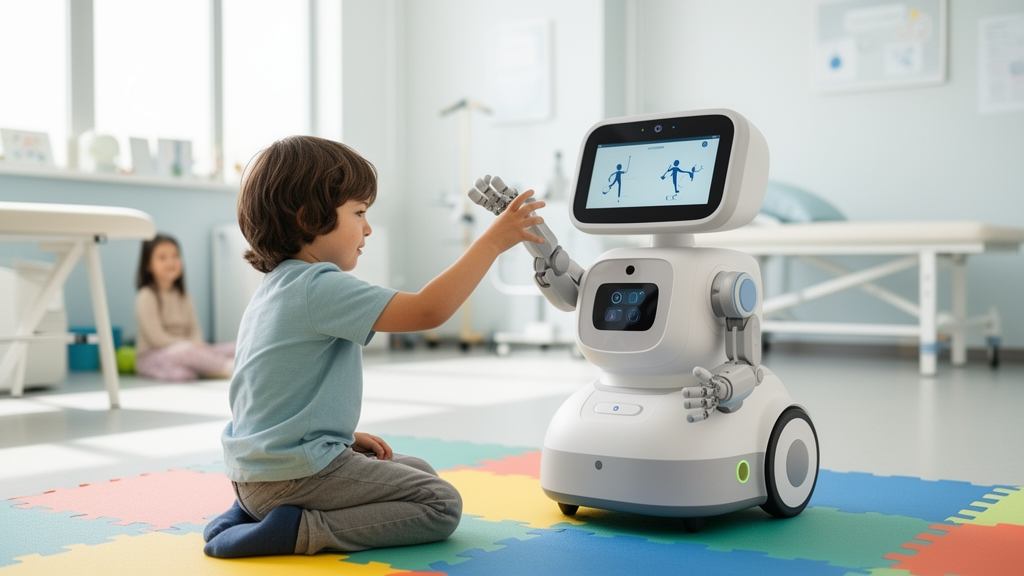
Researchers evaluating the Mobirobot project have documented how interprofessional collaboration shaped the iterative adaptation of a socially assistive robot across paediatric healthcare environments. The study examined how clinical and technical stakeholders translated practical therapeutic requirements into targeted modifications to the robotic system and its everyday deployment procedures.
Conducted as Phase 2 of the initiative between 2022 and 2024, the investigation encompassed three distinct care environments: inpatient sports therapy, inpatient physiotherapy, and outpatient physiotherapy. The research team included contributors from the Medical School OWL at Bielefeld University, Evangelisches Klinikum Bethel, and Hand & Fuß Physiotherapie in Bielefeld, Germany.
To capture stakeholder perspectives, the development framework combined recurring interdisciplinary assemblies, weekly technical meetings, setting-specific exchanges, a dedicated care-staff workshop, and hands-on testing during site visits. The authors systematically reviewed 25 formal meeting and workshop records that catalogued observational findings from deployment settings alongside technical system revisions.
Analysis of these records revealed iterative modifications across the robot’s interaction mechanisms, exercise programming, technical infrastructure, and clinical deployment routines. Specific adaptations included configuring tailored exercise regimens that therapists could adjust directly, as well as altering physical placement parameters to accommodate the constraints of bedside physiotherapy.
The documented development process also identified technical features that proved unviable in clinical practice, leading the team to discontinue an unreliable heart-rate monitoring component.
The study derived broader development considerations centred on interaction design, therapeutic adaptability, professional supervisory control, technical robustness, and institutional integration. However, the authors noted key evidentiary boundaries, explaining that the reviewed records did not establish the precise frequency of reported user needs or verify whether the resulting technical adaptations improved clinical outcomes for paediatric patients.
The authors emphasize that successfully embedding socially assistive technologies into paediatric therapy demands continuous alignment among therapeutic goals, professional responsibilities, and local healthcare workflows. In examining the Phase 2 development cycles, the research highlights how repeated contact between technical and clinical stakeholders allowed direct observations from site visits to inform subsequent technical revisions.
The documented decisions yielded five distinct developmental lessons addressing interaction, therapeutic adaptability, professional control, technical robustness, and integration into local practice.
Spanning inpatient sports therapy, inpatient physiotherapy, and outpatient physiotherapy, the project provided a longitudinal view of how distinct care settings present varying implementation challenges.
The study’s empirical basis rests entirely on the qualitative review of 25 meeting and workshop records spanning the 2022 to 2024 timeframe, which systematically documented technical alterations alongside observational notes from site visits. While these qualitative accounts illustrate the collaborative pathways that guided system revisions across successive development cycles, the investigators explicitly cautioned that the reviewed records do not quantify how frequently specific stakeholder needs were expressed during the project. Furthermore, the available documentation does not establish whether the resulting technical adaptations improved clinical outcomes or therapeutic efficacy for paediatric patients. Consequently, the authors present these documented development lessons as foundational considerations to inform future interprofessional co-development initiatives in assistive healthcare technology.
Subject of Research: Interprofessional development of socially assistive robots in paediatric therapy
Article Title: Interprofessional and agile development of Mobirobot: a socially assistive robot for paediatric therapy across clinical and therapeutic settings
Article References: Dyck, L., Galetzka, A., Noller, M., Rinke, A.-L., Bormann, J., Miller, J., Hochbaum, M., Siemann, J., Alboth, J., Berwinkel, A., Luz, J., Kley-Zobel, B., Cyrys, M., Flöttmann, N., Vogeler, A., Melnikova, M., Petras, I.-K., Siniatchkin, M., Barthlen, W., & Vollmer, A.-L. (2026). Interprofessional and agile development of Mobirobot: a socially assistive robot for paediatric therapy across clinical and therapeutic settings. Frontiers in Digital Health, 8, Article 1699971. https://doi.org/10.3389/fdgth.2026.1699971
Image Credits: AI Generated
DOI: 10.3389/fdgth.2026.1699971
Keywords: socially assistive robots, paediatric therapy, inpatient physiotherapy, outpatient physiotherapy, inpatient sports therapy, interprofessional development, human-robot interaction, participatory design, digital health, agile development, bedside physiotherapy, exercise regimens, heart-rate monitoring, clinical workflows, therapeutic adaptability, technical robustness
News Source: Harold Sullivan. (November 26, 2026). Mobirobot Development Traces Paediatric Therapy Adaptations Across Three Clinical Settings. Scienmag.