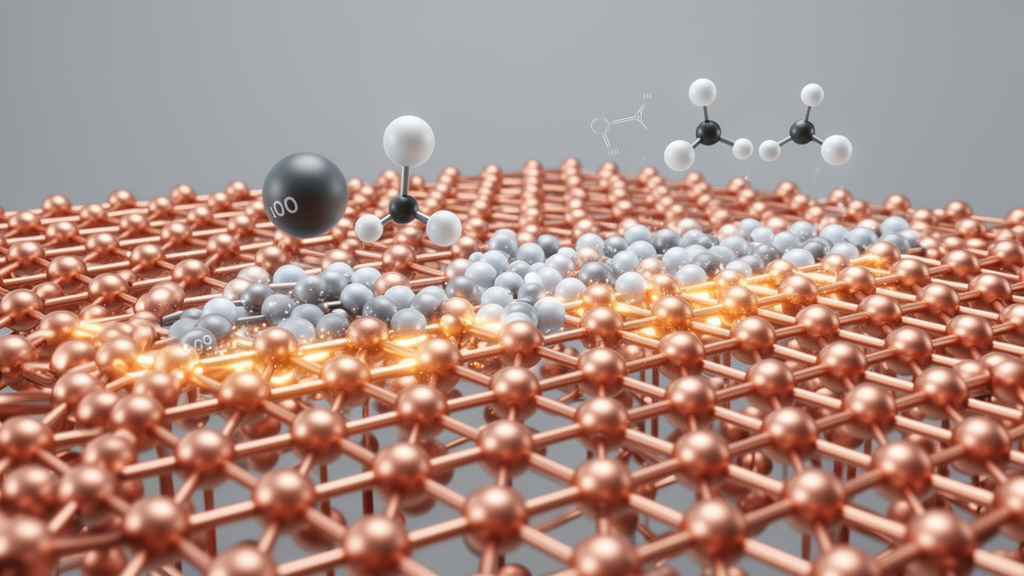
A research team led by Professor Zhe Weng at Tianjin University has developed a specialized dual-strain copper electrocatalyst that achieves high efficiency and unprecedented production rates in transforming carbon dioxide into valuable multicarbon compounds. Described in a peer-reviewed study, the synthesized catalyst, designated Cu-BLS, incorporates atomically dispersed nickel oxide anchors to establish coexisting compressive and tensile lattice-strain domains across a single copper matrix. Under demanding operational conditions in an advanced electrolyzer, the engineered material demonstrated an 88.9 percent Faradaic efficiency for multicarbon products alongside a record mass-normalized partial current density of 7103 amperes per gram at an ampere-level current density of 1.6 amperes per square centimeter.
Electrochemical conversion of captured carbon dioxide into multicarbon chemicals such as ethylene and ethanol using renewable electricity represents a promising technical pathway toward establishing sustainable chemical supply chains and realizing carbon neutrality. Metallic copper has long served as the benchmark catalyst for this conversion because of its unique capability to facilitate the necessary reduction cascades. However, practical deployment has historically encountered an intrinsic chemical bottleneck during the critical carbon–carbon coupling step. Efficient catalysis demands contradictory surface characteristics: intermediate carbon monoxide must bind strongly to the catalytic surface, yet rapid hydrogenation and water activation must simultaneously proceed. On conventional copper surfaces, these competing mechanistic requirements typically counteract each other, imposing fundamental trade-offs on reaction rates and overall energy conversion efficiencies.
Conventional lattice-strain engineering methods adjust surface atomic behavior by introducing mechanical distortions, but traditional material synthesis protocols typically impose only a single uniform strain mode, producing either purely compressive or purely tensile strain across the catalyst surface. This single-mode restriction misses the catalytic advantages that arise from pairing opposing strain regimes within adjacent domains. To overcome this limitation, the researchers established a dual-strain field engineering strategy. By anchoring atomically dispersed nickel oxide units onto the copper catalyst structure, the team successfully synthesized stable, localized regions of alternating compressive and tensile lattice strain that function concurrently throughout the catalytic surface layer.
Mechanistic investigations combining operando spectroscopy and density functional theory calculations revealed that the two distinct lattice environments divide the chemical labor necessary for multicarbon formation. Compressive-strained domains selectively strengthen carbon monoxide adsorption, stabilizing crucial reaction intermediates on the surface. Concurrently, neighboring tensile-strained domains decrease the thermodynamic barrier for water dissociation and accelerate the hydrogenation of adsorbed carbon monoxide into hydroxymethylidyne intermediates. This local spatial cooperation provides a tailored microenvironment that promotes an asymmetric carbon–carbon coupling pathway between carbon monoxide and hydroxymethylidyne, which exhibits an activation barrier of 0.71 electron volts, considerably lower than the symmetric carbon monoxide dimerization barrier of at least 1.02 electron volts.
Experimental verification using in situ attenuated total reflection surface-enhanced infrared absorption spectroscopy confirmed that the Cu-BLS catalyst proceeds almost exclusively through this asymmetric coupling sequence. During spectroscopic tracking, the key hydroxymethylidyne intermediate emerged at a markedly less negative electrode potential on Cu-BLS than on reference copper materials lacking the engineered dual strain. The crucial contribution of the atomic anchors was further verified through thermal control experiments: when annealing treatments were applied to intentionally eliminate the dispersed nickel oxide units, the surrounding copper lattice strain relaxed, resulting in a precipitous drop in ethylene Faradaic efficiency down to a range of 10 to 30 percent.
The catalyst demonstrated substantial performance enhancements across different electrochemical test configurations. In an initial flow cell evaluated at a current density of 800 milliamperes per square centimeter, Cu-BLS attained a Faradaic efficiency of 84.3 percent for multicarbon products and 60.2 percent specifically for ethylene, substantially outperforming an unstrained reference catalyst that delivered 64.7 percent and 45.4 percent, respectively. When evaluated in a thin-electrolyte-layer flow cell optimized to reduce total cell operating voltage, Cu-BLS sustained multicarbon Faradaic efficiencies exceeding 75 percent across an industrially relevant current range spanning 0.6 to 2.0 amperes per square centimeter, maintaining continuous operational stability over roughly 50 hours of electroreduction testing.
Looking toward technological translation, the research team intends to focus future developmental work on scaling up the synthesis of the dual-strain material, refining the spatial distribution of opposing strain domains, and optimizing the broader energy efficiency and long-term durability of full electrolyzer systems. The collaborative study was conducted by the Nanoyang Group at Tianjin University in partnership with researchers at Oregon State University and other collaborating institutions, with financial backing provided by the National Natural Science Foundation of China. The findings illustrate a versatile architectural design principle capable of steering complex multi-step electrocatalytic reactions requiring precise nanoscale coordination of reactive surface intermediates.
Subject of Research: Dual-strain copper electrocatalyst for carbon dioxide reduction to multicarbon products
Article Title: Squeeze and stretch: a dual-strain copper catalyst unlocks an efficient new route to greener ethylene
Article References: Squeeze and stretch: a dual-strain copper catalyst unlocks an efficient new route to greener ethylene. Original publication (Bibliographic details unavailable.)
Image Credits: AI Generated
DOI: Not provided
Keywords: carbon dioxide electroreduction, copper catalyst, dual-strain engineering, ethylene production, nickel oxide anchors, Faradaic efficiency, asymmetric C–C coupling, flow cell electrolyzer, operando spectroscopy, density functional theory, multicarbon products, Tianjin University, lattice strain, electrocatalysis, thin-electrolyte layer, in situ ATR-SEIRAS, renewable electricity
News Source: Bethany Barker. (November 26, 2026). Dual-Strain Copper Catalyst Drives Efficient Ethylene Production from Carbon Dioxide. Scienmag.