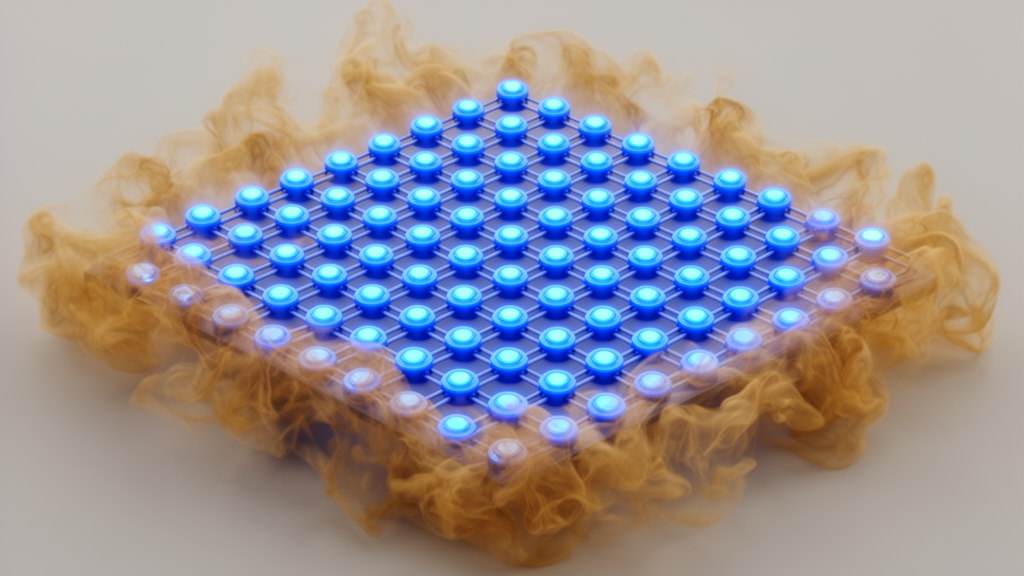
Theoretical physicists have established that actively corrected surface codes coupled to a continuous, un-reset quantum environment face fundamental decoherence limits that challenge standard assumptions of fault-tolerant quantum computing. In an analytical study published in the Brazilian Journal of Physics, researchers E. Novais and A. H. Castro-Neto demonstrated that a true thermodynamic threshold protecting an encoded logical qubit exists strictly for environments characterized by short-range spatial correlations. By employing a generalized Caldeira-Leggett dissipative framework, the authors mapped the long-time quantum evolution of an actively stabilized surface code onto a one-dimensional boundary conformal field theory, establishing an exact mathematical equivalence to the anisotropic Kondo impurity model. This analytical mapping reveals that while active quantum error correction effectively suppresses high-frequency environmental fluctuations, the macroscopic footprint of large-scale code lattices inevitably amplifies slow, long-wavelength environmental modes, destroying topological protection whenever the spatial correlations of the continuous bath become critical or long-ranged.
Standard quantum error correction protocols have historically modeled environmental decoherence as a discrete, stochastic Markovian process where classical variables apply random Pauli bit-flip or phase-flip errors to physical qubits with a fixed independent probability. Under these classical approximations, celebrated threshold theorems rigorously prove that whenever physical error rates remain below a critical numerical value, periodic syndrome extraction and classical active recovery operations can preserve encoded quantum information indefinitely. Even modern extensions addressing coherent noise typically rely on bounded operator norms to guarantee fault-tolerant bounds. The authors argue that this stochastic paradigm obscures the true physical reality of open quantum systems, where physical qubits inevitably interact with continuous, interacting, gapless quantum fields whose operators are mathematically unbounded. Because macroscopic quantum hardware inevitably couples to extended physical environments such as substrate phonons, electromagnetic continua, or charge fluctuators, evaluating the operational viability of fault tolerance requires directly modeling continuous quantum dissipation rather than relying solely on classical noise abstractions.
To capture the continuous quantum nature of physical hardware, the researchers adopted the foundational framework developed by Caldeira and Leggett, which treats an dissipative environment as a continuous bath of non-interacting quantum harmonic oscillators coupled linearly to physical system coordinates. Within this generalized setting, the authors evaluated a two-dimensional surface code lattice governed by self-dual gauge-invariant operators, where physical qubits reside on the edges of an open square lattice. The code defines local four-body star operators measuring Pauli X products around lattice vertices and four-body plaquette operators measuring Pauli Z products enclosing lattice tiles, while two macroscopic non-trivial Wilson loop strings spanning opposite lattice boundaries define the logical operators. While early passive formulations sought to protect encoded quantum states through an energetic ground-state gap, two-dimensional topological codes are known to suffer from thermal fragility due to unconfined anyonic diffusion. Active quantum error correction overcomes this thermal instability by periodically measuring local stabilizer operators at discrete intervals of duration tau, projectively resetting high-frequency errors through classical decoding algorithms like minimum-weight perfect matching.
In the investigated model, discrete error correction interventions are assumed to operate instantaneously at discrete clock intervals, leaving physical qubits to evolve unitarily under the continuous environmental coupling during interstitial cycles of duration tau. Using the interaction-picture Dyson series, the authors evaluated the intra-cycle quantum evolution generated by a linear coupling between the physical qubits and a continuous bosonic bath. At the conclusion of each cycle, projective stabilizer measurements collapse the local physical state, successfully eliminating dynamic quantum trajectories that conflict with the extracted classical syndrome. However, standard decoding routines assume that observed defects were generated by the shortest possible physical error chain of length n. Because the continuous time-evolution operator generates superpositions of complementary error paths, an assumed defect chain of length n inadvertently combines with an unprojected complementary quantum trajectory of length L minus n, completing a macroscopic Wilson loop across the lattice. The lowest-order logical failure surviving projective filtering occurs when this complementary amplitude is minimized at order L divided by two.
Evaluating this critical order within the Dyson series demonstrates that the amplitude of a macroscopic logical failure is governed by a multi-point temporal correlation function of the continuous bosonic bath. Normal-ordering these time-ordered operators through real-space Wick contractions decomposes the L divided by two interaction terms into a massive sum over pair contractions. For a single error chain, there are exactly double-factorial pairings of points, reflecting a dramatic combinatorial proliferation of Feynman diagrams. Furthermore, on a two-dimensional lattice of linear dimension L, there are L independent parallel contours, each admitting a massive combinatorial choice of spatial error distributions. Applying Stirling approximation reveals that the total number of degenerate failure pathways scales as the square root of two L divided by pi multiplied by two to the power L. This massive entropy of macroscopic paths directly competes against the spatial and temporal decay of the environmental two-point propagators, establishing an effective pairwise interaction scaling with the environmental dynamical exponent z.
By integrating out the fast intra-cycle modes and absorbing the combinatorial degeneracy into an effective coupling, the long-time dissipative dynamics of the logical qubit reduce to a one-dimensional Tomonaga-Luttinger liquid coupled to a localized macroscopic boundary operator. Classical static solutions to the resulting Euler-Lagrange equations show that the spatial gradient of the bosonic field forms a discontinuous step profile whose polarity is strictly slaved to the logical Z eigenvalue. Consequently, the coupled quantum system exhibits two degenerate topological vacua separated by a macroscopic field deformation that cannot be bridged by perturbative fluctuations. A logical bit-flip transition requires macroscopic quantum tunneling between these vacua, which the authors formalized through instanton kink solutions in imaginary time. Algebraic duality dictates that the transverse physical error operator couples to the vertex operator of the dual conjugate phase field, producing an effective infrared Hamiltonian mathematically identical to the anisotropic Kondo impurity model describing a localized spin-one-half particle coupled to a one-dimensional conduction bath.
Analyzing the resulting low-energy physics via one-loop renormalization group scaling equations reveals fundamentally divergent thermodynamic behaviors across different coupling regimes. In the ferromagnetic regime, the flow drives transverse tunneling events to zero, leaving off-diagonal logical coherences to decay asymptotically as a power law rather than an exponential decay, thereby prolonging logical memory lifetime. Conversely, in the antiferromagnetic regime, the renormalization group flow universally runs away toward strong coupling, forming an entangled Kondo singlet that completely scrambles the logical quantum state at a characteristic Kondo energy scale. For environments exhibiting generalized Ohmic spectral densities, the existence of an asymptotic thermodynamic threshold depends entirely on the spatial correlation exponent z. When z exceeds one half, spatial correlations decay sufficiently fast that the effective Kondo coupling decreases exponentially with code distance, yielding a computational lifetime that scales as a double exponential in L. In critical regimes where z equals one half, long-range correlations generate logarithmic divergences that inevitably drive the coupling toward failure as system size increases, while long-range regimes with z below one half exhibit power-law growth of the bare coupling, eliminating any asymptotic threshold.
Extending the boundary conformal field theory to finite temperatures demonstrates that active error correction inherently compromises its own environmental stability. Because discrete syndrome extractions and gate pulses require localized energy in time, their repeated physical execution constantly injects bosonic excitations into the continuous bath. While macroscopic refrigeration systems efficiently extract heat from high-frequency ultraviolet modes, low-frequency infrared modes cannot be actively reset by local stabilizer projections. Mapping the field correlators to a finite-temperature cylinder reveals that thermal fluctuations impose an effective infrared cutoff at a characteristic thermal timescale proportional to Planck constant divided by thermal energy. In the ferromagnetic regime, this thermal cutoff halts the algebraic coherence decay, replacing it with an exponential Korringa-like relaxation rate proportional to temperature. Similarly, in the antiferromagnetic regime, temperatures exceeding the Kondo scale interrupt singlet formation but subject the logical state to thermal Korringa relaxation scaling linearly with temperature and the square of the macroscopic coupling, ensuring a finite operational lifetime across all regimes for any finite code distance.
These scaling limits carry direct practical consequences for prominent quantum computing architectures, highlighting a stark contrast between superconducting circuits and neutral atom arrays. Superconducting transmon processors achieve remarkably fast error correction cycles of approximately one microsecond, but their macroscopic physical footprints, requiring lattice spacings of roughly one millimeter, exacerbate substrate interactions. Capacitive crosstalk, piezoelectric phonon coupling, and substrate charge bursts generate collective charge excitations with dispersion relations scaling as the square root of momentum, directly matching the critical exponent z equals one half. In this critical regime, expanding the code distance to suppress discrete errors inadvertently amplifies continuous bath interactions, driving critical coupling thresholds toward zero. In contrast, neutral atom arrays operate with significantly slower cycles of approximately one millisecond due to optical tweezer shuttling overhead. However, because neutral atoms spend the vast majority of their operational cycles parked in dipole-isolated ground states, interacting strongly with the electromagnetic vacuum only during brief microsecond Rydberg pulses, their time-averaged continuous coupling is phenomenologically suppressed, keeping them well below the calculated critical threshold of two point five times ten to the minus twelve despite slow clocks.
Ultimately, the researchers demonstrated that sub-Ohmic environments where the spectral density exponent s is less than one represent the most severe threat to topological quantum architectures. In sub-Ohmic baths, the renormalization group equation acquires a relevant linear eigenvalue proportional to one minus s, which downgrades the computational operation time from an exponential dependence to a strict power law. Under these conditions, short-range thresholds are reduced from double-exponential protection to simple exponential scaling, while critical and long-range environments suffer rapid power-law collapse of computational coherence as the code size expands. By bridging the gap between quantum information theory and condensed matter field theory, this work rigorously shows that algorithmic error correction alone cannot circumvent continuous quantum decoherence. Achieving truly fault-tolerant, scalable quantum computation will require hardware designs that explicitly account for the continuous spectral and spatial geometry of the physical substrate, ensuring that macroscopic scaling does not weaponize the surrounding quantum bath against the logical memory.
Subject of Research: Theoretical decoherence limits of actively corrected surface codes in continuous quantum environments
Article Title: Quantum Decoherence of the Surface Code: A Generalized Caldeira-Leggett Approach
Article References: Novais, E., & Castro-Neto, A. H. (2026). Quantum Decoherence of the Surface Code: A Generalized Caldeira-Leggett Approach. Brazilian Journal of Physics, 56(4), Article 194. https://doi.org/10.1007/s13538-026-02120-9
Image Credits: AI Generated
DOI: 10.1007/s13538-026-02120-9
Keywords: quantum error correction, surface code, Caldeira-Leggett model, quantum decoherence, anisotropic Kondo model, boundary conformal field theory, thermodynamic threshold, dynamical exponent, Ohmic bath, renormalization group, Kosterlitz-Thouless flow, superconducting qubits, transmon arrays, neutral atom arrays, Korringa relaxation, topological protection, Tomonaga-Luttinger liquid
News Source: Katie Riggs. (November 26, 2026). Continuous Quantum Environments Limit Surface Code Protection Below Critical Spatial Thresholds. Scienmag.