Accurately quantifying how much carbon forests absorb from the atmosphere remains a persistent scientific challenge across global climate mitigation initiatives. In a newly published review conducted by researchers from Northwest A&F University in China, investigators evaluate the current state of forest carbon accounting and conclude that existing single-method approaches cannot simultaneously deliver high accuracy, continuous spatial coverage, realistic process representation, and independently verifiable results. Ground-based surveys, aerial monitoring, satellite observations, and numerical models each capture distinct elements of the carbon budget, yet none alone provides a comprehensive picture. To overcome these limitations, the authors propose a coordinated space–air–ground integrated evaluation framework designed to harmonize empirical observations with computational modeling architectures.
The review, published in the peer-reviewed journal Forest Ecosystems, emphasizes that carbon accounting errors often originate from an overlooked distinction between carbon stocks and carbon sinks. A forest carbon stock denotes the absolute quantity of carbon stored within living trees, standing and fallen dead wood, forest litter, and underlying soils at a specific moment in time. Conversely, a carbon sink represents the net amount of carbon removed from the atmosphere across a defined operational period after subtracting all concurrent carbon releases. Consequently, a forest containing a substantial carbon stock is not necessarily functioning as an active carbon sink, particularly when disturbances such as wildfires, commercial harvesting, prolonged droughts, or elevated tree mortality return stored carbon back into the atmosphere.
Maintaining unambiguous conceptual clarity between stocks, fluxes, and net sinks serves as a necessary operational prerequisite for dependable environmental accounting. Conflating these fundamental metrics introduces risks of double counting, mismatched historical baselines, and divergent monitoring, reporting, and verification procedures. Such discrepancies directly degrade the comparability and scientific credibility of forest carbon accounting systems worldwide.
To assess modern analytical capabilities, the review systematically categorizes and examines seven prominent methodological families currently applied to forest carbon accounting. These comprise empirical statistical models, remote sensing inversion models, ecological process models, biogeochemical models, flux observation and atmospheric inversion models, machine learning models, and integrated or ensemble modeling systems. While empirical measurements such as trunk diameter, tree height, and soil sampling establish concrete baseline data, remote sensing methods are essential for extrapolating structural parameters across expansive landscapes.
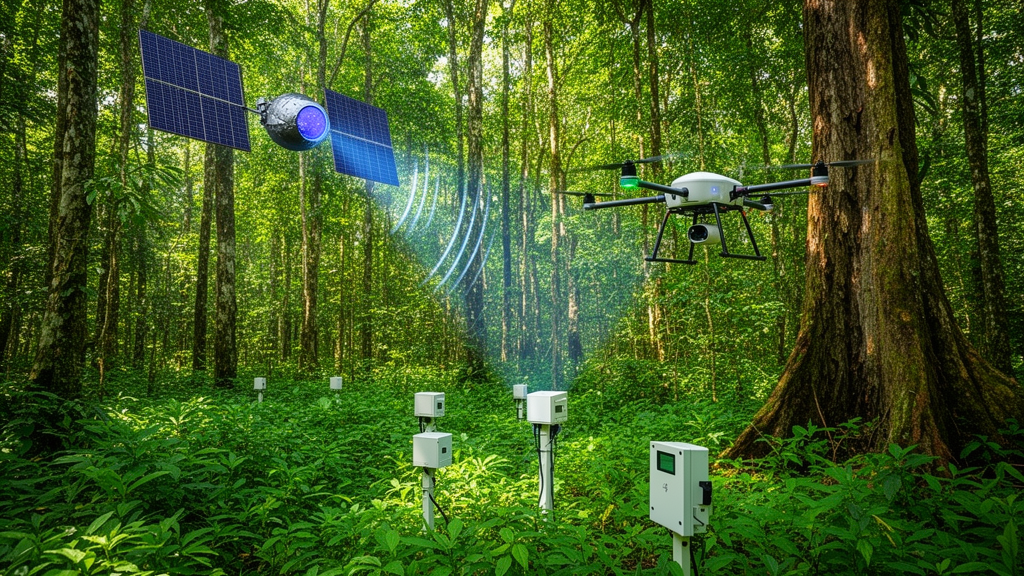
To synthesize the respective strengths of these disparate tools, the authors outline an operational multi-tier assessment system structured across space, air, and ground tiers. Ground-level investigations—including long-term permanent plots, national forest inventories, terrestrial laser scanning, detailed soil and litter sampling, and eddy covariance flux towers—serve as primary empirical anchors. These terrestrial measurements provide essential authenticity constraints that researchers require for rigorous model calibration and independent post-hoc validation, ensuring that mathematical predictions reflect verifiable physical forest conditions.
Aircraft and uncrewed aerial drones bridge the spatial divide between localized ground plots and broad satellite swaths by connecting stem-level measurements with canopy-level structural parameters across intermediate landscapes. Concurrently, spaceborne satellite remote sensing and atmospheric carbon dioxide monitoring extend surveillance across whole geographic regions, supplying the continuous, repeated measurements necessary to track forest structural evolution, changes in stored carbon pools, and dynamic carbon budget shifts over time.
The overarching architecture relies on data assimilation to unify observational streams with multiple computational model varieties, incorporating ecological process models, biogeochemical frameworks, remote sensing inversions, and machine learning outputs. Crucially, the system incorporates uncertainty propagation analysis to formally determine and communicate the precise confidence bounds associated with resulting estimates. Through this synchronized integration, researchers can evaluate standing carbon stocks, periodic stock variations, continuous carbon fluxes, and net carbon sinks simultaneously as interconnected values rather than isolated, discordant metrics.
The review also cautions against equating total global terrestrial carbon sink estimates directly with forest carbon sinks, noting that terrestrial figures inherently include grasslands, agricultural croplands, and non-forest biomes. Furthermore, while forest conservation, ecological restoration, and sustainable timber management deliver meaningful contributions to climate mitigation, the authors stress that forest preservation cannot substitute for steep, direct reductions in fossil-fuel emissions. Future modeling advancements must explicitly account for post-disturbance recovery dynamics, management interventions such as thinning and regeneration, and the ultimate lifecycle destination of timber entering harvested wood products and energy systems.
Subject of Research: Integrated space, air, and ground framework for forest carbon sink estimation
Article Title: A new space–air–ground evaluation framework aims to improve carbon sink estimates
Article References: A new space–air–ground evaluation framework aims to improve carbon sink estimates. Original publication (Bibliographic details unavailable.)
Image Credits: AI Generated
DOI: Not provided
Keywords: forest carbon sinks, carbon stock, space-air-ground framework, data assimilation, Northwest A&F University, Forest Ecosystems, remote sensing inversion, ecological process models, biogeochemical models, atmospheric inversion, flux observation, terrestrial laser scanning, forest inventories, monitoring reporting and verification, greenhouse gas inventories, uncertainty propagation analysis, carbon fluxes
News Source: Alan Morgan. (November 26, 2026). Integrated Space Air Ground Framework Aims to Improve Forest Carbon Sink Estimates. Scienmag.