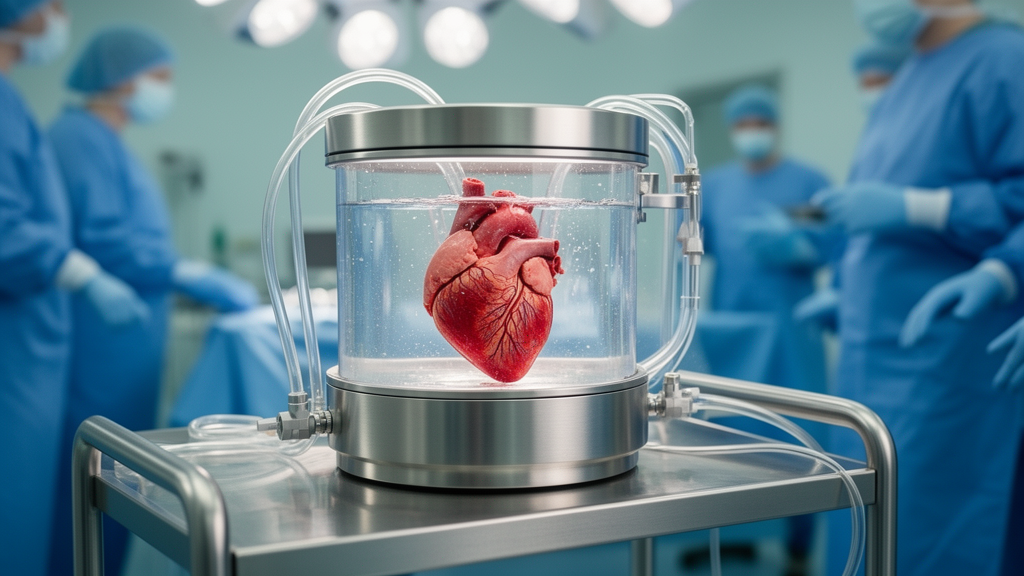
In a retrospective comparative study examining multiorgan transplantation, controlled hypothermic storage of donor hearts was associated with a marked reduction in severe early graft dysfunction compared with conventional ice cold storage. The investigation, conducted across two major academic surgical centers in France, evaluated seventeen adult recipients undergoing simultaneous single-stage heart-liver or heart-kidney transplantation between January 2020 and May 2026. Among the ten patients whose cardiac allografts were transported using traditional static ice packaging, seven developed severe early graft dysfunction requiring postoperative mechanical circulatory support in the form of extracorporeal membrane oxygenation within twenty-four hours. In sharp contrast, none of the seven recipients who received donor hearts preserved with a controlled hypothermic storage device experienced severe early graft dysfunction. These preliminary observations suggest that precise temperature control during transit may improve initial cardiac performance in complex combined transplant operations.
The clinical rationale for controlled hypothermic storage stems from evidence gathered in isolated heart transplantation, primarily through the Global Utilization And Registry Database for Improved heArt preservatioN registry. While conventional cold preservation relies on placing donor organs into preservation solution surrounded by ice, controlled hypothermic storage aims to maintain hypothermic metabolic reduction while preventing freezing injury and cellular damage that cause graft failure. Previous registry analyses in solitary heart recipients linked controlled hypothermic storage to reduced severe primary graft dysfunction, decreased mechanical circulatory support use, and reduced hospital stays. Such reductions in resource utilization permit centers to reallocate specialized resources and expand capacity for intricate surgical candidates. However, despite documented utility in isolated procedures, clinical evidence regarding donor heart preservation strategies in combined heart-liver and heart-kidney transplantation had remained unexamined in clinical literature.
To evaluate whether preservation benefits observed in isolated procedures translate to dual-organ recipients, investigators conducted a retrospective cohort analysis approved by the French Society of Thoracic and Cardiovascular Surgery Institutional Review Board under protocol IRB00012919. Patient inclusion followed institutional policies at Marie Lannelongue Hospital in Le Plessis Robinson and Georges Pompidou European Hospital in Paris, providing candidates the opportunity to decline participation. The cohort comprised adult recipients who underwent single-stage combined procedures using donor organs procured from the same individual donor. In every operative case, surgical teams completed implantation of the cardiac allograft prior to beginning implantation of either the liver or kidney allograft during the same operation.
The preservation protocol transitioned across participating centers following the institutional adoption of specialized preservation hardware in 2023. Prior to this clinical integration, harvested cardiac grafts were managed using conventional ice cold storage, where donor organs were immersed in sterile preservation solution inside an insulated container supplied with four reusable refrigerant gel packs known as Vitalpack EVO. Following device implementation in 2023, cardiac grafts were preferentially managed using the SherpaPak Cardiac Transport System, a controlled hypothermic preservation system designed to maintain donor myocardium consistently within a target temperature range between 4 and 8 degrees Celsius in cold preservation fluid. Throughout the study period, non-cardiac organs were handled according to standardized institutional preservation modalities: all donor livers were preserved using static cold storage, whereas all donor kidneys were maintained continuously using hypothermic machine perfusion prior to final vascular implantation.
Study endpoints adhered to rigorous international consensus definitions to ensure standardized outcome measurement across surgical cohorts. The primary outcome was severe early graft dysfunction of the cardiac allograft, defined by the International Society for Heart and Lung Transplantation consensus summary as graft dysfunction of unknown etiology presenting within twenty-four postoperative hours that necessitated mechanical circulatory support. In all instances where extracorporeal membrane oxygenation was required, support was initiated intraoperatively following heart implantation and prior to secondary organ insertion. Secondary endpoints included total mechanical ventilation duration, postoperative renal replacement therapy, acute cardiac rejection requiring therapy at one year, and early dysfunction of abdominal grafts. Kidney delayed graft function was defined as the requirement for renal replacement therapy within the initial post-transplant week, while early liver allograft dysfunction was defined using the Olthoff criteria, incorporating peak transaminases, bilirubin, and coagulopathy.
Baseline donor profiles demonstrated balanced characteristics between preservation cohorts, whereas recipient profiles exhibited meaningful baseline differences. Overall donor age had a median of 47 years, with a median body mass index of 23.2 kilograms per square meter and a normal median left ventricular ejection fraction of 65 percent across groups. Total cardiac ischemic time was comparable, registering a median of 204 minutes in the ice cold storage group and 228 minutes in the controlled hypothermic storage group. In the controlled hypothermic cohort, recorded storage temperatures stayed strictly regulated, exhibiting a median minimum temperature of 6.3 degrees Celsius and a median maximum temperature of 8.0 degrees Celsius. Conversely, recipients treated with controlled hypothermic storage presented with higher median body mass index values of 27.3 compared with 22.9, lower median pre-transplant ejection fractions of 37 percent, and longer median waitlist durations.
Surgical complexity before transplantation was notably higher among recipients assigned to the controlled hypothermic storage cohort, particularly regarding prior cardiac operations requiring redo sternotomy. Across the total cohort, eight patients had undergone previous cardiac surgical procedures, including five of seven patients, or 71.4 percent, in the controlled storage group, compared with three of ten patients, or 30.0 percent, in the ice cold storage group. Among the eight individuals requiring redo sternotomy, seven had undergone their primary interventions to repair congenital heart disease, while one patient had a history of corrective valve surgery. Six of these eight reoperative sternotomy cases occurred among heart-liver transplant recipients, all six of whom had previous surgical intervention for congenital lesions.
Primary outcome results demonstrated a pronounced contrast in cardiac stability: seven of ten patients in the ice storage group developed severe early graft dysfunction, representing 70 percent of conventional cases, whereas zero cases occurred among the seven patients managed with controlled storage. In the ice storage cohort, severe graft failure manifested across four heart-liver recipients and three heart-kidney recipients, requiring extracorporeal membrane oxygenation support lasting a median duration of four days, with an interquartile range of two to seven days. Regarding secondary complications, patients in the ice storage cohort experienced higher frequencies of postoperative sepsis at 60 percent versus 28.6 percent, pneumonia at 40 percent versus 14.3 percent, stroke at 30 percent versus zero, and acute kidney injury requiring post-transplant dialysis at 60 percent versus 28.6 percent. However, recipients managed with controlled hypothermic storage exhibited a higher median mechanical ventilation duration of 21 hours.
Early kidney allograft failure requiring dialysis occurred in two of eight heart-kidney recipients, split equally with one case in the ice cold cohort and one in the controlled hypothermic cohort, though neither patient showed persistent kidney failure or rejection at one-year follow-up. Early liver allograft failure occurred in two of nine heart-liver recipients, involving one of six ice storage patients and one of three controlled storage patients, with neither experiencing allograft failure at one year among those reaching that timepoint. Acute cardiac rejection occurred in four patients overall, comprising two individuals in each cohort. While total hospital stay was longer in the controlled group at a median of 34 days, intensive care unit stay was substantially shorter at 7 days versus 15.5 days.
Patient survival analyses recorded three total deaths across the study window, all occurring exclusively among combined heart-liver transplant recipients. Two deaths occurred in the ice cold storage group and one occurred in the controlled hypothermic storage group, resulting in an overall cohort mortality rate of 17.6 percent. Across the three fatal cases, causes of death were refractory septic shock in two patients and acute cerebral stroke in one patient. In addition, two of the three deceased patients had previously developed severe early graft dysfunction requiring mechanical circulatory support. Thirty-day mortality across the entire cohort was 5.9 percent, with one death occurring in the ice storage cohort and none in the controlled hypothermic cohort. Among the subset of heart-liver recipients, thirty-day mortality was 11.1 percent, a figure comparable to the 12.5 percent rate documented in the Spanish COMBI registry, although differing from historical benchmarks.
The authors emphasize that these clinical associations must be interpreted within the context of key methodological constraints, notably the retrospective study design and limited sample size of seventeen patients. A significant potential era effect exists because ice cold storage was utilized primarily during the earlier study phase, whereas controlled hypothermic storage was adopted after 2023. Consequently, observed differences in postoperative outcomes could be confounded by progressive improvements in institutional surgical experience, perioperative critical care techniques, and disparate median follow-up durations, which spanned 35.5 months for ice storage compared with 21.0 months for controlled storage. Furthermore, the ice cold storage group contained a higher proportion of heart-liver recipients, who inherently faced greater baseline complication risks. Supported by the TREASURE research program under the France 2030 investment plan, the research team highlighted the necessity for larger multicenter clinical trials to validate whether controlled hypothermic storage consistently prevents graft dysfunction.
Subject of Research: Controlled hypothermic storage of donor hearts in combined heart transplantation
Article Title: Preliminary experience with controlled hypothermic storage of donor heart in combined heart transplantation
Article References: Argaw, S. T., Lora Ronco, L., Frering, A., Kloeckner, M., Coutance, G., Coilly, A., Vibert, E., Snanoudj, R., Genty, T., Achouh, P., Belli, E., & Guihaire, J. (2027). Preliminary experience with controlled hypothermic storage of donor heart in combined heart transplantation. JHLT Open, 15, Article 100707. https://doi.org/10.1016/j.jhlto.2026.100707
Image Credits: AI Generated
DOI: 10.1016/j.jhlto.2026.100707
Keywords: controlled hypothermic storage, heart transplantation, combined heart-liver transplantation, combined heart-kidney transplantation, early graft dysfunction, extracorporeal membrane oxygenation, SherpaPak, static cold storage, organ preservation, primary graft dysfunction, cardiac allograft, multiorgan transplantation, hypothermic machine perfusion, ischemic time, redo sternotomy, ISHLT consensus, transplant outcomes
News Source: Ophelia Keating. (November 26, 2026). Controlled Hypothermic Heart Storage Linked to Less Early Dysfunction in Combined Transplants. Scienmag.