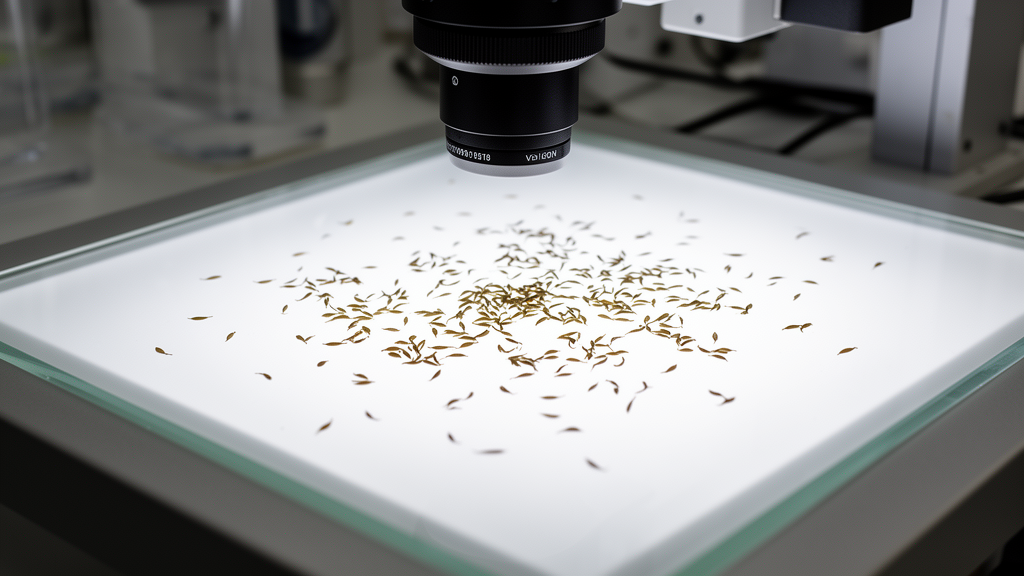
Agricultural researchers have introduced an automated computer vision pipeline combining deep learning object detectors, explainable gradient attribution, and constrained language model reporting to evaluate seed fill in zoysiagrass. Crop establishment across managed turf environments depends heavily on seed vigor and germination uniformity, yet commercial seed lots frequently contain structurally deficient or empty hulls that cannot be distinguished through conventional inspection of external surfaces alone. To address this operational bottleneck, investigators developed an integrated hardware and software workflow that shines transmitted visible light through seed bodies, processes high-resolution digital imagery with modern neural detection architectures, and translates model activations into transparent, auditable diagnostic summaries suitable for plant breeding specialists.
The biological challenge of seed quality assessment in turfgrass breeding stems from the complex anatomy of the reproductive florets, where a fully formed protective hull may enclose either a dense, mature caryopsis or an empty cavity. Standard reflective color imaging similarly fails because the external pigmentation and superficial surface texture of empty and filled zoysiagrass seeds appear largely identical under incident top-down lighting. By directing a high-intensity uniform backlight beneath the sample plane, the research team exploited optical transmission disparities, allowing internal tissue mass, optical opacity, and caryopsis density to register clearly against translucent outer hulls.
To rigorously train and validate candidate neural architectures, the researchers assembled an experimental benchmark from DALZ 2502, an elite experimental zoysiagrass line undergoing multi-environment evaluation in the National Turfgrass Evaluation Program. The source material was generated through four cycles of phenotypic recurrent selection from a three-parental, open-pollinated breeding population managed at the Texas A&M AgriLife Research and Extension Center in Dallas, with experimental seeds harvested and cleaned in Enid, Oklahoma. To prevent detection models from exploiting incidental frequency biases, the research team applied a class-balancing protocol to establish an artificial one-to-one proportion of empty and filled seeds, resulting in 1077 unique physical seeds comprising 529 empty and 548 filled units. Each physical arrangement was photographed across three distinct camera exposure durations, generating a dataset of 204 high-resolution images containing 3231 bounding box annotations. A strict partition policy ensured that physical seeds and their corresponding exposure triplets were assigned entirely to either model development or an independent six-arrangement evaluation pool of 94 physical seeds.
Establishing an uncompromised ground truth reference required a systematic two-stage microscopic screening protocol conducted under controlled transmitted illumination. An experienced evaluator inspected every individual seed beneath an Olympus SZ61 stereomicroscope operating at 20x to 35x magnification, utilizing the base light-emitting diode illuminator set between 30 and 60 percent intensity to visually verify the internal presence or absence of a dark, amber-colored caryopsis. Ultra-fine tweezers were used to handle individual seeds to prevent mechanical deformation or hull damage during transfer into labeled holding vessels. Each seed subsequently underwent a masked repeat inspection under identical transmitted lighting to confirm category assignment before bounding-box coordinate registration. Seeds exhibiting partial filling, mechanical fracture, or optical ambiguity were excluded from the benchmark to eliminate borderline labeling errors, ensuring that all bounding boxes represented definitively verified biological targets for downstream neural network supervision.
The accompanying physical acquisition platform was engineered using accessible, cost-effective commercial components designed for prospective adaptation into portable, field-ready screening stations. The optical rig incorporated a Raspberry Pi 4 Model B single-board computer paired with an official High Quality Camera module featuring a 12.3-megapixel Sony IMX477 complementary metal-oxide-semiconductor sensor. The camera was coupled to a 5-to-50-millimeter manual zoom lens positioned at a fixed working distance of approximately 20 millimeters above a 12-by-8-inch inspection board. Beneath the imaging board, a Zocelight A4-D60 diffuse rechargeable light pad supplied steady transmitted illumination rated at a nominal 6500 Kelvin color temperature and 9000 lux output. For every physical seed arrangement, triplets of raw full-resolution frames were acquired at sensitivity ISO 100 under low exposures of 5 to 6 milliseconds, medium exposures of 7 to 8 milliseconds, and high exposures of 9 to 10 milliseconds, capturing subtle variations in optical saturation, border contrast, and internal tissue transmission.
To support automated coverage over extensive seed surfaces without manual repositioning, the investigators designed a motorized Cartesian XY scanning gantry around the illuminated seed plane. The apparatus was built from V-slot modular aluminum extrusions, mounting the top-down camera carriage on a lateral transverse bridge driven by a NEMA 17 stepper motor and belt transmission. A second synchronized stepper motor directed longitudinal travel along dual parallel base rails, guiding the optical sensor across a predetermined serpentine trajectory that systematically captured overlapping image tiles following mechanical settling intervals. While the current prototype relies on manual lens focusing and height calibration prior to scanning execution, the mechanical assembly demonstrated stable automated transport capable of surveying broad seed arrangements without disturbing seed orientation or introducing mechanical vibration artifacts into digital frames.
Model benchmarking evaluated two prominent real-time detection paradigms across six structural scales, comparing convolutional You Only Look Once architectures against transformer-based Real-Time Detection Transformers. The convolutional group evaluated YOLO26 in nano, small, and medium configurations, which employ hierarchical spatial pyramid pooling and partial self-attention neck structures for single-stage anchor-free bounding box regression. The transformer family evaluated RT-DETRv2 across small, medium, and large variants combining residual convolutional backbones with multi-scale cross-attention and direct bipartite matching object queries. All candidate networks were fine-tuned using standardized 1280-pixel input dimensions, AdamW optimization, cosine learning schedules, and conservative photometric augmentations. Models were evaluated both on exposure-specific training subsets and on pooled multi-exposure data, measuring strict seed-level localization and classification accuracy against an intersection-over-union matching threshold of 0.70.
Across cross-validation experiments, the models demonstrated clear performance trade-offs governed by neural parameter capacity and photographic illumination levels. Among convolutional variants, YOLO26s demonstrated exceptional overall resilience, reaching 97.8 ± 1.3 percent accuracy, 94.1 ± 1.5 percent precision, 98.0 ± 1.2 percent recall, and 99.8 ± 0.2 percent mean average precision at an intersection-over-union threshold of 0.50 under medium exposure conditions. Pooling all three exposures preserved robust generalization in YOLO26s, which maintained 96.8 ± 0.3 percent accuracy and a 93.7 ± 0.4 percent F1-score across the broader data distribution. The larger YOLO26m achieved the highest exposure-specific accuracy of 97.9 ± 2.3 percent under low exposure conditions, yet its accuracy dropped to 92.6 ± 2.6 percent under medium exposure, indicating that increased convolutional capacity did not guarantee uniform gains across differing illumination levels.
Within the transformer-based family, RT-DETRv2-m emerged as the top-performing detector under high-exposure lighting, delivering 98.9 ± 0.8 percent accuracy, 99.5 ± 0.4 percent precision, 99.0 ± 0.5 percent recall, and an F1-score of 99.4 ± 0.2 percent during cross-validation, while recording 100.0 percent accuracy on the designated held-out test fold. In contrast, the compact RT-DETRv2-s configuration equipped with a ResNet-18 backbone failed to capture subtle internal seed structures reliably, yielding an accuracy of only 62.5 ± 10.5 percent under high exposure and 58.0 ± 12.1 percent when trained on pooled exposures. Scaling the transformer architecture up to RT-DETRv2-l with a 76.6-million-parameter ResNet-101 backbone offered no performance benefit over the medium model, achieving an accuracy of 95.5 ± 1.6 percent under high exposure while substantially inflating computational overhead.
Practical hardware deployment tests conducted on an Intel Core i7-1365U central processor and an entry-level NVIDIA RTX A500 graphics processing unit highlighted stark throughput divergences between network families. The compact YOLO26n model, containing 2.57 million parameters, achieved inference latencies of 702.4 milliseconds on the central processing unit and 130.5 milliseconds on the graphics processor while sustaining 95.2 percent test accuracy. The balanced YOLO26s model required 164.5 milliseconds on the graphics processor for 96.8 percent accuracy. Conversely, the highly accurate RT-DETRv2-m model required 42.86 million parameters, demanding 7011.7 milliseconds on the central processor and 765.6 milliseconds on the graphics chip. The oversized RT-DETRv2-l required over 65 seconds per image on central processing hardware, demonstrating that while transformer models provide superior peak accuracy for offline verification, lightweight convolutional architectures remain essential for high-throughput, interactive sorting workflows.
To prevent deep learning models from functioning as opaque black-box predictors, the framework incorporated Gradient-weighted Class Activation Mapping to compute spatial attributions from the final convolutional feature layer for every matched seed detection. Heatmaps were tightly constrained to individual seed contours using morphological foreground masks, preventing visual spillover from adjacent seed hulls or background illumination. The attribution maps were partitioned into regular cell grids to identify the top quartile of influential regions, producing quantitative spatial metrics including attention entropy, coverage area, and component clustering. Computational faithfulness testing via an instance deletion protocol demonstrated that masking the highest-attribution cells induced an average target score drop of 0.273, significantly exceeding the 0.179 drop caused by removing lowest-attribution cells, confirming that highlighted regions contributed positively to model sensitivity.
The terminal layer of the architecture integrated an artificial intelligence interpretation module implemented with OpenAI’s GPT-4.1 mini model, backed by deterministic fallback templates to guarantee continuous offline utility. Operating through structured constraints, the language agent assembled model identification, bounding box coordinates, confidence percentages, and quantitative attribution statistics into concise, auditable seed records without altering the underlying detector classification. Explicit prompt guardrails prohibited the agent from extrapolating physiological viability, embryo vigor, or field germination capacity from static visual fill cues. Operating costs for agentic synthesis were calculated at approximately 0.27 United States dollars per 2000 analyzed seeds, establishing an economical, verifiable reporting mechanism that links raw pixel coordinates, gradient heatmaps, and formal morphological terminology into an auditable diagnostic trail.
The study authors emphasize several operational caveats, noting that model accuracy remains conditional on a single elite zoysiagrass line and a class-balanced benchmark that does not reflect natural seed lot fill proportions. Visible internal fill serves solely as an anatomical proxy, as seeds possessing full caryopses may still experience germination failure resulting from physiological dormancy, mechanical injury, embryo deterioration, or microbial pathogen infection. Furthermore, while gradient-based saliency confirms that detectors focus on internal seed bodies rather than peripheral background artifacts, attribution maps represent post-hoc model sensitivities rather than anatomical proof of caryopsis boundaries.
Subject of Research: Explainable deep learning and computer vision framework for turfgrass seed set assessment
Article Title: An explainable artificial intelligence-guided agentic framework for turfgrass seed set assessment
Article References: Wang, Y., Martin, C., Chandra, A., & Zahid, A. (2026). An explainable artificial intelligence-guided agentic framework for turfgrass seed set assessment. Smart Agricultural Technology, 15, Article 102767. https://doi.org/10.1016/j.atech.2026.102767
Image Credits: AI Generated
DOI: 10.1016/j.atech.2026.102767
Keywords: zoysiagrass, seed quality assessment, explainable artificial intelligence, computer vision, object detection, YOLO26, RT-DETRv2, Grad-CAM, turfgrass breeding, transmitted light imaging, caryopsis detection, seed phenotyping, agricultural automation, large language model agents, instance deletion test, digital phenotyping, DALZ 2502
News Source: Blake Davidson. (November 26, 2026). Explainable Artificial Intelligence and Backlight Vision Streamline Turfgrass Seed Evaluation. Scienmag.