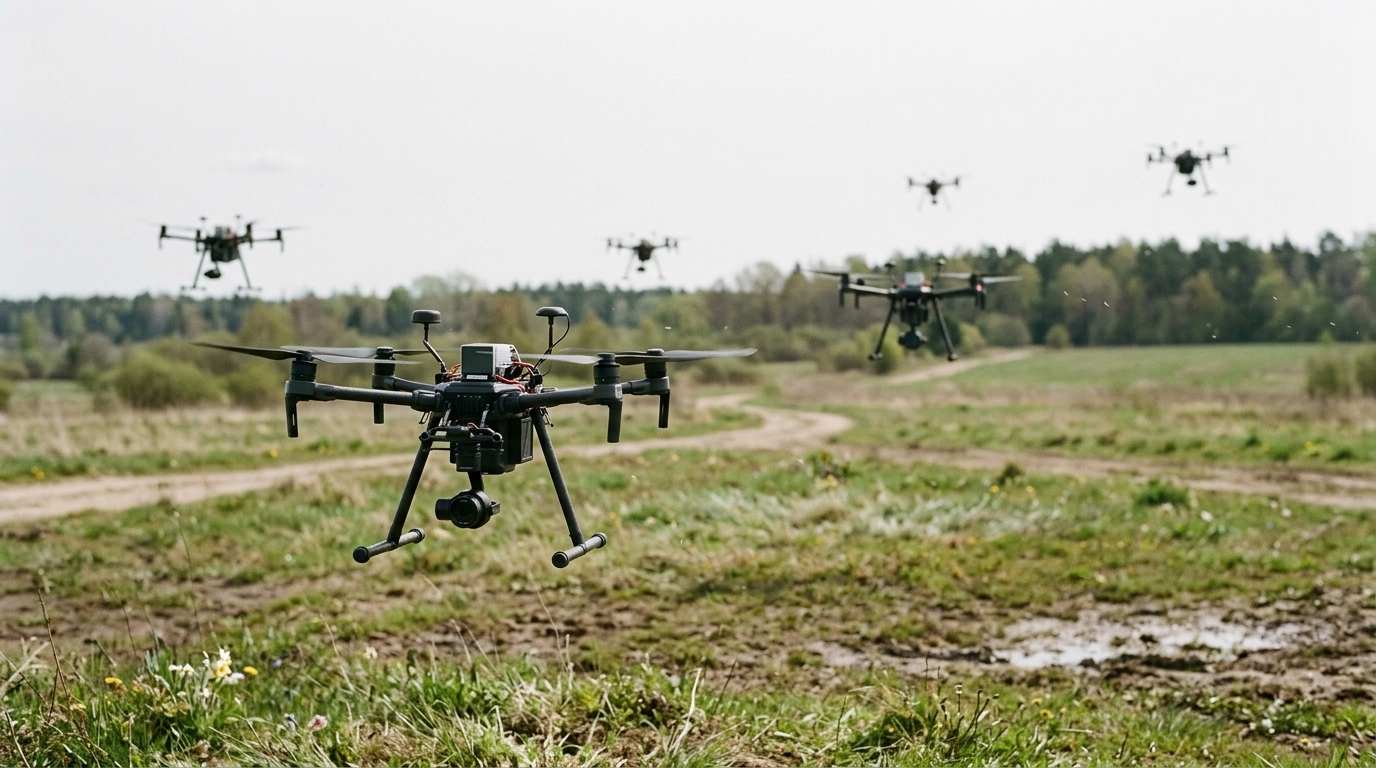
A retrieval-augmented language model framework achieved 76.2 percent assignment accuracy and a mean explanation similarity of 0.8147 with expert reasoning when assigning unmanned aerial vehicles to missions, according to an experimental study published in Neural Computing and Applications by researcher Anıl Sezgin. The investigation tested whether retrieval-augmented generation combined with large language models could resolve the complex reasoning requirements inherent in coordinating devices across IoD systems. In these operational settings, selecting an appropriate drone for a designated operation requires an automated system to simultaneously evaluate multiple interrelated device parameters, device constraints, and operational context elements.
The decision-making process for mission-aware drone coordination depends directly on analyzing the specific payload of the device, its available energy, the onboard sensors used, the mission type, and the operational environment. To process these diverse variables, the proposed method utilizes a sentence-level transformer model during inference to encode incoming mission parameters into semantic embeddings. The system then evaluates these representations using cosine similarity metrics to retrieve the top-k semantically similar historical mission cases from past records, ensuring that previous deployment experience directly informs current assignments.
Once the system retrieves these relevant historical cases, it integrates the contextual data into structured prompts formatted specifically for LLaMA 3.1 8B Instruct. Guided by these structured inputs, the language model produces two distinct outputs: an explicit unmanned aerial vehicle recommendation and a set of structured rationale tags. This dual output design ensures that the system delivers not only an automated operational decision but also transparent, structured reasoning that human operators can interpret during ongoing mission planning and deployment workflows.
Experimental evaluations demonstrated clear performance advantages for the retrieval-enhanced language model over established baseline approaches. A deterministic rule-based heuristic, evaluated as a lower-bound reference for static decision logic, achieved only 37.1 percent assignment accuracy and 14.4 percent full-match explanation accuracy. A Genetic Algorithm baseline achieved a higher assignment accuracy of 59.4 percent. While additional supervised learning baselines offered stronger comparative accuracy points against the proposed framework, those alternative models did not generate mission-level explanations for their assignments.
These experimental outcomes show that retrieval-enhanced large language models can successfully coordinate mission-aware drone assignments while supplying structured, operator-interpretable rationale tags within IoD environments. By grounding generative model prompts in semantically similar historical cases, the architecture bridges the gap between automated assignment performance and understandable operational reasoning.
Subject of Research: Retrieval-augmented language models for mission-aware unmanned aerial vehicle assignment
Article Title: Semantic retrieval for mission-aware UAV coordination: a large language model approach
Article References: Sezgin, A. (2026). Semantic retrieval for mission-aware UAV coordination: a large language model approach. Neural Computing and Applications, 38(23), Article 912. https://doi.org/10.1007/s00521-026-12642-7
Image Credits: AI Generated
DOI: 10.1007/s00521-026-12642-7
Keywords: unmanned aerial vehicles, UAV coordination, retrieval-augmented generation, RAG-LLM framework, LLaMA 3.1 8B Instruct, IoD systems, semantic retrieval, sentence-level transformer, cosine similarity, rationale tags, mission parameters, drone assignment, expert reasoning, Genetic Algorithm baseline, rule-based heuristic, supervised learning baselines, operator interpretability
News Source: Denise Maddox. (November 25, 2026). Retrieval Augmented Language Model Reaches 76 Percent Accuracy in Drone Coordination. Scienmag.